

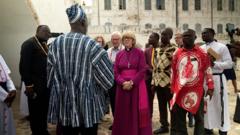
In a profound journey tracing the painful intersections of faith, history, and institutional accountability, high-ranking ecclesiastical leadership has reaffirmed a multi-million-pound commitment dedicated to addressing the historic legacies of transatlantic chattel slavery. Standing within the haunting stone bastions of Cape Coast Castle in Ghana—a monument that bore witness to the processing of countless human beings into forced bondage—the initiative has taken on renewed moral urgency, prompting a complex global debate about corporate reparations, institutional repentance, and the financial restitution owed for historical atrocities.
The backdrop of this renewed pledge is as heavy as the physical architecture of the Ghanaian coastline. Cape Coast Castle, with its whitewashed walls concealing subterranean dungeons of unimaginable despair, serves as an inescapable reminder of the Church of England’s historical entanglements with the trade of human beings. Centuries ago, ecclesiastical figures, prominent parishioners, and institutional endowments directly and indirectly profited from the economic machinery of the slave trade. Today, modern leadership is grappling with the profound challenge of reconciling a sacred mission of spiritual redemption with the hard, financial realities of historical debt.
At the center of this ongoing narrative is the comprehensive £100 million fund established to confront these historical realities head-on. While the announcement of such a significant financial allocation initially sent ripples of surprise and cautious optimism through global religious and political communities, the operationalization of the fund has been a subject of intense scrutiny. Critics have questioned whether the figure is sufficiently proportional to the immense, multi-generational damage inflicted by the slave trade, while supporters view it as an unprecedented, courageous admission of institutional guilt that sets a powerful precedent for other global institutions.
Historical Architecture of Complicity: The Church and the Trade
Archival records reveal that clerics, bishops, and lay leaders frequently justified the economic subjugation of African peoples through twisted theological interpretations, creating a ideological scaffolding that propped up the entire apparatus of chattel slavery. The wealth generated from these human tragedies was woven into the very fabric of British institutional life, funding endowments, building magnificent structures, and sustaining economic enterprises that persisted long after the formal abolition of slavery in the nineteenth century.
When the British government abolished slavery in 1833, it compensated slave owners—not the enslaved people—for their loss of "property." Among those compensated were various ecclesiastical figures and trusts connected to the church. This historical truth has haunted the institutional conscience for generations, leading to periodic calls for introspection and financial reckoning. However, for decades, these calls were largely met with institutional defensiveness, theological obfuscation, or symbolic gestures that fell far short of material restitution.
The decision to establish a £100 million fund marked a dramatic departure from historical precedent. It represented a systemic institutional acknowledgment that apologies, while necessary, are fundamentally insufficient without tangible material commitment. By tying the fund's deployment to healing, education, and economic empowerment in communities historically affected by the trade, the initiative sought to move beyond mere rhetoric into the realm of restorative justice.
The Pilgrimage to Cape Coast: Symbolism and Substance
The recent high-profile visit to Cape Coast Castle was designed to bridge the gap between abstract policy decisions and visceral, human reality. Standing in the very spaces where enslaved Africans were held before being forced through the Door of No Return, leadership was confronted with the physical legacy of the decisions made by their institutional forebears centuries ago. The visit was not merely diplomatic; it was framed as an act of profound witness and listening.
During the visit, extensive consultations were held with Ghanaian religious leaders, historians, community activists, and descendants of those impacted by the slave trade. These dialogues were critical in shaping how the £100 million fund is perceived and how it will ultimately be distributed. Local stakeholders emphasized that the funds must not be deployed in a paternalistic manner, but rather through genuine partnerships that respect the autonomy, agency, and self-determined development goals of West African communities.
The emotional weight of the Cape Coast visit cannot be overstated. Walking through the damp, oppressive chambers of the castle, leadership heard firsthand accounts of how the historical trauma of the slave trade continues to ripple through families and societies across generations. This immersive experience appears to have galvanized a renewed personal and institutional resolve, ensuring that the financial commitment is treated not as a one-off public relations exercise, but as a long-term, generational covenant of repair.
Economic Implications and the Mechanics of Restorative Funding
Managing a £100 million restorative fund is an intricate economic and logistical undertaking. Financial experts and economists have pointed out that distributing such a sum effectively requires sophisticated planning, rigorous oversight, and deep community consultation to ensure maximum impact. The fund is primarily intended to support initiatives focused on economic empowerment, educational opportunities, health infrastructure, and cultural preservation in areas deeply scarred by the historical slave trade.
However, economists and financial analysts frequently debate the adequacy of the sum relative to the immense scale of historical extraction. The wealth generated from the transatlantic slave trade fueled the industrial revolution in Europe, laying the foundations for modern financial systems, insurance markets, and global trade networks. Viewed through this macroeconomic lens, £100 million represents a fraction of the historical wealth transferred from the Global South to the Global North. Nevertheless, financial strategists within the institution argue that the fund is structured as an investment in sustainable futures rather than a retroactive payout, aiming to catalyze long-term economic resilience.
Moreover, the mechanics of the fund involve careful investment strategies to ensure that the capital generates sustainable returns over time, allowing for enduring support rather than a rapid depletion of resources. This endowment model requires balancing ethical investment criteria—ensuring the fund's own assets are entirely cleansed of any modern exploitative practices—with the need for reliable financial growth to fund ongoing community projects in the UK, the Caribbean, and West Africa.
Global Perspectives and the Ripple Effect on Other Institutions
The commitment to the £100 million fund has sent shockwaves far beyond the borders of the United Kingdom and Ghana, resonating across the international community and placing pressure on other historical institutions. Universities, banks, insurance corporations, and government bodies that trace their origins back to the era of the transatlantic slave trade are watching the initiative closely. For decades, many of these entities have resisted calls for reparations, citing the passage of time, the complexity of tracing historical liabilities, and the fear of setting legal precedents.
By taking a definitive step forward, religious leadership has shifted the moral landscape of the reparations debate. International human rights lawyers and historians suggest that this move undermines the common defense that historical injustices are too distant or complex to address meaningfully today. If a religious institution with ancient historical roots can transparently audit its past and commit substantial financial resources to repair, other corporate and state entities find it increasingly difficult to justify institutional inertia.
In the Caribbean, regional bodies and national reparations committees have welcomed the development while simultaneously arguing that it should serve as a baseline rather than a ceiling for global reparatory justice. Caribbean leaders have long advocated for comprehensive state-level reparations from former colonial powers, focusing on systemic issues such as chronic public health challenges, educational deficits, and economic underdevelopment rooted in the plantation economy. The church’s initiative is thus viewed as a vital moral catalyst in a much broader, geopolitically complex global movement.
Internal Dissent and Theological Debates
Despite widespread international praise, the initiative has not been without its internal controversies. Within the church itself, a spectrum of opinions exists regarding how the funds should be allocated and whether the institution should focus more intensely on contemporary domestic social issues or historic international debts. Some traditionalist members have questioned the appropriateness of using church resources for historical redress, arguing that funds should be primarily directed toward supporting dwindling local congregations and maintaining aging places of worship.
Conversely, progressive theologians and social justice advocates within the fold argue that true spiritual renewal is impossible without confronting institutional sin and enacting concrete repentance. They point to biblical imperatives concerning restitution and justice, arguing that ignoring historical complicity undermines the moral authority and integrity of the faith. This internal tension reflects a broader cultural debate taking place across Western societies regarding how contemporary institutions should reckon with difficult, national histories.
Furthermore, debates have emerged concerning the exact timeline and speed of the fund's disbursement. Critics have voiced frustration at the perceived bureaucratic delays in getting money directly into the hands of grassroots projects in West Africa and the Caribbean. Leadership has responded by emphasizing the necessity of thorough due diligence, ensuring that partnerships are built on transparency, mutual respect, and accountability, thereby avoiding the pitfalls of poorly managed international aid.
The Path Forward: Accountability, Transparency, and Legacy
As the initiative moves into its next operational phases, the focus will increasingly shift toward measurable outcomes and transparent reporting. Civil society organizations in Ghana, the wider African continent, and the Caribbean have made it clear that they will hold the institution strictly accountable to its promises. The success of the £100 million fund will ultimately be judged not by the initial headlines it generated, but by the tangible, long-term improvements in the lives of individuals and communities touched by its programs.
Plans for independent oversight boards, comprising international experts in economic development, human rights, and historical research, are currently being refined to ensure that the distribution of capital remains transparent, ethical, and effective. These boards will be tasked with evaluating project proposals, monitoring ongoing initiatives, and publishing regular reports on the fund's impact.
The reaffirmation of the commitment at Cape Coast Castle marks a pivotal chapter in an ongoing global story of reckoning with the past. It demonstrates that while history cannot be rewritten, its destructive legacies can be actively addressed through courage, institutional honesty, and material sacrifice. As the world watches to see how this ambitious restorative project unfolds, it remains a landmark effort in the global pursuit of historical justice, setting a standard that will undoubtedly influence generations to come.


