

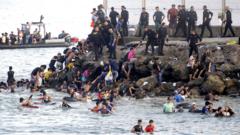
BRUSSELS — In the wake of a sudden and alarming surge of migrant crossings into the Spanish exclave of Ceuta, European Commission President Ursula von der Leyen has issued a resolute call for significantly reinforced external borders across the European Union. This unfolding humanitarian, political, and security dilemma has catalyzed an emergency summit of EU interior ministers, drawing sharp focus onto the vulnerabilities inherent in Europe’s southern perimeter and sparking a renewed, deeply polarized debate over the bloc’s migration and asylum framework.
The latest incidents in Ceuta, which sits on the northern coast of Africa flanked entirely by Morocco and the Mediterranean Sea, have underscored the precarious nature of Europe’s geopolitical frontiers. Thousands of individuals, motivated by a complex matrix of economic desperation, localized political instability, and the perennial hope for a sustainable livelihood in Europe, managed to breach the heavily fortified border barriers. The sheer volume of arrivals within a compressed timeframe overwhelmed local reception capacities, thrusting the small Spanish territory into the center of an international spotlight and forcing Brussels to re-evaluate its border management strategies with immediate urgency.
As interior ministers from across the 27 member states prepare to convene in Brussels, the political temperature surrounding migration governance has reached a boiling point. The events in Ceuta are not viewed by European policymakers as an isolated localized anomaly, but rather as a bellwether for wider systemic pressures building along the Mediterranean and Atlantic migration corridors. Consequently, the upcoming ministerial consultations are expected to transcend routine crisis management, delving into structural overhauls of border surveillance, diplomatic leverage with transit nations, and the perennial, contentious question of burden-sharing among member states.
The Geopolitical Anatomy of Ceuta: A Unique Frontier
To comprehend the gravity of the current crisis, one must examine the unique geopolitical geography of Ceuta and its sister exclave, Melilla. As the only two European Union land territories on the African continent, they have historically functioned as irresistible magnets for individuals seeking entry into Europe. Surrounded by Morocco and fortified by state-of-the-art double fences equipped with thermal cameras, closed-circuit television, and motion sensors, these territories represent a physical manifestation of the boundary separating the global North from the global South.
The governance of these borders is inextricably linked to the diplomatic relationship between Madrid and Rabat. Morocco acts as a critical gatekeeper for European security, deploying substantial law enforcement resources to deter unauthorized migration. However, this partnership is notoriously delicate, frequently influenced by broader diplomatic currents, bilateral disputes, and geopolitical maneuvering. When diplomatic friction arises between Morocco and Spain—or the European Union at large&mdashthe enforcement apparatus at the border has historically shown elasticity, leading to sudden surges in crossings that catch European authorities flat-footed.
Analysts specializing in North African affairs note that the recent crossings in Ceuta occurred against a backdrop of persistent regional tensions and economic headwinds exacerbated by post-pandemic recovery struggles, inflation, and climate-induced agricultural pressures across the broader Sahel and Maghreb regions. For many young people in West and North Africa, the economic prospects at home remain bleak, fueling a persistent willingness to undertake perilous journeys toward European soil. The physical barrier at Ceuta, while formidable, ultimately serves as a temporary physical deterrent against an unyielding tide of human mobility driven by structural global inequalities.
Brussels Responds: Von der Leyen’s Call for Action
In response to the escalating situation, European Commission President Ursula von der Leyen did not mince words, forcefully articulating the necessity for a unified European response anchored in enhanced border fortification. Speaking from Brussels, von der Leyen emphasized that the security of one member state is the security of the entire European Union, framing the events in Ceuta as a collective challenge that requires a collective remedy.
“Our external borders are our shared responsibility,” von der Leyen stated, signaling a clear shift toward prioritizing operational security, advanced surveillance technologies, and rapid deployment capabilities. The Commission’s stance reflects a delicate balancing act: demonstrating resolve to European citizens concerned about border integrity while attempting to uphold international human rights obligations and the fundamental right to seek asylum.
The proposed measures under discussion are multifaceted. Beyond physical infrastructure enhancements, such as upgrading fences, increasing lighting, and expanding surveillance grid coverage, the European Union is looking closely at bolstering the operational capacity of Frontex, the European Border and Coast Guard Agency. Frontex personnel could potentially be deployed in a more proactive advisory and operational support role alongside Spanish authorities, providing aerial surveillance, intelligence sharing, and logistical coordination.
The Emergency Interior Ministers Meeting: Stakes and Divisions
The emergency gathering of EU interior ministers carries immense political weight. While there is a broad consensus regarding the necessity of preventing unauthorized entries, profound ideological and geographical divisions persist concerning how the bloc should manage migration once individuals arrive on European territory.
Frontline states such as Spain, Italy, Greece, and Malta have long argued that they shoulder an unfair proportion of the processing and hosting responsibilities due to their geographic positioning. These nations frequently express frustration over the reluctance of northern and eastern member states to accept mandatory relocation quotas for asylum seekers. Conversely, countries like Poland, Hungary, and several others maintain a staunchly restrictionist stance, prioritizing strict border closures, national sovereignty, and resistance to any centralized distribution mechanism.
This ongoing friction has historically stymied comprehensive reform of the Common European Asylum System. However, sudden crises like the one in Ceuta tend to inject a temporary sense of urgency into the negotiations. Ministers attending the emergency session will attempt to reconcile these divergent priorities, focusing heavily on short-term operational containment while cautiously probing whether the shock of the recent crossings can generate momentum for broader policy consensus.
Economic and Regional Implications of Border Hardening
The policy prescription of stronger borders, while politically popular among conservative segments of the European electorate, carries significant economic and geopolitical externalities that merit deep analytical scrutiny. Hardening external borders often necessitates multi-million-euro investments in physical infrastructure, surveillance technology, and security personnel. While these expenditures stimulate the defense and security technology sectors within the EU, critics argue they represent a reactive allocation of resources that fails to address the root causes of migration.
Furthermore, tightening borders without concurrent legal pathways for migration often drives desperate individuals into the hands of sophisticated transnational smuggling networks. Criminal syndicates adapt rapidly to increased enforcement by pioneering riskier maritime routes or exploiting different land corridors, frequently resulting in higher rates of tragedy at sea and on land. The economic engine of the smuggling trade thrives precisely on the mismatch between restrictive legal entry channels and the persistent labor market demands within various European economies.
Regionally, Europe’s reliance on third-party transit countries like Morocco, Turkey, and Libya to stem migration flows creates complex dependencies. Critics point out that these partnerships can lead to transactional foreign policy dynamics, where transit nations leverage migration control to extract financial aid, political concessions, or diplomatic support on contentious territorial issues from Brussels. Maintaining these fragile alliances requires delicate diplomatic footwork and continuous financial investment, making Europe’s border security architecture vulnerable to external political volatility.
Human Rights and Humanitarian Concerns
As the European Union moves toward a more securitized approach, human rights organizations and legal experts have raised profound concerns regarding the protection of fundamental rights, particularly the principle of non-refoulement, which prohibits the expulsion of persons to countries where they face persecution. Humanitarian advocates argue that an exclusive focus on deterrence and border reinforcement often leads to hasty expulsions and a failure to adequately assess individual protection claims.
In the immediate aftermath of the Ceuta crossings, reports surfaced regarding rapid summary returns, prompting inquiries from human rights monitors and legal watchdogs. Civil society organizations emphasize that international and European law guarantees every individual the right to have their asylum application examined fairly and thoroughly, regardless of the manner of their entry.
The tension between state sovereignty, national security imperatives, and humanitarian obligations defines the core ethical dilemma facing modern European governance. Policymakers in Brussels and national capitals find themselves navigating a treacherous political tightrope: failing to secure borders invites domestic political backlash from rising nationalist movements, while compromising on human rights standards erodes the moral authority and foundational values upon which the European project was built.
Expert Perspectives and Future Policy Trajectories
Leading migration scholars and security analysts offer diverse viewpoints on the long-term viability of the European Commission’s current strategy. Many argue that physical walls and enhanced surveillance, while necessary components of modern statecraft, are ultimately insufficient as standalone solutions to global migration dynamics driven by demographic shifts, economic disparities, and climate change.
Dr. Elena Vance, a senior fellow in European security studies at a prominent Brussels-based research institute, suggests that the EU must adopt a truly comprehensive framework that pairs robust border management with proactive external engagement and expanded legal pathways.
“Securing the perimeter buys time and political breathing room, but it does not solve the underlying equation,” Dr. Vance notes. “If Europe wants sustainable migration governance, it must invest strategically in the economic development of origin countries, forge genuine partnerships based on mutual benefit rather than mere containment, and establish sensible, regulated channels for labor migration that reflect the demographic realities of an aging European continent.”
Other experts point out that Europe’s aging workforce creates an inherent economic demand for labor across multiple sectors, including agriculture, construction, healthcare, and technology. The disconnect between this economic reality and the prevailing political rhetoric of zero-immigration creates a persistent underground economy characterized by undocumented labor, exploitation, and social integration challenges.
Looking Ahead: The Road from Brussels
The upcoming emergency meeting of interior ministers will set the political tone for Europe’s migration policy for the foreseeable future. While immediate outcomes are likely to center on tactical reinforcements, intelligence sharing, and financial support for Spain and other frontline territories, the broader strategic debate remains unresolved.
As climate pressures accelerate and global inequalities persist, border flashpoints like Ceuta will undoubtedly reoccur, testing the unity, resilience, and ethical commitments of the European Union. President von der Leyen’s decisive call for stronger borders represents an immediate defensive posture, but the enduring success of European migration policy will ultimately be measured by its ability to balance security with humanity, realism with diplomacy, and national sovereignty with collective solidarity.
Sierraleo News Network will continue to monitor these developments closely, providing comprehensive coverage and deep analytical reporting as the interior ministers deliberate in Brussels and the geopolitical landscape of European migration evolves.


