

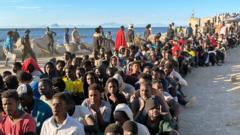
In the wake of one of the most volatile migration events in recent European history, the European Union has formally commended Spain for its rapid and decisive handling of the border emergency in Ceuta, even as human rights organizations and regional analysts grapple with the profound humanitarian, political, and diplomatic fallout of the mass expulsions that followed.
The crisis, which unfolded along the jagged coastline and heavily fortified perimeter fences of Ceuta—a Spanish autonomous city situated on the northern coast of Africa—tested the logistical limits of southern European border enforcement. According to official figures released by Spanish authorities, approximately 72,000 individuals crossed irregularly into the enclave over a compressed period of several days. In the immediate aftermath of this unprecedented influx, a massive diplomatic, logistical, and security operation was mobilized by Madrid, resulting in the swift return of approximately 70,000 of those who crossed back across the border into neighboring Morocco.
This unfolding dynamic has once again thrust the complex geopolitical realities of the European Union's southern periphery into the global spotlight. Ceuta, alongside its sister enclave Melilla, represents the only direct land border shared between the European Union and the African continent. This unique geographic reality transforms these territories into powerful magnets for individuals fleeing economic destitution, political instability, and regional conflict, while simultaneously turning them into high-stakes geopolitical leverage points in Euro-African relations.
Historical Context of Ceuta and Migration Patterns
To fully understand the magnitude of the recent events in Ceuta, one must examine the deep historical tapestry that defines the enclave's status. Dating back centuries, Spanish presence in Ceuta has been a point of historical contention and strategic importance. For modern migration analysts, however, the focus is less on its sixteenth-century fortifications and more on its late-twentieth and twenty-first-century evolution as a frontline flashpoint for migration governance.
Over the past two decades, the security architecture surrounding Ceuta has undergone continuous transformation. High-tech surveillance systems, thermal cameras, motion sensors, and multi-layered fences topped with razor wire have progressively turned the border into one of the most heavily fortified zones in the world. Despite these measures, migration pressure has remained constant. Economic disparities between sub-Saharan Africa, North Africa, and Western Europe, exacerbated by global macroeconomic shocks, climate change, and regional conflicts, continue to drive desperate populations toward these European footholds.
Historically, migration flows through Ceuta have fluctuated in direct correlation with the state of bilateral relations between Madrid and Rabat. Because Morocco acts as a crucial gatekeeper for European-bound migration along the western Mediterranean route, the stability of border enforcement is deeply dependent on political cooperation. Whenever diplomatic friction arises between the two kingdoms, sudden surges in border crossings frequently follow, illustrating how migration is often utilized as a barometer for broader geopolitical tensions.
The Anatomy of the Crisis: Days of Uncertainty
The recent crisis began with an unprecedented surge that overwhelmed local security infrastructure almost instantaneously. Eyewitness accounts and security briefings from the ground described scenes of chaos and exhaustion, as thousands of individuals—including many young people and unaccompanied minors—swam around breakwaters or scaled the formidable barriers under the cover of variable visibility.
Local municipal services in Ceuta, a city with a population of roughly 85,000 residents, were brought to the brink of collapse within hours. Temporary reception centers were flooded far beyond maximum capacity, forcing authorities to utilize open-air sports complexes, industrial warehouses, and beaches as makeshift processing and holding areas. The sheer velocity of arrivals outpaced standard bureaucratic procedures, creating an acute humanitarian dilemma characterized by shortages of food, clean water, medical triage, and psychological support.
As the crisis escalated, the central government in Madrid activated emergency protocols, deploying national police units, civil guard reinforcements, and military personnel to assist local authorities in restoring order and securing the perimeter. The primary objective articulated by the Spanish executive was twofold: to re-establish absolute control over the international border and to initiate an immediate, large-scale repatriation process in coordination with Moroccan counterparts.
Brussels Responds: Endorsement and EU Solidarity
In the halls of power in Brussels, the reaction to Spain's handling of the situation was marked by strong institutional support. European Union officials were quick to publicly commend Madrid for what they termed a swift, efficient, and legally sound response to an exceptional border emergency.
The European Commission emphasized that the security of Ceuta’s border is synonymous with the security of the entire Schengen Area. From the perspective of EU leadership, allowing an unmanaged, mass irregular influx to establish a permanent precedent would undermine the integrity of the bloc’s common migration and asylum framework. Consequently, Brussels framed Spain's actions not merely as a national security measure, but as a defense of the collective European border regime.
Furthermore, the European Union reiterated its financial and logistical commitment to supporting Spain and Morocco in managing shared migration challenges. EU representatives stressed the necessity of maintaining robust partnerships with countries of origin and transit, arguing that long-term stability can only be achieved through comprehensive cooperation that addresses the root causes of migration while enhancing joint border management capabilities.
The Swift Repatriation Process: Legal and Practical Realities
The most striking statistic emerging from the crisis is the speed and scale of the returns: out of approximately 72,000 individuals who entered the enclave, roughly 70,000 were returned to Morocco within a matter of days. This rapid turnaround rate has drawn intense scrutiny from legal scholars, human rights advocates, and international observers.
Under international law and European human rights jurisprudence, collective expulsions are strictly prohibited. Every individual subject to border enforcement measures is theoretically entitled to an individualized assessment of their protection needs, access to legal counsel, and the opportunity to apply for asylum. Human rights organizations have raised serious concerns that the sheer volume and speed of the returns executed by Spanish authorities in Ceuta may have precluded proper individual vulnerability assessments.
Conversely, the Spanish government has defended the legality of the operations, maintaining that the returns were conducted in strict accordance with bilateral readmission agreements established with Morocco. Officials in Madrid argued that the majority of those who crossed did so under specific economic motivations rather than credible threats of political persecution, and that fast-track administrative returns were essential to prevent a protracted humanitarian disaster inside the cramped confines of the enclave.
Economic Implications for Spain and the Region
Beyond the immediate humanitarian and political dimensions, border crises of this magnitude exert substantial economic impacts on Ceuta and the broader Spanish economy. As an autonomous city, Ceuta’s economy relies heavily on cross-border commerce, trade, tourism, and services linked to mainland Spain and neighboring Moroccan provinces.
Repeated border closures, political friction, and security escalations invariably disrupt local commerce. Small businesses, retail operators, and tourism stakeholders in Ceuta frequently bear the brunt of geopolitical instability, suffering significant financial losses during periods of heightened tension. Furthermore, the emergency mobilization of security forces, medical teams, and logistical infrastructure requires considerable public expenditure from both national and municipal budgets.
On a national scale, migration management represents a permanent, high-cost item in the Spanish fiscal landscape. Funding reception centers, processing facilities, deportation flights, and integration programs requires sustained investment. Economists note that while aging populations in Western Europe necessitate managed labor migration, sudden, uncoordinated influxes strain public services and complicate fiscal planning, fueling ongoing domestic political debates over resource allocation and welfare sustainability.
Political Fallout and Domestic Polarization
Internally, the Ceuta crisis has acted as an accelerant for political polarization within Spain. The events triggered intense parliamentary debates, with opposition parties criticizing the government’s initial vulnerability and demanding a tougher long-term stance against unauthorized entries.
Conservative and right-wing political factions utilized the crisis to argue that Spain's border defenses are chronically underfunded and that diplomatic relations with North African partners require a fundamental overhaul. They contended that perceived weaknesses in handling the emergency emboldened migration networks and exposed strategic vulnerabilities in national security.
On the other side of the political spectrum, left-wing parties, humanitarian associations, and civil society groups condemned the swiftness of the mass returns, emphasizing the moral and legal obligations of the Spanish state to protect vulnerable individuals, particularly unaccompanied minors. Protests erupted in several major Spanish cities, with demonstrators calling for more humane migration policies, expanded legal pathways for entry, and greater solidarity with those fleeing poverty and conflict.
The Geopolitical Chessboard: Spain, Morocco, and the EU
At the heart of the Ceuta crisis lies a delicate and multifaceted diplomatic tango between Madrid and Rabat. Morocco occupies an indispensable strategic position in Europe’s southern migration architecture. Without effective cooperation from Moroccan security services, stemming the tide of irregular migration across the Strait of Gibraltar and through the fences of Ceuta and Melilla becomes virtually impossible.
International relations experts often describe this dynamic as a form of geopolitical interdependence. Morocco frequently leverages its role as a migration guardian to extract political concessions, economic aid, or diplomatic support regarding contentious territorial claims, such as the status of Western Sahara. When diplomatic disagreements surface, enforcement at the border can experience sudden lulls, allowing migration pressure to swell as a subtle form of diplomatic signaling.
The recent crisis highlighted the urgent need for structural stability in Euro-African diplomatic frameworks. Observers note that relying purely on transactional containment strategies—whereby European capitals provide financial assistance in exchange for aggressive border enforcement by third countries—remains inherently fragile. Analysts argue for a more holistic approach that encompasses robust economic development partnerships, educational exchanges, legal labor migration pathways, and genuine security cooperation that addresses the root drivers of human mobility.
Expert Opinions and Civil Society Perspectives
Academic researchers and migration experts have offered diverse interpretations of the events in Ceuta, reflecting the deep complexity of modern border governance. Dr. Elena Ramirez, a senior researcher in European migration policy at the Madrid Institute for Strategic Studies, noted that the crisis exposed the structural shortcomings of the EU’s external border strategy.
According to Dr. Ramirez, treating migration primarily through a lens of security and border enforcement inevitably leads to recurring crises. In her assessment, as long as profound economic disparities and instability persist globally, individuals will continue to seek out European territory, regardless of the physical barriers erected against them. She emphasized that European policymakers must transition from reactive crisis management to proactive, sustainable regional integration policies.
Meanwhile, representatives from international humanitarian organizations focused heavily on the rights of the individuals affected. Legal advocacy groups pointed out that speed should never supersede due process. They argued that returning 70,000 people in such a compressed timeframe creates an alarming precedent where human rights obligations are sidelined in favor of rapid political and security resolutions. These organizations continue to call for independent monitoring mechanisms at all European external borders to ensure transparency and accountability.
Global Perspectives and Comparative Analysis
The situation in Ceuta is not an isolated phenomenon, but rather a microcosm of global migration challenges currently reshaping borders across the globe. From the southern border of the United States to the maritime boundaries of Australia and the eastern land borders of the European Union, sovereign states are increasingly grappling with how to reconcile national security imperatives with international humanitarian duties.
Comparative analysts frequently draw parallels between the pressures faced by Spain in Ceuta and those experienced by Greece and Italy along the central and eastern Mediterranean routes. In each case, frontline southern states bear a disproportionate share of the operational and financial burden of managing the external borders of a broader geopolitical union. This imbalance has historically fueled friction within the European Union, as southern member states push for more mandatory solidarity and burden-sharing mechanisms among all member nations.
Global governance experts suggest that the future of international migration management depends heavily on multilateral cooperation and adherence to international law. Unilateral crackdowns and fast-track expulsions may offer immediate political relief and short-term operational containment, but they rarely resolve the underlying structural pressures that drive human migration in the twenty-first century.
Future Consequences and Policy Implications
As the immediate dust settles in Ceuta, policymakers in Madrid and Brussels are turning their attention to the long-term policy implications of the crisis. Several key lessons are expected to influence future migration strategies across the European Union.
First, there is an acute recognition of the need for enhanced early-warning intelligence systems capable of detecting shifts in migration patterns before they materialize as full-scale border emergencies. Strengthening intelligence sharing between Spanish and Moroccan authorities will be paramount to preventing future sudden surges.
Second, the crisis has revitalized discussions surrounding the proposed EU Pact on Migration and Asylum. Member states remain deeply divided over key provisions, particularly regarding mandatory relocation quotas and solidarity contributions. However, dramatic episodes like the one in Ceuta serve as stark reminders that a unified, resilient European migration framework is urgently required to prevent frontline states from being left to manage continental-scale challenges in isolation.
Finally, the humanitarian dimension will remain a central point of contention. As civil society organizations maintain pressure on governments to respect fundamental rights, policymakers will face the ongoing challenge of balancing rigorous border enforcement with humane treatment standards. The delicate balance between security and humanity will continue to define the ethical and political identity of European governance for years to come.
In conclusion, while the European Union’s official commendation of Spain highlights a successful short-term operational response to a severe border emergency, the deeper narrative of Ceuta remains one of enduring complexity. It serves as a vivid reminder that borders are not merely lines drawn on a map, but dynamic meeting points of wealth, poverty, diplomacy, and human aspiration—flashpoints where the future of global relations is continuously tested and negotiated.