

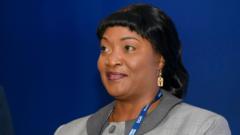
Monrovia — In a development that has sent profound shockwaves through the political corridors of West Africa, former Liberian Vice-President Jewel Howard-Taylor has been formally charged in connection with a sweeping transnational drug-trafficking probe. The high-profile arrest, executed at Roberts International Airport just outside the capital of Monrovia, marks a watershed moment in the nation's ongoing struggle against the multi-billion-dollar narcotics trade that has increasingly plagued the Mano River Union basin. As investigators piece together the intricate web of illicit finance, logistics, and political patronage, the legal proceedings against one of Liberia’s most influential public figures threaten to upend domestic political alliances, test the resilience of the nation's judicial institutions, and draw intense international scrutiny regarding the penetration of organized crime into the highest echelons of West African governance.
The arrest at Liberia's primary international gateway was the culmination of months of meticulous intelligence gathering, coordinated between domestic law enforcement agencies and specialized international anti-narcotics task forces. According to official disclosures from prosecuting authorities, Jewel Howard-Taylor was detained as she attempted to process travel documentation. The apprehension was swift, executed without violent resistance, but it immediately immobilized a central figure in contemporary Liberian politics. Howard-Taylor, who served as Vice-President from 2018 to 2024 under former President George Weah and holds the historic distinction of being the first woman to hold the office, as well as being the former wife of convicted war criminal and former President Charles Taylor, has not yet publicly commented on the allegations. Her legal counsel has indicated that they are reviewing the charge sheet and preparing a formal defense, maintaining a stance of cautious silence as the gravity of the accusations becomes fully apparent.
The specifics of the indictment, while still being unsealed in phases by the Monrovia City Court, point toward allegations of conspiracy, facilitation, and the laundering of proceeds derived from illicit drug trafficking. Investigators have spent a considerable timeframe tracing financial transactions and communications logs that allegedly link high-ranking political operatives to regional drug syndicates. West Africa has long transitioned from a mere transshipment route for South American cocaine destined for European markets to a localized hub of consumption, warehousing, and financial laundering. The involvement of figures possessing state-level security clearances and diplomatic influence underscores the alarming vulnerability of West African states to cartel infiltration, a phenomenon that security analysts have warned poses a direct and existential threat to regional stability.
The Historical Backdrop of Political Power and Patronage in Liberia
To comprehend the magnitude of the charges against Jewel Howard-Taylor, one must examine the complex and deeply entrenched architecture of Liberian political history over the past three decades. Howard-Taylor's political trajectory is inextricably linked to the turbulent legacy of the late 20th and early 21st centuries. As the former wife of Charles Taylor, she occupied a space of immense privilege and notoriety during the height of the National Patriotic Front of Liberia era and the subsequent presidency. Even after her marriage to Charles Taylor dissolved and the former president was tried and convicted by the Special Court for Sierra Leone for war crimes and crimes against humanity, Jewel Howard-Taylor successfully reinvented herself as a formidable, independent political force in her own right.
Elected as a Senator for Bong County in 2005, a densely populated and politically critical central region, she cultivated a reputation as an articulate, assertive legislator who championed women's rights, educational reform, and decentralization. Her alliance with George Weah ahead of the 2017 presidential election was a masterclass in political pragmatism, uniting the grassroots popularity of Weah's Congress for Democratic Change with the enduring loyalties of the traditional Taylor base in Bong and surrounding counties. This coalition swept them to power, cementing Howard-Taylor's position as a dominant power broker. Throughout her tenure as Vice-President, she managed to navigate the internal frictions of the administration while maintaining a robust personal political brand.
However, the transition of power following the democratic defeat of the Coalition for Democratic Change in the late 2023 elections shifted the political landscape dramatically. Stripped of executive immunity and the protective insulation of high office, political figures from the previous administration have found themselves increasingly exposed to retrospective investigations. While the current administration under President Joseph Boakai has consistently maintained that its anti-corruption and rule-of-law agenda is blind to political affiliation, critics and opposition members have periodically raised concerns regarding the potential weaponization of the judiciary. The charges against Howard-Taylor will therefore serve as a definitive litmus test for the institutional independence of Liberia's courts, determining whether high-profile prosecutions are executed with rigorous, uncompromised evidentiary standards or perceived as political score-settling.
The Anatomy of West Africa's Narco-State Vulnerability
The broader regional context of this arrest sheds light on the escalating menace of international drug trafficking across the West African coastline. Over the past fifteen years, cartels operating out of Latin America have increasingly exploited the porous borders, weak maritime enforcement capabilities, and pervasive systemic corruption of West African nations to move multi-ton shipments of cocaine into lucrative European consumer markets. Countries such as Guinea-Bissau, Sierra Leone, Ghana, and Liberia have historically found themselves on the front lines of this illicit trade. The profits generated by these operations dwarf the national budgets of several host countries, creating a corrosive financial power dynamic that can easily subvert state institutions.
Security experts note that drug cartels do not merely use West Africa as a passive bridge; they actively cultivate alliances with political elites, military officials, law enforcement leadership, and customs authorities to ensure safe passage, warehousing, and impunity. The involvement of individuals possessing state-level influence is often the linchpin of successful cartel operations in the region. Protection from high places guarantees that container inspections are bypassed, private airstrips operate without oversight, and law enforcement raids are strategically diverted or aborted. When investigations breach this protective barrier—as appears to be the case in the ongoing probe involving the former Vice-President—it exposes the deep structural fissures within the security architecture of the state.
In recent years, regional bodies such as the Economic Community of West African States, alongside international bodies including the United Nations Office on Drugs and Crime, have repeatedly warned that the infusion of narcotics money into the political economies of the region threatens to establish fully fledged narco-states. These criminal networks finance political campaigns, purchase electoral loyalty, and fund private security apparatuses, effectively eroding democracy from the inside out. The prosecution of a figure of Jewel Howard-Taylor's stature is unprecedented in modern Liberian history, signaling to international partners that local authorities may finally be willing to confront the apex of criminal patronage, regardless of the political fallout.
Economic Implications and Foreign Relations
The domestic and international economic fallout from this high-profile arrest is expected to be multifaceted. Liberia's economy, still recovering from the devastating historical impacts of civil conflict, the 2014 Ebola epidemic, and the global inflationary shocks of recent years, relies heavily on foreign direct investment, international donor assistance, and multilateral financial support. International partners, including the United States, the European Union, and various financial institutions, have consistently conditioned their developmental aid and budgetary support on verifiable improvements in governance, transparency, and the aggressive prosecution of corruption and organized crime.
A decisive, transparent, and legally sound prosecution of individuals linked to drug trafficking can significantly enhance Liberia's international credibility, signaling to foreign investors that the rule of law is actively enforced and that impunity for the powerful is no longer guaranteed. Conversely, any perception of procedural irregularity, political bias, or judicial compromise could severely damage investor confidence, leading to a tightening of foreign assistance and a downgrading of the nation's governance ratings.
Furthermore, the narcotics trade introduces severe economic distortions within local communities. The influx of illicit capital drives up real estate prices, distorts local labor markets, and fosters a shadow economy that bypasses state taxation while fueling violent crime, addiction, and public health crises. As the judicial process unfolds, financial investigators will undoubtedly seek to trace the asset trails associated with the indictment. Asset forfeiture laws, though historically underutilized in Liberia, may be invoked to recover funds and property allegedly acquired through criminal enterprise, potentially injecting recovered assets back into public infrastructure and social development programs.
Legal Dynamics and the Battle for Due Process
As the legal battle formally commences, the proceedings will be scrutinized by domestic and international legal scholars alike. The burden of proof resting upon state prosecutors is exceptionally heavy, given the prominence of the defendant and the intense public interest surrounding the case. Under Liberian law, every accused individual is presumed innocent until proven guilty in a court of law, and the defense team is expected to mount a rigorous challenge regarding the admissibility of evidence, the legality of the arrest, and the credibility of cooperating witnesses or informants.
Legal analysts point out that drug-trafficking and money-laundering prosecutions of this magnitude require robust forensic accounting, airtight chain-of-custody documentation for physical evidence, and seamless cooperation across international jurisdictions. In many developing nations, the legal framework to combat transnational organized crime exists on paper, but the institutional capacity—ranging from forensic laboratory facilities to specialized judicial training—often lags behind the sophistication of modern criminal syndicates. The manner in which the Liberian judiciary handles pre-trial detention, bail applications, and evidentiary hearings will serve as an essential benchmark for the maturity and independence of the nation's justice system.
Moreover, the political dimensions of the trial cannot be entirely separated from the legal arguments. Defense attorneys are likely to frame the charges as politically motivated, designed to sideline opposition leadership and diminish the electoral prospects of the Coalition for Democratic Change ahead of future political cycles. Prosecutors, meanwhile, must meticulously insulate their case from political interference, relying purely on documentation, financial records, communications intercepts, and verifiable witness testimony to substantiate the indictment.
Expert Perspectives and Regional Reactions
Regional security analysts and political scientists across West Africa have offered diverse interpretations of the arrest, reflecting the complex interplay between justice, politics, and stability. Dr. Amara Kanneh, a senior researcher on governance and transnational crime based in Freetown, emphasized the symbolic and practical weight of the detention. "This is not merely about an individual," Dr. Kanneh observed in an interview discussing the broader regional landscape. "It represents a critical juncture for West Africa. For too long, political elites have operated under the assumption of absolute impunity. If judicial systems in countries like Liberia can successfully investigate, try, and adjudicate high-ranking officials without descending into political chaos, it sends an unmistakable deterrent signal to criminal networks throughout the sub-region."
However, other observers urge caution, warning of the potential for social and political polarization. Jewel Howard-Taylor retains a deeply loyal following, particularly within Bong County and among supporters of the former ruling coalition. Mobilizing these constituencies against what they perceive as targeted persecution could introduce friction into an already fragile domestic political equilibrium. Civil society organizations in Monrovia have largely adopted a cautious wait-and-see stance, issuing statements that emphasize the primacy of the rule of law while calling for absolute transparency, unhindered access for legal counsel, and the prevention of pre-trial abuses.
International diplomatic missions in Monrovia have also been closely monitoring the situation. Several embassies have reiterated their commitment to supporting anti-corruption initiatives and strengthening judicial institutions while emphasizing that the legal process must unfold fairly and impartially in strict accordance with Liberian constitutional principles.
Future Consequences and the Road Ahead for Liberian Governance
Looking forward, the case involving Jewel Howard-Taylor will undoubtedly cast a long shadow over the political and social trajectory of Liberia. Several potential scenarios emerge as the legal proceedings advance through the courts. If the prosecution successfully secures a conviction, it will establish a monumental legal precedent, demonstrating that no individual, regardless of their historical lineage, electoral mandate, or high office, is above the law. Such an outcome would significantly bolster public trust in democratic institutions and reinforce the country's anti-corruption credentials on the global stage.
Conversely, should the case falter due to evidentiary deficiencies, procedural missteps, or allegations of political interference, the repercussions could be profoundly damaging. A failed prosecution would not only validate claims of political victimization by the opposition but also deepen public cynicism regarding the capability of the state to confront powerful criminal networks. Furthermore, it could embolden transnational syndicates, reinforcing the perception that West African states remain vulnerable to elite capture and organized crime.
Beyond the immediate courtroom drama, the broader systemic challenge remains: how Liberia and its neighbors can effectively dismantle the financial and logistical infrastructure of the narcotics trade. Law enforcement agencies must look beyond individual high-profile arrests to dismantle entire networks, targeting shell companies, illicit financial flows, corrupt customs officials, and international suppliers. Strengthening inter-agency cooperation, enhancing maritime surveillance, and passing rigorous asset-recovery legislation are essential steps in this ongoing war.
As the sun sets over Monrovia and the legal machinery grinds slowly forward, the nation finds itself at a historical crossroads. The detention of a former Vice-President on drug-trafficking charges is a stark reminder of the immense pressures facing West African democracies. Whether this moment catalyzes a enduring strengthening of the rule of law or becomes another contentious chapter in the nation's political history depends entirely on the integrity, transparency, and resilience of Liberia's institutions in the days and weeks to come. The Sierraleo News Network will continue to provide comprehensive, objective, and unflinching coverage of these unfolding developments as they shape the future of the region.


