
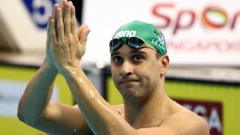

As the global sporting calendar marches toward its next major milestone, the conversation within elite aquatics circles increasingly centers on a singular, monumental milestone: the potential crowning achievement of South Africa’s most celebrated swimming export. Chad le Clos, a name synonymous with resilience, butterfly dominance, and relentless competitive drive, has openly expressed his profound ambition to claim sole possession of the all-time record for medals won by a male athlete in the history of the Commonwealth Games. With an illustrious career that has already seen him scale the highest peaks of international swimming, this latest pursuit represents not merely a numerical accumulation of hardware, but the enduring legacy of a competitor who refuses to fade into the background of athletic history.
The Commonwealth Games hold a unique and cherished place in the broader ecosystem of international sports. Often described as the Friendly Games, this quadrennial gathering brings together nations from across the globe, predominantly bound by shared historical ties to the Commonwealth of Nations. For athletes hailing from regions where state-sponsored funding can occasionally fluctuate, or where winter sports take a backseat to track, field, and aquatics, the Commonwealth Games serve as a premier stage. It is a competition where regional rivalries come to the fore, where commonwealth records are shattered, and where athletes from smaller nations can compete on a truly global broadcast platform. Within this storied arena, the swimming pool has historically been a theatre of high drama, producing iconic moments that resonate for generations. To stand atop the podium in this environment is an honor; to dominate it across multiple generations of athletes is the stuff of legend.
Chad le Clos is no stranger to the pressures, privileges, and demands of elite international competition. Bursting onto the global consciousness with a breathtaking upset victory over the legendary American swimmer Michael Phelps in the 200-meter butterfly at the 2012 London Olympic Games, le Clos forever altered the landscape of South African sports. That single moment in the aquatics center—captured by television cameras worldwide as his father, Bert le Clos, delivered an emotionally unforgettable television interview—catapulted the Durban-born swimmer into global superstardom. Yet, unlike athletes who peak and subsequently wane following a single Olympic triumph, le Clos demonstrated an extraordinary capacity for longevity. He has continually reinvented his training methodologies, adapted to shifting tactical paradigms within the sport, and managed the inevitable physical toll that decades of elite-level butterfly and freestyle swimming exact on the human body.
The Anatomy of a Record: Understanding the Commonwealth Pantheon
To fully comprehend the magnitude of what le Clos is aiming to achieve, one must examine the historical architecture of the Commonwealth Games records. Over the decades, the swimming events have been graced by transcendent talents from Australia, England, Canada, South Africa, and beyond. Names like Ian Thorpe, Grant Hackett, Susie O'Neill, and more recently, Emma McKeon and Adam Peaty, have left indelible marks on the competition's record books. McKeon, the phenomenal Australian freestyler and butterfly specialist, shattered numerous records to become the most decorated athlete overall in Commonwealth Games history, setting a benchmark that highlights the sheer depth of excellence required to conquer the multi-sport event.
In the men's division, the record for total medals has been a fiercely contested metric. Chad le Clos currently sits in an elite echelon of athletes, having accumulated a staggering tally of medals across multiple editions of the Games, stretching from his breakthrough performances in Delhi 2011, through Glasgow 2014, Gold Coast 2018, and into Birmingham 2022. Tied with fellow sporting legends in terms of sheer overall medal count, the South African icon understands that securing one more trip to the podium in subsequent competition will elevate him past historical peers, granting him undisputed possession of the male record. It is a mathematical target, certainly, but one weighted down by the psychological burden of expectation, the physical uncertainty of aging in a notoriously youth-dominated sport, and the relentless emergence of hungry, younger challengers.
Achieving this feat requires a rare convergence of physical preparation, tactical intelligence, and sheer mental fortitude. Swimming is an unforgiving sport where races are won and lost by hundredths of a second. A momentary lapse in concentration at the wall, a mistimed turn, or a slight miscalculation in pacing can mean the difference between a gold medal and missing the podium entirely. For an athlete who has competed at the absolute summit for over a decade, the challenge is as much about managing recovery and injury prevention as it is about putting in the hard yards in the chlorine-filled training pools of Durban, Europe, or wherever his training camps take him. The joints endure immense stress, particularly the shoulders in butterfly specialists, making le Clos's sustained competitiveness well into his career nothing short of a medical and physiological marvel.
The South African Sporting Context and Regional Implications
Beyond the personal glory and the statistical footnote in swimming history, Chad le Clos's pursuit carries profound significance for South African sport. South Africa occupies a unique position on the African continent as a powerhouse in various international sporting codes, yet it consistently battles systemic challenges, economic constraints, and infrastructural hurdles. Swimming, traditionally viewed as an expensive sport requiring access to well-maintained heated pools, specialized coaching, and financial backing for travel, often struggles with grassroots accessibility in developing nations. Despite these barriers, South Africa has punched remarkably well above its weight class, producing world-class swimmers who dominate global leaderboards.
When le Clos steps onto the pool deck representing the rainbow nation, he carries the hopes of millions who view him as a national treasure. His continued success acts as a vital catalyst for sports development within the country. Success breeds participation, and participation builds the future pipelines of talent. Young South African boys and women watching le Clos carve through the water on their television screens see a tangible, living proof that an athlete from their neighborhoods can conquer the world. Sport in South Africa has historically served as an extraordinary unifying force, transcending socioeconomic and racial divides in a manner few other cultural phenomena can replicate. By chasing history at the Commonwealth Games, le Clos is not merely adding to his personal trophy room; he is reinforcing a national narrative of resilience, excellence, and global competitiveness.
Furthermore, the broader economic and touristic implications for host cities and participating nations tied to elite athletes of le Clos’s stature cannot be overlooked. Major multi-sport events draw massive international media attention, tourism revenue, and corporate sponsorship dollars. When marquee athletes confirm their participation and openly target historic records, it drives broadcast ratings upward, increases ticket sales, and secures the commercial viability of the games. Sponsors love a narrative of historical pursuit; the human element of an aging champion hunting one final, definitive record provides the ideal dramatic arc for marketing campaigns and public engagement strategies.
The Evolution of International Aquatics: Adapting to a Changing Landscape
To analyze Chad le Clos's quest objectively, one must also look closely at the macro-level evolution of competitive swimming over the past decade. The sport has undergone a dramatic transformation. Nutritional science, biomechanical analysis using high-speed underwater cameras, and sports psychology have evolved at a breakneck pace. The swimmers entering the elite circuit today are taller, leaner, and benefit from data-driven training regimens that were unimaginable when le Clos first burst onto the international scene as a teenager.
In this context, le Clos's longevity is an anomaly. Many middle-distance butterfly and freestyle specialists experience a sharp decline in performance once they cross the threshold into their late twenties, as explosive fast-twitch muscle fibers begin to lose their peak responsiveness and recovery times lengthen. Yet, le Clos has successfully navigated this transition by leaning into his vast reservoir of tactical experience. He understands how to manage his energy reserves across preliminary heats, semi-finals, and finals—a skill that only decades of racing under immense pressure can impart. He has occasionally adjusted his event program, focusing selectively where his strengths yield the highest probability of success, while remaining a formidable competitor across multiple distances.
Coaches and sports scientists frequently point to le Clos's racing IQ as his ultimate weapon. In races where younger opponents might rely purely on raw physical speed and an aggressive, front-running strategy, le Clos has often relied on his renowned finishing kick—a breathtaking display of underwater dolphin kicking and relentless stroke rate maintenance over the final fifteen meters of a race. This tactical maturity allows him to remain competitive against athletes who may hold temporary physiological advantages. It is this exact blend of brains and brawn that keeps him in contention for historic records, proving that in elite aquatics, wisdom and experience can frequently neutralize youthful exuberance.
Expert Perspectives and the Psychological Dimensions of Chasing History
Sport psychologists often emphasize the unique mental strain experienced by athletes who are explicitly chasing historical milestones. When an individual is simply competing to win a race, their focus is externally directed toward the competitors in adjacent lanes. However, when an athlete is racing against the ghosts of history—trying to surpass established numerical records set by legendary predecessors—the psychological burden shifts inward. Every training session is viewed through the magnifying glass of legacy; every minor injury or subpar performance feels amplified.
Interviews and public statements from le Clos reveal an athlete who has learned to embrace this pressure rather than shrink from it. There is a palpable sense of joy and gratitude in how he speaks about his career. Having experienced the dizzying highs of Olympic gold and the humbling lows of missing the podium in subsequent major championships, le Clos has cultivated a mature, philosophical perspective on his sporting life. He has openly acknowledged that standing alone as the most decorated male athlete in Commonwealth Games history would be an amazing, career-defining capstone, but he also approaches the challenge with the liberated mindset of someone who has already cemented his place in the pantheon of the sport.
Aquatics analysts and former Olympic champions frequently debate the mental resilience required to sustain a career of this length. Many elite competitors burn out due to the relentless psychological grind of the lifestyle—the early morning training sessions before sunrise, the strict dietary regimens, the constant travel, and the intense public scrutiny. The fact that le Clos continues to find intrinsic motivation to push his body through the grueling training blocks necessary to compete at the world-class level speaks volumes about his character. It is an internal fire that cannot be coached or manufactured; it is an innate competitive hunger that defines true sporting greats.
Global Perspectives and the Future of the Commonwealth Games
As the global sporting ecosystem faces various geopolitical and economic shifts, the relevance and format of traditional multi-sport events like the Commonwealth Games are occasionally subjected to critical evaluation. Questions regarding funding, hosting logistics, and scheduling conflicts with world championships or Olympic cycles frequently emerge in sports administration circles. In this environment, marquee athletes who commit to the Games play a vital role in validating their ongoing prestige.
When a global superstar of le Clos's magnitude expresses explicit excitement and dedication toward the Commonwealth Games, it sends a powerful message to the international sporting community. It reinforces the notion that these Games possess a distinct, irreplaceable heritage that transcends mere commercial value. For athletes from smaller island nations, African states, and Caribbean countries, sharing a competition venue with a multi-medal-winning global icon like le Clos provides an inspirational benchmark. It elevates the competitive standard of the entire meet.
Looking toward the horizon, regardless of the exact logistical arrangements or future host cities of upcoming Commonwealth editions, the narrative surrounding le Clos's medal tally will remain a central focal point for sports historians and media observers. The prospect of witnessing an athlete break a long-standing historical record is one of the most compelling aspects of sport. It draws casual fans to television screens and fills arenas with spectators eager to witness history unfold in real time.
The Legacy of Chad le Clos: Beyond the Medals
While the immediate focus remains squarely on the numerical tally of medals and the historic record, the broader legacy of Chad le Clos extends far beyond the statistics. Long after he hangs up his goggles and steps away from the competitive pool for the final time, his impact on South African and global swimming will reverberate. He has been an ambassador for the sport, engaging with fans, supporting grassroots initiatives, and demonstrating sportsmanship in both victory and defeat.
The journey of an elite athlete is rarely a linear trajectory of unmitigated success. Le Clos has faced his share of adversity—battling illness, managing form slumps, and dealing with the inevitable criticisms that accompany high-profile athletic performance in the modern digital age. How he has responded to these challenges—by recalibrating, working harder, and returning to the podium—serves as a masterclass in resilience for anyone navigating high-pressure environments, whether in sports, business, or everyday life.
As anticipation builds for the next chapters of international competition, the swimming world will keep a watchful eye on South Africa's most decorated butterfly specialist. Whether he ultimately captures the sole possession of the male Commonwealth Games medal record or simply adds another remarkable chapter to an already peerless career, Chad le Clos has already secured his immortality in the hearts of sports fans worldwide. His quest is a testament to the power of human ambition, the beauty of athletic longevity, and the relentless pursuit of greatness against the relentless march of time.