
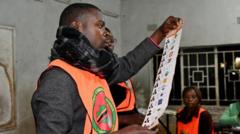

The Electoral Commission of Zambia has officially resumed the nationwide vote-counting process following an enforced, tense operational pause triggered by outbreaks of coordinated violence and the targeted disruption of polling facilities. The temporary suspension of tallying activities highlights the fragile nature of civic administration in regions experiencing hyper-polarized political climates, forcing security apparatuses to scramble for control while election officials grapple with the monumental task of preserving the integrity of the democratic mandate amid acute logistical and physical threats.
The decision to halt operations came down late in the election cycle, an extraordinary measure that immediately sent shockwaves through the political landscape of the southern African nation. According to official statements released by electoral authorities, the pause was not merely a precautionary measure against general civil unrest, but a direct response to targeted assaults on polling staff. These violent episodes culminated in the brazen theft of marked ballot papers, an occurrence that strikes directly at the foundational legitimacy of any democratic exercise. As verification and tabulation centers locked down their perimeters, political actors, international observers, and ordinary citizens held their collective breath, acutely aware that the credibility of the entire electoral architecture hung in a precarious balance.
Zambia has long prided itself on being a bastion of relative political stability and democratic maturity within a volatile regional neighborhood. Since the peaceful transition of power in historical multi-party elections, the nation has cultivated an international reputation for holding competitive, largely orderly contests. However, contemporary political dynamics have increasingly been defined by fierce polarization, economic anxieties, and a hyper-competitive race between established political heavyweights. In this high-stakes environment, the margins between victory and defeat are razor-thin, amplifying the desperation of political camps and heightening the risk that localized frustrations could erupt into systemic violence. The recent incidents of intimidation and ballot theft are not isolated anomalies; rather, they serve as alarming symptoms of a deeper, more systemic malaise affecting the electoral ecosystem.
Anatomy of the Crisis: The Mechanics of the Disruption
To understand the gravity of the electoral commission's decision to pause the count, one must examine the precise sequence of events that unfolded at vulnerable polling stations and collation centers. As voting drew to a close and the physical ballots were secured for transport to regional hubs, reports began to filter through of organized groups mobilizing with the explicit intent of disrupting the chain of custody. Eyewitness accounts, corroborated by preliminary security assessments, describe instances where armed or aggressive mobs breached perimeter security, overwhelming outnumbered police details stationed at remote precincts.
The primary target of these coordinated actions was not merely generalized chaos, but the seizure of sensitive electoral materials. Marked ballot papers, the tangible proof of the electorate's will, were physically removed from official custody in several flashpoint zones. The implications of stolen ballots are profound. In an electoral dispute, the physical paper trail is the ultimate arbiter of truth, capable of overriding digital discrepancies or human error in tallying. When those papers are compromised, stolen, or destroyed, the verification process is fundamentally crippled. Electoral officials were thus placed in an impossible dilemma: proceed with a count known to be numerically incomplete due to missing materials, or halt the process entirely to restore order and investigate the extent of the security breach.
The commission chose the latter path, invoking emergency protocols designed to safeguard the integrity of the vote. While this decision was widely praised by international governance watchdogs as a necessary acknowledgment of reality, it also ignited fierce political controversy. Opposition elements and ruling party representatives alike rushed to interpret the pause through the prism of partisan advantage, with various camps launching preemptive accusations of manipulation, incompetence, or bad faith. The information vacuum created by the temporary suspension of data updates immediately became a breeding ground for disinformation, viral rumors on social media platforms, and psychological warfare among rival political factions.
Historical Context: Zambia's Democratic Trajectory
The current tension cannot be viewed in a vacuum; it is the product of a complex historical evolution characterized by hard-fought democratic milestones and recurrent institutional strain. Zambia transitioned from a one-party state under the United National Independence Party and founding leader Kenneth Kaunda to a multi-party democracy in the early 1990s. That historic shift established a constitutional framework that has successfully facilitated multiple peaceful transfers of power between opposing political parties—a feat that remains tragically elusive in many parts of the African continent.
However, this institutional resilience has been severely tested in recent decades by socio-economic pressures. Zambia's economy, heavily dependent on copper mining and vulnerable to global commodity price fluctuations, has struggled to deliver equitable prosperity to a youthful demographic. High youth unemployment, rising costs of living, and widening wealth disparities have transformed the political arena into a high-stakes arena where winning state power is frequently perceived by citizens as the primary, if not the only, pathway to economic survival and social mobility. Consequently, political campaigns routinely assume an existential character, raising the psychological temperature of the electorate and lowering the threshold for political violence.
Previous electoral cycles have also witnessed flashes of tension, but the systematic targeting of electoral administrative staff represents a worrying escalation. In past elections, disputes were largely confined to legal challenges filed in the courts or localized street protests following the announcement of results. The direct physical assault on polling personnel and the looting of sensitive materials points to a troubling evolution in tactical disruption, suggesting that bad actors are increasingly willing to undermine the foundational infrastructure of the state to achieve their political objectives.
Economic Implications of Political Instability
Beyond the immediate questions of governance and public safety, the crisis surrounding the vote count carries profound economic ramifications for a nation striving to solidify its macroeconomic recovery. Zambia has spent the past several years navigating a grueling debt restructuring process, working painstakingly with international creditors, multilateral financial institutions, and bilateral partners to regain fiscal sovereignty following a historic sovereign default.
International investors, rating agencies, and foreign lenders monitor the stability of the host nation with microscopic precision during election periods. Predictability and the rule of law are paramount currencies in the global financial markets. When news of violent disruptions, stolen ballots, and paralyzed electoral processes breaks across international financial terminals, the immediate reaction of the market is one of risk aversion. Currency fluctuations, spikes in borrowing costs, and the sudden hesitation of foreign direct investment are the predictable collateral damage of political instability.
Economic analysts point out that any prolonged uncertainty or contested outcome could severely derail ongoing structural reforms. The nation's vital mining sector, which requires massive long-term capital investments to modernize infrastructure and increase production output, is particularly sensitive to political risk. Mining conglomerates and international financiers require ironclad assurances that the regulatory environment will remain stable regardless of which political coalition occupies the executive branch. Therefore, the swift, transparent, and credible finalization of the electoral process is not merely a political imperative for domestic harmony; it is an absolute economic necessity to maintain international confidence and protect the livelihoods of millions of ordinary Zambians.
Regional and Continental Repercussions
The ripples of the Zambian electoral crisis extend far beyond its borders, resonating throughout the Southern African Development Community and the broader African Union framework. In a region that has recently witnessed democratic regressions, military coups, and constitutional manipulations in neighboring states, Zambia has historically served as a vital anchor of democratic stability and institutional resilience.
Neighboring governments and regional bodies view the events unfolding in Zambia with acute anxiety. The Southern African Development Community has deployed observer missions to monitor the conduct of the polls, tasked with evaluating whether the process aligns with regional principles and guidelines governing democratic elections. The targeted violence against election workers and the theft of ballots present these regional monitors with a severe diplomatic and operational test. How the regional bodies respond—balancing the imperative of non-interference in sovereign affairs with the collective responsibility to uphold democratic norms—will set an important precedent for future electoral crises across the continent.
Furthermore, civil society networks across Africa are watching closely. The erosion of trust in electoral management bodies is a continental challenge, with citizens increasingly questioning whether independent commissions can truly remain impartial under intense political pressure. If the Electoral Commission of Zambia can successfully navigate this crisis, restore security, and deliver a credible, transparent final tally, it could provide a masterclass in institutional crisis management. Conversely, a botched resolution or a process perpetually mired in controversy could further deepen the crisis of confidence in democratic governance across the entire sub-region.
Expert Perspectives and Governance Analysis
Political scientists, constitutional scholars, and security experts have offered varied yet sobering analyses of the situation, emphasizing that the crisis is symptomatic of deeper institutional vulnerabilities that must be addressed long after the current ballots are tallied. Dr. Chileshe Mwewa, a senior researcher in African governance based in Lusaka, argues that the root cause of the violence lies in the failure to de-escalate the rhetoric of existential threat that permeates contemporary political campaigning.
When political parties frame elections not as a contest of competing policy visions, but as an apocalyptic struggle between forces of good and evil, supporters naturally feel justified in taking extreme measures to secure victory, Dr. Mwewa explains. The physical attack on electoral staff is the logical endpoint of a political culture that demonizes independent arbiters and treats the institutions of state as spoils of war rather than neutral public assets.
Security analysts have likewise criticized the operational preparedness of law enforcement agencies in securing vulnerable polling precincts. While praising the bravery of individual police officers who found themselves outmatched by organized mobs, security experts emphasize that the decentralized nature of elections requires a much more robust intelligence-led policing model. Pre-election threat assessments should have identified high-risk zones, ensuring that adequate tactical reserves were positioned to deter and suppress coordinated attacks before they could result in the theft of sensitive materials.
Legal experts point out that the electoral commission faces a complex maze of statutory deadlines and procedural requirements. Pausing the count is an administrative emergency measure, but the law strictly dictates timeframes within which final results must be declared. As days tick by, the legal pressure on the commission intensifies, raising the specter of subsequent constitutional challenges in the Supreme Court. Every step of the tabulation process moving forward will be subjected to intense judicial scrutiny by armies of high-powered legal teams representing the competing political parties.
The Human Cost and the Voice of the Electorate
Amid the high-stakes political maneuvering, macroeconomic calculations, and geopolitical analysis, it is easy to overlook the human dimension of the crisis. The true victims of the violence and disruption are the ordinary citizens of Zambia—the millions of voters who stood patiently for hours in long queues under the sun, determined to exercise their constitutional right to choose their leaders.
For the average voter, the images of chaos, police mobilization, and locked tally centers evoke profound feelings of anxiety and disillusionment. The democratic contract is built upon trust: the citizen invests their faith in the state, participates peacefully in the electoral ritual, and trusts that their individual ballot will be counted accurately and protected fiercely by the authorities. When marked ballots are stolen and polling staff are assaulted, that fundamental trust is violently breached.
Interviews conducted with voters in various urban and rural districts reveal a mixture of resilience and deep fatigue. Many citizens express frustration that the peaceful expressions of their democratic will have been hijacked by violent fringe elements acting on behalf of desperate political operatives. Civil society organizations have mobilized grassroots peace campaigns, urging calm and reminding the populace that no political office is worth the blood of a fellow citizen. Community leaders, religious figures, and traditional authorities have added their voices to the chorus calling for restraint, emphasizing the shared national identity that transcends partisan divides.
The Path Forward: Resumption and Verification
As vote counting officially resumes under heavily reinforced security protocols, the immediate challenge for the electoral commission is twofold: ensuring absolute physical security for remaining operations and rebuilding public trust through radical transparency. The commission has announced that additional security personnel, including elite units of the national police and augmented defense forces, have been deployed to secure all remaining collation centers, transit routes, and central data processing facilities.
To address the fallout from the stolen ballots, the commission is implementing stringent auditing mechanisms. Representatives from all competing political parties, alongside accredited international and domestic observers, are being granted unprecedented access to cross-reference audit trails, serial numbers, and reconciliation forms. This inclusive approach is designed to ensure that no single entity can unilaterally manipulate the process or cast doubt on the authenticity of the final numbers.
However, the road ahead remains fraught with peril. Even if the technical hurdles of counting and verification are successfully overcome, the announcement of the final results will trigger a new phase in the political cycle. The losing factions will face critical decisions regarding whether to accept the outcome or pursue formal legal challenges. The tone and temperament of political leaders during that critical post-election window will determine whether the nation can successfully turn the page on this dark chapter or whether underlying grievances will continue to simmer.
Ultimately, the current crisis serves as a stark reminder that democracy is not a self-sustaining automatic mechanism, but a fragile, living enterprise that requires constant nourishment, institutional vigilance, and an unshakeable commitment to the rule of law by all segments of society. The resilience of the Zambian people, tested severely by these recent events, remains the ultimate guarantor of the nation's democratic future. As the tallying lights flicker back on across the country, the eyes of the entire continent and the global community remain fixed on Lusaka, watching to see whether the democratic flame will burn brighter through the adversity or succumb to the pressures of polarization.