
Traoré’s Four-Year Rule in Burkina Faso Tested by Sankara’s Legacy
Captain Ibrahim Traoré has led Burkina Faso for four years, a period increasingly compared with Thomas Sankara’s time in power as the country pursues economic independence amid insecurity and...

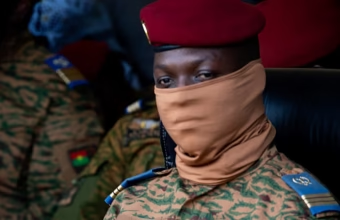
Captain Ibrahim Traoré has completed four years as Burkina Faso’s leader, matching the length of time Thomas Sankara was in power and placing Traoré’s rule under renewed comparison with the former revolutionary president.
Table Of Content
Traoré has said he is carrying Sankara’s legacy forward. Both men came to power as young, red-beret-wearing army captains and have been associated with calls for national sovereignty, Pan-Africanism, economic independence and greater reliance on local production.
A programme centred on sovereignty
Traoré’s government has nationalised gold mines, promoted local industries and launched Faso Mebo, an infrastructure programme intended to build roads and develop cities using local resources.
The approach reflects some of the priorities associated with Sankara, who promoted education, women’s empowerment, self-reliance and local production after seizing power in 1983. Sankara described his programme at the time as a “democratic and popular revolution.”
However, the conditions facing Burkina Faso today differ sharply from those of Sankara’s period in power. The country remains under pressure from jihadist groups, with violence affecting large parts of the country and some towns facing blockades.
Security pressure and political restrictions
The security crisis has also shaped the government’s treatment of civilians and public institutions. Journalists, magistrates and civil society figures have been forcibly recruited and sent to the front lines, according to the verified account of the situation.
Political opposition has been restricted under Traoré, adding to concerns about the limits placed on public and political activity during the security crisis.
The combination of continued violence and political restrictions sets Traoré’s leadership apart from the image of Sankara’s rule that supporters invoke. While both governments have been linked to sovereignty and self-reliance, Burkina Faso’s current administration is operating amid a prolonged jihadist conflict.
Changing regional alliances
Traoré has also shifted Burkina Faso’s external relationships. His government has moved away from France and strengthened ties with Russia.
Burkina Faso has joined Mali and Niger in a new regional confederation, reflecting a broader move by the three countries to pursue closer cooperation outside their previous regional alignments. The formal structure and name of the confederation have not been detailed in the available information.
Sankara was assassinated in 1987, four years after taking power. Nearly four decades later, his political image remains an important reference point for Traoré’s government as it presents its policies as part of a continuing struggle for sovereignty and economic independence.
Traoré’s four years in power therefore represent both a deliberate connection to Sankara’s legacy and a governing record shaped by conditions Sankara did not face, including widespread jihadist violence, blockades and restrictions on political opposition.




No Comment! Be the first one.