
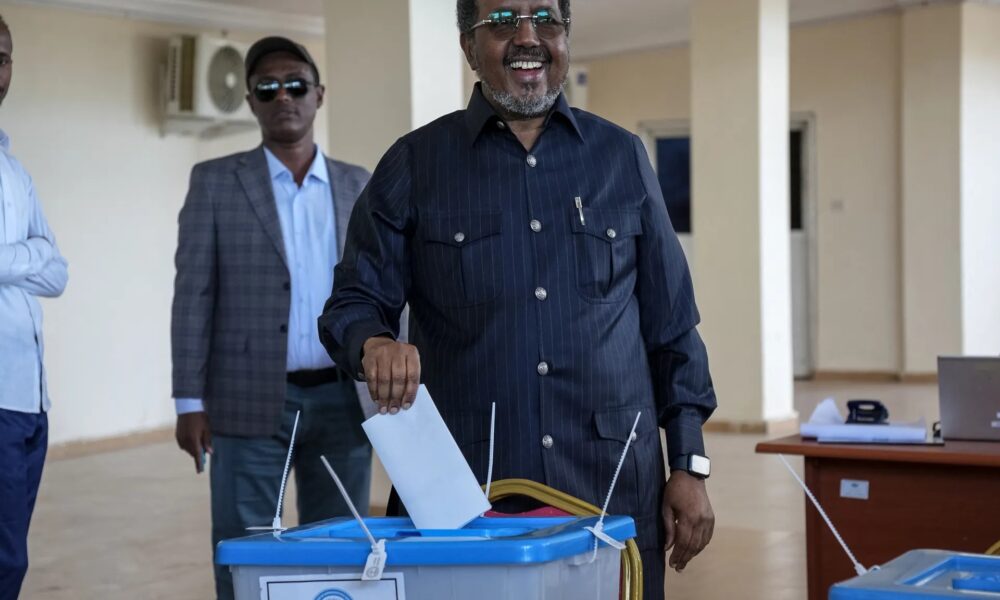
Somalia’s Independent National Elections and Boundaries Commission has announced planned dates for parliamentary and presidential elections in 2027, setting the country on a politically contested path toward its next national polls.
Table Of Content
Commission chief Abdikarim Ahmed Hassan said on Somalia’s state broadcaster that elections for members of both the lower and upper parliamentary chambers are planned for April 15, 2027. The presidential election is scheduled for May 15.
The electoral body said the presidential timetable was based on a rule that defines the president’s term as five years from the date the officeholder is sworn in.
Opposition challenges timetable
The announcement has been welcomed by the government but rejected or questioned by opposition figures and other critics. The government described the dates as an “important stage … towards reinforcing the country’s democratic system” and urged all political parties to take part peacefully and in good faith.
Former President Mohamed Abdullahi Farmaajo called the decision a “dangerous threat to Somalia’s statehood and future” in a post on X. He urged the authorities to reach an agreement with all factions before proceeding with a decision on the polls.
Former President Sheikh Sharif Sheikh Ahmed warned that a disputed electoral process could produce parallel elections and civil conflict.
Analyst Samira Gaid told AFP that there was no political agreement to hold the elections. She said the government’s actions were contributing to “further fragmentation” and could result in “conflict and more confrontation within the remaining federal member states.”
Some residents in Mogadishu also described the announcement as one-sided. Omar Said, a Mogadishu resident, told AFP that announcing a schedule driven by one side and rejected by the opposition was “effectively declaring a new conflict.”
Dispute over constitutional changes
President Hassan Sheikh Mohamud began his second term in 2022. His government declared a transition period through a constitutional amendment in May, although the source report does not specify the year of that amendment.
Opposition parties boycotted the vote on the constitutional changes and have rejected them. Mohamud is also seeking to replace an electoral system involving established clan elders with party-based elections. Critics have described that effort as a power grab.
The absence of a reported political agreement leaves uncertainty over whether the announced timetable will be implemented. The warnings about conflict and fragmentation have been presented by critics and analysts as potential consequences, rather than confirmed outcomes.
Security and regional context
The election dispute comes as Somalia continues to face security challenges. Al-Shabab emerged from the Islamic Courts Union in the mid-2000s and pledged allegiance to al-Qaeda in 2012. The group holds territory in parts of southern and central Somalia and has carried out deadly attacks in Mogadishu and neighbouring Kenya.
Mohamud has said Al-Shabab no longer has a presence in major cities and has little possibility of taking control of Somalia, while acknowledging that significant security challenges remain. He has described the United States as Somalia’s strongest partner in the fight against terrorism.
Mohamud has also characterised Somalia’s relations with Ethiopia as good. He said Mogadishu did not object to Ethiopia gaining sea access through a joint agreement allowing the use of Somali ports for economic interests.
That position follows tensions over Ethiopia’s January 2024 memorandum of understanding with Somaliland on sea access, which Somalia condemned as a violation of its sovereignty. Somalia and Ethiopia later agreed to ease tensions.



No Comment! Be the first one.