African Mobile Banking Offers Lessons for European Banks
Growth in financial account ownership and mobile money across sub-Saharan Africa is prompting discussion about how European banks could improve simplicity, accessibility and customer focus.
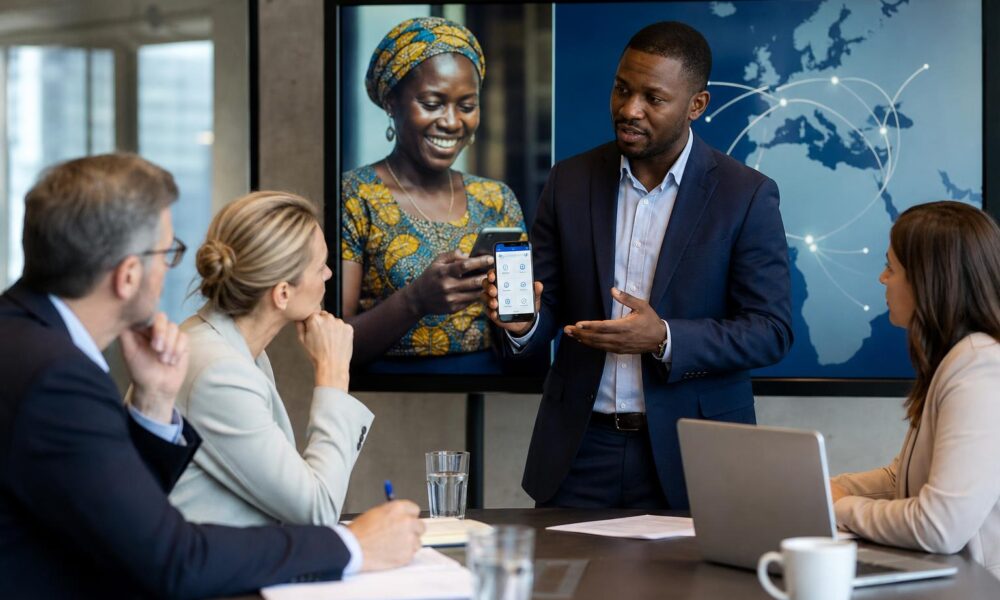
Rapid growth in financial account ownership and mobile money across sub-Saharan Africa is drawing attention to banking models that could offer lessons for European institutions.
Table Of Content
According to figures cited from the World Bank’s Global Findex 2025 report, the share of adults in sub-Saharan Africa with a financial account rose from 34% in 2014 to 58% in 2024. The report also found that 40% of adults in the region had a mobile money account in 2024.
GSMA data cited in the report shows that Africa had 1.1 billion registered mobile money accounts in 2024, an annual increase of 19%. Monthly active accounts reached 286 million, up 12% year on year, while mobile money transactions totalled 81 billion with a combined value of $1.1 trillion.
M-Pesa and the reach of mobile services
M-Pesa is highlighted as a prominent example of African financial innovation. The service was launched by Safaricom PLC, Kenya’s publicly listed mobile network operator, and added financial services to an existing mobile network.
Marta Mróz-Sipiora, Director of Global Development and Innovation at Asseco Poland, said the model showed how simple money transfers could be delivered through a mobile operator. She described Africa as an important example of using mobile banking and financial services to respond to customers’ practical needs.
Account ownership varies widely across the region. World Bank data cited in the report puts account ownership at 90% of adults in Kenya and 89% in Mauritius, compared with 14% in Niger and 20% in Chad.
Mróz-Sipiora, who specialises in the strategic development and digital transformation of financial institutions, said her work on projects in Kenya, South Africa and other countries had shown her that technology could reach communities traditional banking might not have served.
Capitec’s focus on accessible banking
Capitec Bank in South Africa is presented as another example of a banking model built around accessibility and straightforward products. Mróz-Sipiora said the bank was established in 2001 on the foundations of a microlending business, initially serving lower-income people with limited access to traditional banking.
She said Capitec first offered simple loans before developing an online banking platform and later introducing mobile banking services. Physical access to branches also remained important during the bank’s early development.
Capitec reported 26 million active clients for the financial year that ended in February 2026. In Mróz-Sipiora’s assessment, the bank’s development illustrates that technological sophistication does not need to result in a complicated customer experience.
A call for simpler European banking products
Mróz-Sipiora argued that some European banking applications contain functions that customers rarely use. She said banks often fail to remove those features, increasing system maintenance costs.
She also pointed to product design as an area where innovation does not necessarily require an entirely new service. One example discussed was a fixed-term deposit that pays interest upfront, allowing a company to use the funds for invoices, investment or other working-capital needs while the bank retains the money for an agreed period.
In her view, the example shows how changing the structure of a familiar banking product can make it more useful to customers and businesses.
Mróz-Sipiora said cooperation between Europe and Africa should be based on mutual respect and the exchange of experience rather than the assumption that one side has all the solutions. She said European banks could draw inspiration from African approaches and adapt proven ideas to their own markets.



No Comment! Be the first one.