
Former Cameroon Separatist Fighters Hesitate Over Government Reintegration Programme
Former separatist fighters in Cameroon say fears of arrest, mistreatment and inadequate assistance are keeping some away from the government’s disarmament, demobilisation and reintegration...

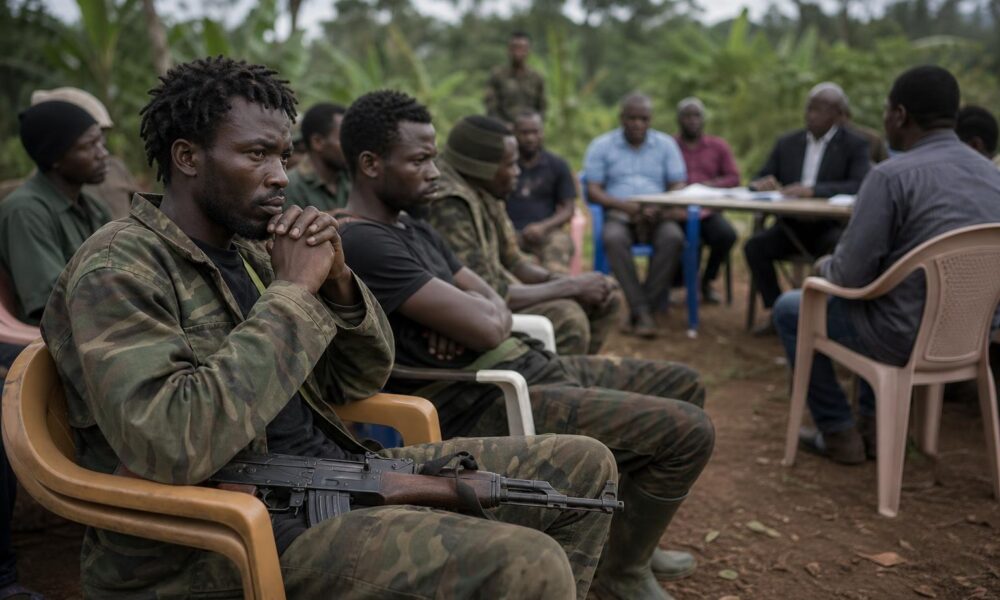
Former separatist fighters in Cameroon are facing a difficult choice between entering government-run disarmament, demobilisation and reintegration centres and rebuilding their lives without official support.
Table Of Content
Several former combatants interviewed in a report have instead pursued civilian work independently, citing fears of arrest, poor treatment and uncertainty about conditions in the centres. Others who joined the programme said the assistance they received was limited and did not address the psychological effects of the conflict.
Former fighters choose civilian work
Collins Mbah, who said he fought between 2016 and 2020, now works as a traditional healer. He said he left the armed struggle after fellow fighters turned against the people they had intended to protect.
Mbah said he would not join the government’s DDR programme, arguing that doing so would have amounted to betraying the people. “I don’t want to have anything to do with the government or the struggle any more. All I need now is peace of mind,” he said.
He said he moves between neighbourhoods in Douala to avoid being caught, while also maintaining that he remains on the government’s wanted list. That claim has not been independently verified.
Peter Mosongo, now a motorcycle taxi rider, said he quit after witnessing what he described as the indiscriminate killing of civilians by fellow fighters. He said fighters threatened him after he left and kidnapped his father in an effort to force him to return.
Mosongo said he avoided DDR because he feared he could end up in prison. He also referred to rumours that some people who surrendered had been killed secretly, a claim that has not been independently verified.
Richard Bende, who now teaches history and geography at a secondary school, said he left because he believed the rebellion had become a “scores-settling venture.”
Concerns inside DDR centres
Paul Mukete entered the DDR programme in Tiko, where he said he received training in poultry and pig farming. However, he said he did not receive psychological care.
Mukete said about 600 people were at the centre, but many later left out of frustration. He also said some former participants rejoined the conflict and were killed. Those claims, including his account of intelligence being shared with the military, have not been independently verified.
Fonbeh Hedwick Chia, founder of Living Vine Mental Health Services, said former fighters need psychological treatment for trauma linked to atrocities they committed or witnessed. He said DDR centres lacked adequate therapeutic support and criticised what he described as a greater government focus on publicity surrounding arrivals than on the former fighters’ welfare.
Chia estimated that about 800 people had renounced the armed struggle, although that figure has not been independently verified.
Government seeks more surrenders
Prime Minister Joseph Dion Ngute launched community dialogue initiatives in Buea in September and in Bamenda on October 15. Local leaders were encouraged to persuade fighters to surrender and enter DDR centres.
At the two events, officials presented 55 fighters as having renounced the armed struggle: 25 in the Southwest region and 30 in the Northwest.
The conflict began after protests in late 2016 by Anglophone lawyers and teachers over the use of Francophone magistrates and French-speaking teachers in English-speaking regions. A government crackdown was followed by an armed separatist campaign seeking independence for the Northwest and Southwest, whose supporters refer to the territory as Ambazonia.
Humanitarian and human rights organisations say the conflict has killed thousands, displaced hundreds of thousands and disrupted education. The Centre for Human Rights and Democracy in Africa said in October that the death toll could be as high as 10,000, although this remains a possible estimate rather than an independently verified total.
Chris Roberts, a political scientist at the University of Calgary, said the conflict was rooted primarily in decades of poor governance rather than language differences. He said continued firefights, ambushes and attacks showed that the war had not ended, despite repeated government claims to the contrary.
“There will not be a military solution to this war,” Roberts said.




No Comment! Be the first one.