
Bio Calls for Fairer Global Institutions at UN General Assembly
President Julius Maada Bio used Sierra Leone’s address to the UN General Assembly to call for stronger multilateral cooperation, reform of global institutions and greater fairness for Africa.
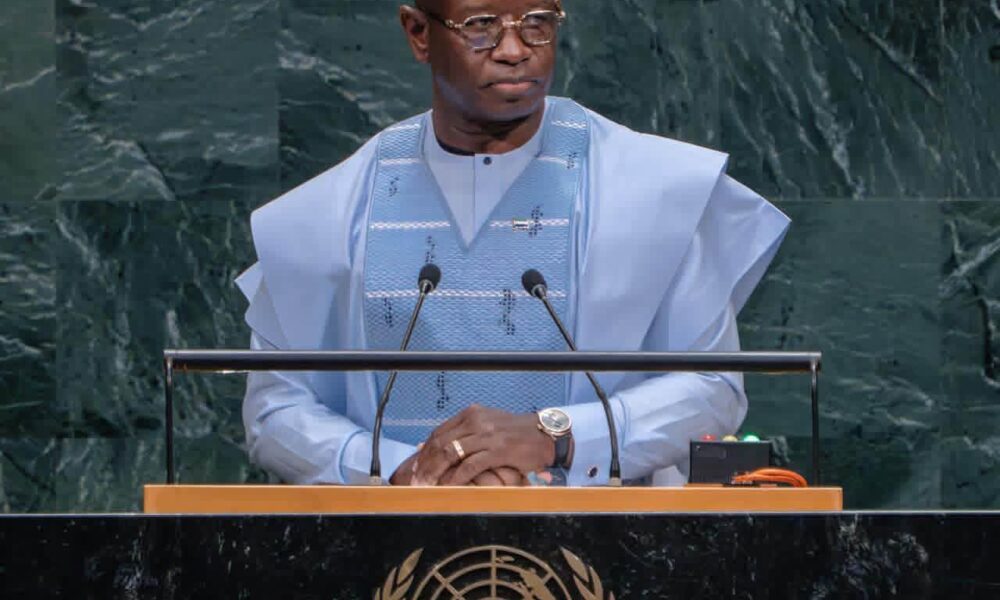
President Julius Maada Bio has called for renewed trust in multilateralism, stronger African representation in global institutions and fairer treatment for developing countries during Sierra Leone’s address to the general debate of the 81st United Nations General Assembly.
Table Of Content
Bio delivered the address on 22 September at the UN General Assembly Hall on behalf of the Government and people of Sierra Leone. He linked the country’s experience after its civil war to the value of international cooperation, noting that Sierra Leone completed disarmament and formally declared the conflict over nearly 25 years ago.
According to the president, the United Nations supported Sierra Leone through disarmament, elections and peacebuilding. He said the experience showed what cooperation can achieve when institutions work to support peace and national recovery.
Trust and international law
Bio said confidence in multilateralism depends on whether international promises are honoured, laws protect everyone equally and institutions respond to the needs of their populations.
“Trust is the currency of multilateralism,” he said, while arguing that international law should be applied consistently, regardless of geography or the identity of those accused.
The president also addressed armed conflicts and global military spending. He said military action may contain a threat but cannot by itself create lasting peace, and argued that national budgets should better reflect the connection between peace and development.
Bio cited global military expenditure of almost US$2.9 trillion in 2025, describing it as the 11th consecutive annual increase. The figures were presented as part of his argument for greater investment in peaceful development and conflict prevention.
Call for Security Council reform
A central part of the address focused on reform of the United Nations Security Council. Bio said the Council continues to reflect the world of 1945 and noted that Africa, despite being home to more than 1.6 billion people, has no permanent seat.
He said the Common African Position calls for no fewer than two permanent seats with the rights and privileges of permanent membership, including the veto if it is retained, as well as five non-permanent seats.
Sierra Leone served on the Security Council in 2024 and 2025. Bio said the country used that term to convene the Council’s first high-level debate on addressing the historical injustice against Africa and to co-draft Resolution 2807 on Youth, Peace and Security with Guyana.
He pledged that Sierra Leone would continue advancing the Common African Position as Coordinator of the African Union Committee of Ten.
Reparations, resources and development
Bio also called for changes to international financial institutions, including fairer voting power, stronger representation for developing countries, increased capital, affordable finance, concessional resources and more equitable debt treatment.
He said reparatory justice should involve acknowledgement, formal apology, the return of cultural heritage, fair redress and guarantees that abuses will not be repeated. Bunce Island, he noted, was a place from which thousands of Africans were forcibly transported across the Atlantic into enslavement, while Freetown later became a home for formerly enslaved and liberated Africans.
On natural resources, Bio said Africa’s critical minerals are essential to the global energy transition but that too much value is created outside the continent. “The green transition must not reproduce the extractive terms of the past,” he said.
He further argued that artificial intelligence could improve education, healthcare, agriculture and public administration, while warning that unequal access to infrastructure, knowledge and rule-making could widen disparities between countries.
Climate, education and international commitments
Climate change was another focus of the address. Bio described the effects on families in Shenge, where he said communities are watching the sea take land, fishing grounds and the graves of their ancestors. “Those who contributed least to the climate crisis are bearing some of its greatest costs,” he said.
The president highlighted Sierra Leone’s Prohibition of Child Marriage Act, enacted in 2024, and reaffirmed support for the rights and education of girls. He also pointed to the country’s Feed Salone programme to increase domestic food production and its Free Quality School Education programme to widen access to education.
Sierra Leone supports the UN80 Initiative and broader reforms intended to make the United Nations more effective, accountable and responsive. Bio also reaffirmed the country’s support for international law, UN peace operations, mediation, peacebuilding and international justice institutions.
He asked member states to support Sierra Leone’s nomination of Professor Charles Chernor Jalloh for election as a judge of the International Court of Justice on 3 November. Closing his address, Bio said the United Nations’ commitment to work “FOR ALL” should become the standard by which its work is measured.




No Comment! Be the first one.