
Rubio Defends US-First Foreign Policy at UN General Assembly
US Secretary of State Marco Rubio defended the Trump administration’s national-interest-focused foreign policy while addressing journalists in New York on Iran, Sudan, Ukraine, Venezuela, China, Gaza...

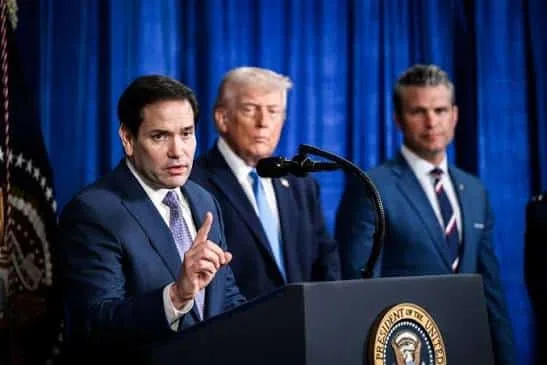
US Secretary of State Marco Rubio has defended the Trump administration’s emphasis on national interests, saying Washington will work with international institutions without allowing the international order to override US priorities.
Table Of Content
Rubio made the remarks on September 23 at the Palace Hotel in New York City, on the margins of the United Nations General Assembly, where world leaders were gathered. His press engagement covered a wide range of foreign policy issues, including Iran, Sudan, Russia and Ukraine, Cuba, Venezuela, China, Taiwan, Gaza, Yemen and wider Middle East security.
National interest at the centre
Rubio said the United States recognised the value of institutions such as the United Nations but would not subordinate its national priorities to the international system. “We will never put the international order above the interest of the United States,” he said.
He also argued that the international system had expanded beyond its intended mandate while struggling to resolve major conflicts and security challenges.
Iran and regional security
On Iran, Rubio said Tehran must not acquire a nuclear weapon. He said Washington remained open to an agreement and continued diplomatic communications through direct and indirect contacts involving mediators.
Rubio added that economic pressure would continue if Iran maintained policies the United States considered threatening. He also said the US would continue protecting commercial shipping in the Strait of Hormuz and accused Iran of attacking vessels in the area. Those accusations were presented as Rubio’s claims and were not independently established in the information available.
He reiterated US security commitments to Saudi Arabia and accused Iranian-backed groups of threatening civilian and energy infrastructure across the region.
Sudan and Ukraine
Rubio described the humanitarian situation in Sudan as catastrophic. He said the United States was working with the United Kingdom and other international partners to seek humanitarian access and safer areas for aid delivery.
He also said external actors supporting opposing sides were contributing significantly to the continuation of the Sudanese war, but he did not identify those actors.
Regarding Russia and Ukraine, Rubio said Washington was interested in exploring a limited ceasefire covering energy infrastructure and grain-related issues. He said the wider war would ultimately require a negotiated settlement rather than a purely military conclusion. He did not indicate that such a ceasefire had been reached.
Cuba, Venezuela and China
Rubio criticised the Cuban Government and said Washington wanted political and economic changes on the island. However, he said the United States preferred political and negotiated means rather than military force, and declined to speculate about possible future US actions.
On Venezuela, Rubio said the Trump administration was supporting efforts aimed at economic stabilisation and a political transition that would eventually lead to elections. He said economic recovery and political reform needed to advance together to create sustainable democratic institutions. Rubio also linked those conditions to the possible return of millions of Venezuelans living abroad.
Rubio described engagement between Washington and Beijing as necessary despite disagreements over trade, supply chains, critical minerals and security. “The relationship between the United States and China will define the 21st century,” he said.
He said decisions on US military equipment sales would need to consider American defence requirements, existing stockpiles and the ability of US industries to replenish equipment, alongside responsibilities in the Indo-Pacific, Europe and other regions.
Gaza and Western Hemisphere cooperation
Rubio said reconstruction and long-term political stability in Gaza were priorities, while warning that rebuilding the territory would be a long-term undertaking. He said donor countries were expected to make financial commitments toward reconstruction.
He also described the Shield of the Americas as a framework for Western Hemisphere cooperation on transnational organised crime, security, economic cooperation and supply chains. The initiative involves countries with differing domestic procedures for designating criminal organisations as terrorist groups.



No Comment! Be the first one.