
Bio Announces Three Commitments to End Child Marriage in Sierra Leone
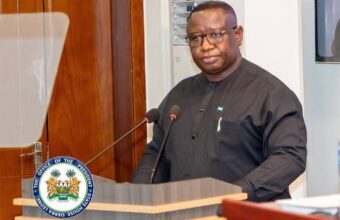
President Julius Maada Bio has announced three national commitments to strengthen Sierra Leone’s efforts to eliminate child, early and forced marriage.


President Julius Maada Bio has announced three further national commitments aimed at strengthening Sierra Leone’s efforts to eliminate child, early and forced marriage.
Table Of Content
Bio made the announcement at a high-level event in New York on 23 September, held on the margins of the 81st Session of the United Nations General Assembly. He also praised First Lady Fatima Bio for her advocacy and determination in the global campaign against child marriage.
Three national commitments
The commitments include developing a comprehensive National Action Plan to eliminate child, early and forced marriage; improving implementation of Sierra Leone’s Prohibition of Child Marriage Act; and beginning progress reporting on 27 November 2026, the first International Day for the Elimination of Child, Early and Forced Marriage.
The government’s implementation efforts are expected to focus on enforcement, birth and marriage registration, education, public awareness and engagement with communities, particularly those that are vulnerable or difficult to reach. The source report does not provide a timeline, budget or specific reporting mechanism for the National Action Plan.
Bio also called on governments and development partners to provide sustained financing for girls’ education and protection, as well as for the effective enforcement of national laws.
Sierra Leone-led international initiative
The commitments follow the adoption by consensus on 4 September 2026 of a Sierra Leone-led resolution establishing 27 November as the International Day for the Elimination of Child, Early and Forced Marriage. Sierra Leone was the main sponsor, with 84 countries joining as co-sponsors. Zambia and Canada were acknowledged for earlier work that helped lay the foundation for the initiative.
Bio described the resolution’s adoption as a historic achievement for girls worldwide and a milestone in Sierra Leone’s leadership on the issue. He said the international day would provide a permanent platform to sustain attention, mobilise action and assess progress towards ending child, early and forced marriage.
“At a time of deep global division, every Member State agreed that no girl should lose her childhood, education or future through marriage,” Bio said.
Law and continuing challenges
According to the president’s remarks, Sierra Leone’s Prohibition of Child Marriage Act sets 18 as the minimum age of marriage without exception and provides accountability for people who facilitate child marriage. Bio said he signed the legislation into law in July 2024.
He said child marriage should not be treated as a private family matter, describing it instead as a rights violation with serious consequences for national development. He also said more than 640 million girls and women alive today were married in childhood.
“These numbers represent a girl whose education may have ended, whose health may have been placed at risk and whose choices were taken away before she was old enough to make them,” he said.
Bio linked the issue to Sustainable Development Goal Target 5.3 and said resources must match international commitments. He said progress should ultimately be measured by the number of children protected from early marriage, kept in school and given the freedom to determine their futures.
First Lady Fatima Bio delivered the vote of thanks, bringing the high-level gathering to a close.




No Comment! Be the first one.