
Kerry James Marshall Retrospective Opens in Paris
Kerry James Marshall’s travelling retrospective, The Histories, has opened at the Musée d’Art Moderne de Paris, where it will remain until January 2027.

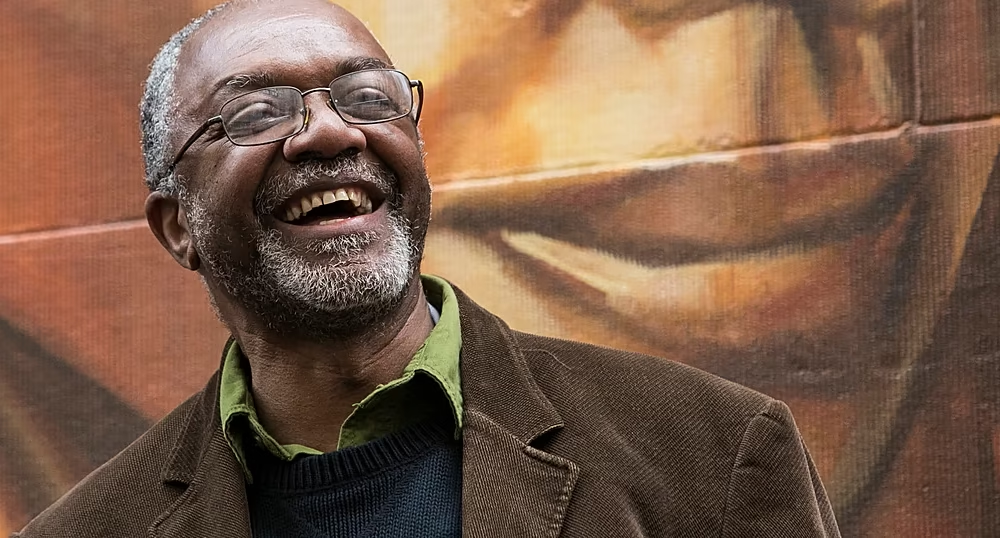
A major retrospective of American artist Kerry James Marshall has opened at the Musée d’Art Moderne de Paris, bringing together work that challenges traditional representations of Black people in Western art.
Table Of Content
Titled The Histories, the travelling exhibition opened on Wednesday and is scheduled to remain in Paris until January 2027. It previously received rave reviews in London and Zurich.
Black figures at the centre
Marshall, 70, is known for paintings that place Black people in ordinary settings while drawing on the visual language of classical European portraiture. His work has been described as making a significant contribution to the presence of Black figures in Western galleries.
Marshall has rejected the idea that he should be treated as a trailblazer who first introduced Black people into art. “It’s not a reasonable assumption to believe that there were no black people in pictures before I had some kind of revelation that they should be there,” he said.
He has cited American artist Charles White as a mentor, while also pointing to the work of Hieronymus Bosch and statues from Ancient Greece as examples of earlier artistic traditions that included Black figures.
Marshall’s paintings have helped bring Black portraiture to a broader mainstream audience, according to the exhibition’s coverage. Collectors named in connection with his work include Sean Combs and Jay-Z. The artist is also reported to hold the auction record for a living Black artist, although the specific sale was not identified.
Works shaped by history and daily life
The Paris presentation includes De Style, painted in 1993, and Black Painting, completed in 2003.
De Style shows clients inside an African American hair salon looking towards a calendar displaying the date of the 1991 beating of Rodney King by police officers in Los Angeles. The scene connects an everyday social setting with a moment that became a major reference point in the country’s discussion of policing and race.
In Black Painting, a barely visible couple embraces in a dark bedroom. A book by Angela Davis rests on a bedside table, adding another historical and political layer to the intimate scene.
Marshall has explained that his use of jet-black skin tones is both aesthetic and rhetorical. “The first thing you see is that they’re black figures, but then you have to move on from that to everything else that’s happening in the picture,” he said.
He has also described blackness as “a rhetorical device, not just as a marker of a certain kind of identity, but to create an aesthetic framework in which people can think about blackness as more than just a simple dead end.”
“Blackness is not a dead end, it’s not a non-colour. It’s something that can be as complex and as rich as any other colour that one might use to make a painting,” Marshall said.
From Birmingham to Los Angeles
Marshall was born in Alabama and spent his early years in racially segregated Birmingham. His family moved to Los Angeles in the 1960s in search of greater opportunities.
He later lived in predominantly Black and poor South Central Los Angeles, where he witnessed the rise of organised gang violence and the 1965 Watts riots. Those experiences form part of the background to an artistic practice that repeatedly combines personal, social and art-historical subjects.
Marshall held his first major retrospective at the Museum of Contemporary Art Chicago approximately ten years before the Paris report. The Histories now extends that examination of his work to a European audience.





No Comment! Be the first one.