
Bah Calls for Locally Produced School Meals to Drive Sierra Leone’s Self-Reliance
Sierra Leone’s Chernor Bah has urged countries to view school feeding as part of a wider investment in education, agriculture, youth employment and national self-reliance.

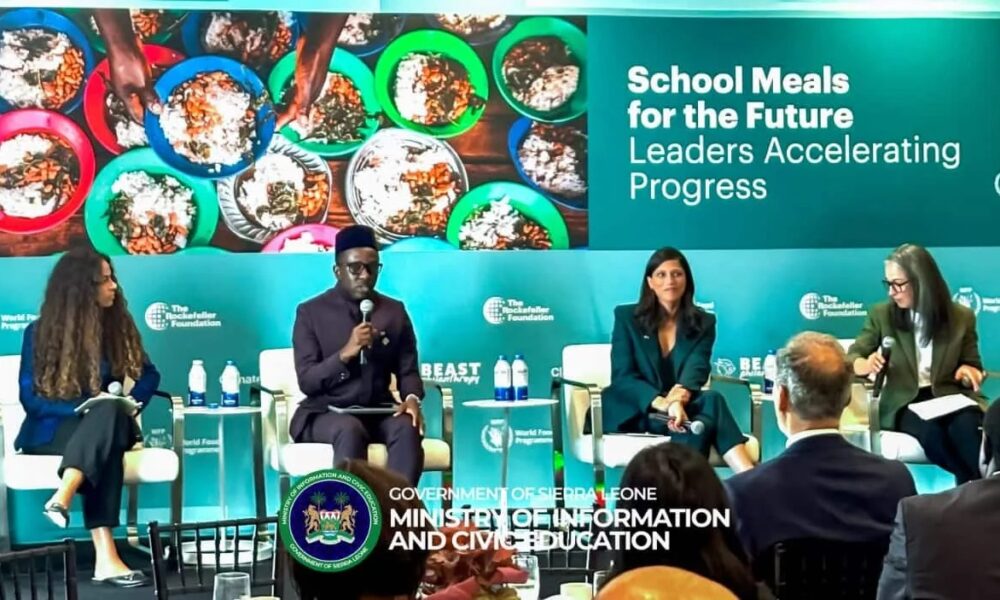
Sierra Leone’s Minister of Information and Civic Education, Chernor Bah, has called for school feeding to be integrated with education, agriculture, nutrition, youth employment and local enterprise.
Bah made the case at the high-level event School Meals for the Future: Leaders Accelerating Progress, held in New York on September 21 on the margins of the 81st Session of the United Nations General Assembly. The gathering was co-hosted by the World Food Programme and The Rockefeller Foundation.
Participants examined how locally produced school meals could support children’s learning while strengthening national food systems. The event brought together government officials, international development leaders, philanthropists and influential content creators.
Linking education and food production
Bah connected Sierra Leone’s Free Quality School Education programme with the Feed Salone initiative, arguing that progress in expanding access to education should be matched by investment in feeding children at school.
“But once we made that bet on education, we also had to bet on feeding children in school,” Bah said. He added: “And once we commit to feeding children in school, we must confront the bigger national question: can we feed our own country?”
According to Bah, locally sourced meals could provide dependable markets for Sierra Leonean farmers and open employment and business opportunities for young people across the agricultural value chain. He identified possible roles for young people as farmers, processors, aggregators, transporters, technology providers and entrepreneurs.
He said school feeding should not be treated only as a stand-alone social programme, but as a point where education, agriculture, nutrition, employment, enterprise and national self-reliance meet.
“These are not disconnected facts,” Bah said. “We have millions of young people who need opportunities, farmers who need reliable markets and children who need nutritious meals. Properly designed, these are not three separate problems. They can become one integrated solution.”
Feed Salone and civic responsibility
Bah described Feed Salone as an initiative aimed at strengthening Sierra Leone’s productive capacity to feed its population, create employment and contribute to economic growth. He also said it forms the second pillar of the country’s National Civic Education Strategy.
The initiative is associated with the message, “Grow what we eat. Eat what we grow.” Bah said the message carries a civic meaning as well as an agricultural one.
“When a young Sierra Leonean grows food, builds an agribusiness, chooses locally produced rice or develops technology that connects farmers to schools, that is not only economic activity. It is civic action,” he said.
Bah also recalled his own experience of going to school hungry and described the difficult choices faced by families deciding between food and transport to school. He said the questions facing children include whether they can reach school, eat, concentrate and imagine a future beyond the present.
He cited Sierra Leone’s young population, arable land and agricultural participation as reasons for connecting school meals to domestic production. The figures he referenced included a median population age of about 19, more than 55% of land described as arable and close to 60% of the population involved in some form of agriculture.
“We bet on education. So we had to feed children in school. Now we must bet on feeding the country and we must do it locally,” Bah said.
He concluded that a locally produced school meal could help keep a child in school, give a farmer a reliable market, create an opportunity for a young person and strengthen confidence in Sierra Leone’s ability to produce more of what its citizens consume.
Bah joined a panel with Éléonore Caroit and Sage Lenier that explored influence, civic action and youth leadership in tackling hunger and improving access to education.


No Comment! Be the first one.