
South African women runners tighten safety measures after East Rand killings
Women runners across South Africa are changing their routines after nine women were found murdered in Johannesburg's East Rand over two months.

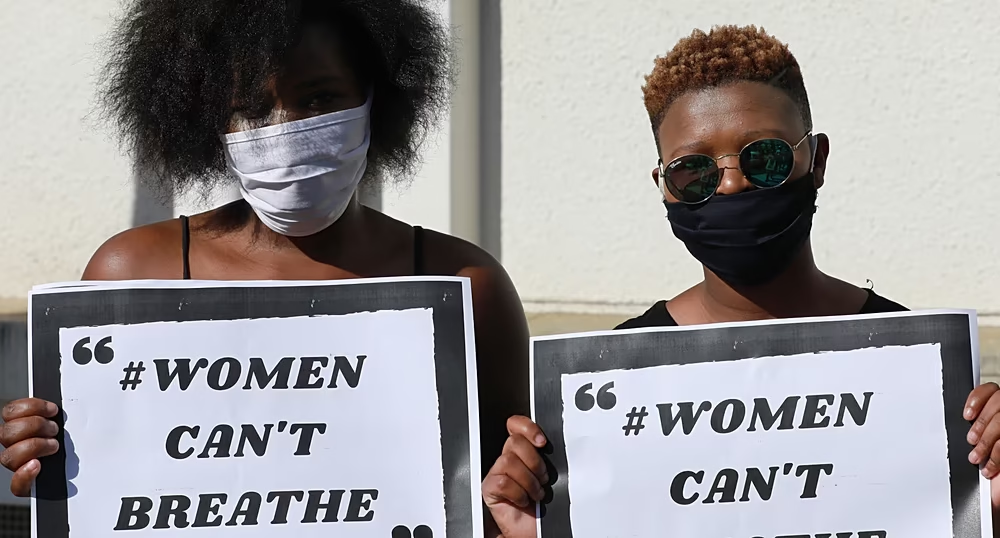
Women runners across South Africa are taking additional precautions after nine women, including runner Elizabeth Moselakgomo, were found murdered in Johannesburg’s East Rand over a period of two months.
Table Of Content
The deaths have led women to alter when and where they exercise, avoid isolated routes and carry items such as pepper spray or knives. Vigils, protests and solidarity runs have also been held in locations ranging from Kempton Park to Cape Town.
Runners change their routines
Moselakgomo, 38, left her home on September 9 to go running and did not return. Her body was found three days later near Kempton Park. Eight other bodies were discovered in the same area since mid-July. Some of the victims were found partially naked and battered.
Nancy Masha, 39, said Moselakgomo’s killing had traumatised her and prompted her to carry pepper spray and a knife when running.
“Our runner was brutally killed. I needed a way to protect myself because I am a woman and also a runner,” Masha said.
She said runners often exercise in difficult places and at unsuitable times, but added: “I won’t stop running.”
Chulumanco Mahamba said she had changed her walking habits and now carried pepper spray. “It feels unfair that we have to change our routines, but I do feel safer when I’m carrying pepper spray,” she said.
Other women have chosen to exercise only in controlled environments. Babalwa Melitafa, 46, said she would not run alone outside the sports oval in a gated community because of what had happened.
Hlompho Matji, 47, a data analyst and runner, questioned whether carrying weapons necessarily made women safer. “We are not trained to use those things,” she said, warning that pepper spray or a knife could be used against someone who was overpowered.
Some women have also avoided secluded areas, run in gated spaces and shared their live locations with relatives or friends.
Police investigations and public response
South African police have arrested three people in connection with the Kempton Park killings. A man is in custody over one murder, while two women have been charged in relation to another. Police have not said that the cases are linked.
Authorities are investigating whether a serial killer or killers may be responsible, but that possibility has not been established. The source of the report also does not state whether the death of another woman found in Soweto was connected to the Kempton Park cases.
The Soweto body was discovered on September 20, wrapped in a duvet. The finding added to fears among women, although details surrounding that case remain limited.
Andiswa Siwela, 43, a filmmaker, runner and mountain hiker in Cape Town, said the killings had affected women far beyond the East Rand.
“We want to be free. We want to do things without fear; we want to live,” she said.
Nkululeko Molosi, captain of the Sunrise Athletics Club, said runners should not have to “choose between our passion for the sport and our personal safety.”
National concern over gender-based violence
South Africa’s Gender-Based Violence Command Centre received 6,782 distress calls between September 1 and 16, according to the government. That amounted to an average of 424 calls a day and represented a 21 percent increase compared with the same period in August.
Gender-based violence remains a serious national concern, despite government pledges to address it and its declaration as a national disaster the previous year.
President Cyril Ramaphosa described the suffering of South African women as “a national shame” during a public holiday gathering. He said women had the right to walk the country’s streets at any hour without fear.
For runners like Masha, however, that freedom remains constrained by the need to assess routes, times and personal protection before leaving home.


No Comment! Be the first one.