
Amnesty Sierra Leone Calls for Notification System for Public Processions
Amnesty International Sierra Leone has proposed replacing the police approval system for public processions with a notification-based framework, alongside safeguards for peaceful assembly and...

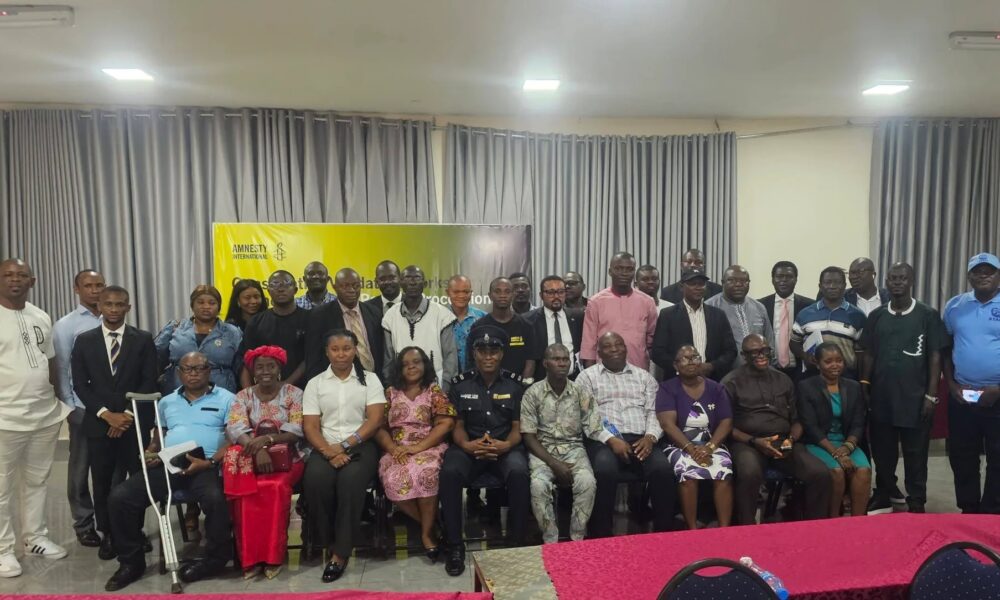
Amnesty International Sierra Leone has proposed replacing the police approval-based system for public processions with a notification framework, following a nationwide consultation on Part III of the Public Order Act of 1965.
Table Of Content
The organisation presented the consultation findings and proposed reforms at a validation workshop held on Tuesday, September 29, 2026, at the New Brookfields Hotel in Freetown.
Part III of the law regulates public processions and demonstrations. The consultation examined how those provisions are enforced and considered possible reforms, including approaches drawn from comparative practices and international standards.
Concerns over police discretion
The consultation was conducted by Amnesty International Sierra Leone’s legal consultants in Freetown, Makeni, Kenema, Kambia and Bo. The workshop brought together policymakers, parliamentarians, civil society organisations, political parties, trade unions, universities, traditional leaders, youth organisations and other stakeholders.
Findings presented by Amnesty International Sierra Leone identified concerns about the discretionary power of police to approve or prohibit public processions. The consultation report also highlighted the absence of clear definitions for terms such as “procession”, “protest” and “demonstration”.
According to the findings, civil society stakeholders consulted in Freetown and the provinces supported moving away from the approval-based model towards a notification-based system. State institutions generally defended the existing arrangement but acknowledged the need for greater clarity and accountability.
Provincial stakeholders also raised concerns about access to police leadership in Freetown. They reported inconsistencies between decisions taken at central level and the conduct of lower-ranking officers in the field.
Proposed legal safeguards
Amnesty International Sierra Leone’s proposed model would introduce a fixed notice period, although the organisation did not specify the length of that period. Under the proposal, a procession for which notice has been given would be allowed to proceed unless authorities issue a lawful and reasoned objection.
The organisation has also proposed that any restrictions on peaceful assembly should be based on criteria that are clear, objective, necessary and proportionate. Its recommendations include making those criteria subject to judicial review and creating an expedited process for challenging restrictions in court.
Other proposals call for decentralising the notification process to regional and local authorities, as well as establishing independent oversight of police conduct. The recommendations also include removing imprisonment as a sanction for failing to provide notification.
Amnesty International Sierra Leone further proposed seeking an interpretation from the Supreme Court on the meaning of “notification” as used in Part III. The consultation materials did not set out a specific process or timeline for pursuing that interpretation.
Balancing assembly and public safety
Solomon M. Sogbandi, Executive Director of Amnesty International Sierra Leone, was identified with the position that restrictions on peaceful assembly should meet clear, objective, necessary and proportionate standards.
Jeremy Simbo, Acting Executive Director of the Centre for Accountability and Rule of Law, said in opening remarks that the state has a responsibility to prevent violence and disorder while ensuring public spaces are used safely and responsibly.
The recommendations are subject to further stakeholder review and validation before the report is finalised. The consultation also considered notification-based systems, risk assessments, dialogue between organisers and police, and independent oversight as part of broader legal and institutional reform options.




No Comment! Be the first one.