
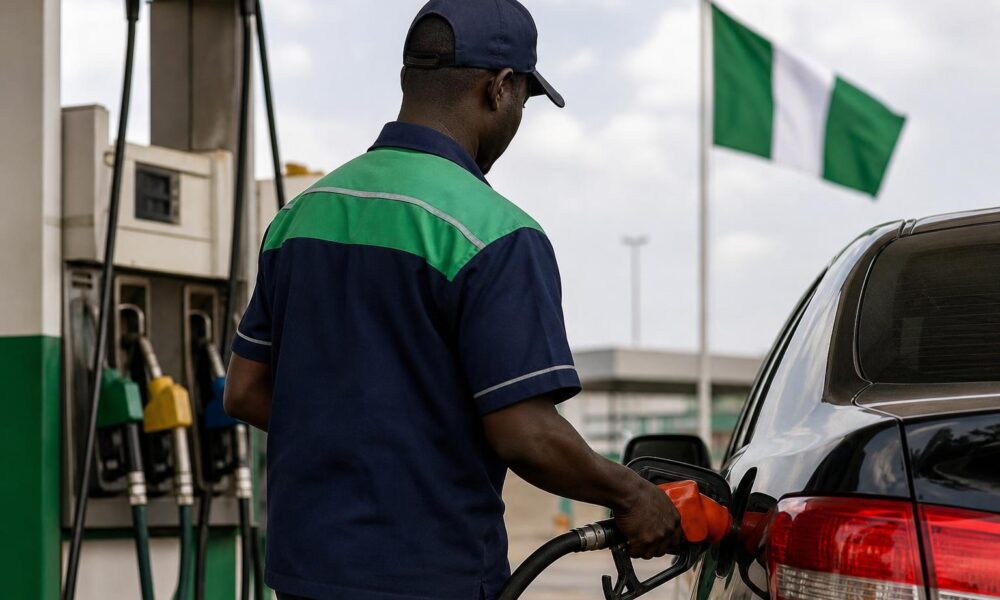
Nigeria has announced a temporary discount on petrol sold through NNPC Limited, alongside plans for a longer-term mechanism to limit pump-price increases as fuel costs put pressure on households and businesses.
Finance Minister Taiwo Oyedele said the discount would apply for an initial 30 days and would give priority to public transport operators across the country. He made the announcement to journalists in Abuja on Thursday.
Oyedele said the measure was intended to ease the impact of energy shocks without restoring the broad fuel subsidy removed by President Bola Tinubu’s government.
“We are offering a discount on petrol dispensed by NNPC Limited for the next 30 days, in the first instance, with priority for public transporters nationwide,” he said.
The minister did not disclose the discounted selling price. He said the arrangement should not be regarded as a subsidy because the government would sell petrol at cost.
“It’s not a subsidy. The government is just saying we sell to you at cost,” Oyedele said.
Proposed ceiling under price modulation
The government also plans to introduce what Oyedele called “price modulation” to reduce volatility in petrol prices. He said officials were negotiating a ceiling of 1,350 naira per litre, with the proposed limit subject to monthly review.
Under the proposed arrangement, refiners and importers would carry costs when prices rise above the ceiling and recover those amounts later when crude prices or exchange rates make that possible. Oyedele described the policy as neither a subsidy nor a price control.
“Pump prices should not have to follow every swing in global crude or the exchange rates,” he said.
Petrol prices have risen to about 1,400 naira per litre from 830 naira before the war in the Middle East, according to the source report. Nigeria is Africa’s top oil producer and is home to the continent’s largest refinery, owned by Aliko Dangote. NNPC Limited operates a large network of petrol stations nationwide.
Opposition criticism
The Nigeria Democratic Congress criticised the measures as an “attempt to re-introduce petrol subsidy through the backdoor”.
Atiku Abubakar also questioned what would happen when the initial discount period ended. “What happens on Day 31? Nigerians wake up to the same brutal prices, the same punishing transport fares and the same rising cost of food,” he said in a social-media statement.
Abubakar proposed what he described as a “targeted” subsidy based on “capped and budgeted production support tied to fuel refined in Nigeria”.
Tinubu removed a major fuel subsidy and floated the naira after taking office in 2023. Economists have broadly supported the reforms, according to the source report, but the changes have also increased living costs and contributed to wider hardship.
Cheap petrol had previously helped keep down the cost of food and other goods and was regarded by some Nigerians as an important government benefit. Tinubu has argued that ending the subsidy prevented a deeper fiscal crisis because the programme had become too costly to sustain.
The president is seeking a second term. Peter Obi and Atiku Abubakar are identified as opposition presidential candidates, with the election date given as January 16. The government has not established whether the temporary petrol discount will continue beyond its initial 30-day period.





No Comment! Be the first one.