
Eliud Kipchoge Ends Marathon Winning Drought with Melbourne Victory
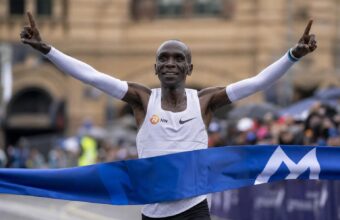
Eliud Kipchoge won in Melbourne in 2:09:10, finishing two seconds inside the race record and claiming his first marathon victory since Berlin in 2023.


Eliud Kipchoge returned to the top of the marathon podium on Sunday, winning in Melbourne, Australia, in 2 hours, 9 minutes and 10 seconds.
The victory was the Kenyan’s first over the distance since his triumph in Berlin in 2023. His time was also two seconds faster than the race record.
Kipchoge, a two-time Olympic champion and former world record-holder, separated from the field inside the final 10 kilometres. The course included sections of the Formula One circuit at Albert Park before concluding inside the Melbourne Cricket Ground.
He slowed as he entered the MCG and waved to spectators along the finish area.
“On the course, it was really wonderful; I enjoyed seeing people standing, cheering, and shouting my name,” Kipchoge said.
He described the route as unlike a conventional marathon because it combined the Albert Park motor-racing track with a finish at a cricket venue.
“It was actually different – running on a beautiful course, but also running on the Formula One track, and above all else, finishing on a cricket ground,” he said.
Australian runners complete men’s podium
Australian runner Thomas Do Canto finished second in 2:10:35, while compatriot Reece Edwards took third in 2:14:33.
In the women’s race, New Zealand’s Camille French won in 2:28:25. Australia’s Sinead Diver placed second in 2:28:49, followed by Ireland’s Nichola Sheridan in 2:29:13.
Part of seven-continent campaign
Melbourne was the third stop in Kipchoge’s World Tour, following races in South Africa and Brazil. The campaign is intended to raise funds for causes he supports.
Kipchoge announced in 2025 that he planned to run marathons on all seven continents over two years, including Antarctica.
At 41, Kipchoge said he remains capable of competing against younger athletes.
“I believe that my body is still peaking – still able to compete with the next generation,” he said.
He added that he increased the pace after 30 kilometres to test whether he could challenge the race record, saying the strategy worked.




No Comment! Be the first one.