
Ebola outbreak expands in eastern DRC as Kenya reports imported case
The Ebola outbreak in the Democratic Republic of the Congo has reached a new health zone in North Kivu, while Kenya investigates its first imported Bundibugyo virus disease case.


The Ebola outbreak in the eastern Democratic Republic of the Congo has expanded to Alimbongo health zone in North Kivu, where four confirmed cases, including two deaths, had been recorded as of October 6, according to the World Health Organization.
Table Of Content
The WHO said Alimbongo had reported Ebola cases for the first time in an October 8 update. The outbreak is caused by Bundibugyo virus, a species of Ebola virus.
Across the DRC, cases had been reported in 64 health zones covering seven provinces. The WHO recorded 8,728 confirmed cases, 4,205 confirmed deaths and 2,269 recoveries as of October 6, putting the crude case fatality ratio at 48.2 percent.
Imported case confirmed in Kenya
Kenya confirmed its first imported case of Bundibugyo virus disease on October 6. The patient was a Kenyan citizen who had been living in the DRC, became ill there and received treatment at several health facilities before travelling to Kenya through Uganda.
According to the WHO, the patient travelled by road to Kampala, then flew to Nairobi and arrived on October 3. The patient was isolated, tested positive and died on October 5 despite supportive treatment.
Kenyan authorities identified 28 contacts, including family members and healthcare workers. The WHO also reported efforts to trace passengers and crew members who were on the flight to Nairobi.
Kenya and Uganda have initiated contact tracing and enhanced surveillance. A preliminary laboratory result for a suspected Ebola case in Wajir County was negative on October 8, according to the county governor, although monitoring continued.
Pressure on treatment capacity
Doctors Without Borders, also known as MSF, said North Kivu accounted for nearly 40 percent of newly confirmed cases nationwide in an update dated October 5. That compared with 24 percent at the end of August.
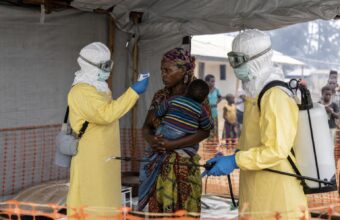
MSF also reported that 34 percent of confirmed Ebola patients were being treated in non-specialised health facilities as of September 28. The organisation said dedicated treatment centres lacked sufficient beds and that delays in diagnosis meant some patients were treated in facilities not equipped to manage Ebola.
Stephanie Hoffmann, coordinator of MSF’s Ebola treatment centre in Butembo, said treatment capacity had been under pressure for weeks.
“Because there are not enough beds available, we are sometimes forced to refer confirmed Ebola patients elsewhere, despite the significant risk this poses to the wider community,” Hoffmann said. “In addition, standards of care in some peripheral facilities do not always meet the requirements for Ebola treatment. This is extremely concerning.”
Contact tracing and community concerns
The WHO said response teams were following up 23,741 of 29,535 identified contacts as of October 4. That represented 80.4 percent, below the response target of at least 85 percent.
Daniel Makasi Levergénois, founder of Watoto Radio, said insecurity and misinformation were undermining containment efforts. He said rumours and misconceptions had contributed to reluctance among some residents to cooperate with response teams.
Alberto Lusenge, a community leader in Beni, warned that mistrust could discourage residents from reporting symptoms or working with health workers. He said North Kivu could become a greater focus of the outbreak without stronger cooperation from local communities.
The Africa Centres for Disease Control and Prevention has called for a community-centred response based on active case finding, systematic contact tracing, daily follow-up of exposed people and sustained engagement with local communities.
Jean Kaseya, director-general of Africa CDC, said rapidly locating and monitoring exposed people was essential. “We will only bring this outbreak under control once the last chain of transmission has been broken,” he said.
The WHO says there are no approved vaccines or specific treatments for Bundibugyo virus disease. Early detection, supportive care and infection prevention remain central to the response.



No Comment! Be the first one.