

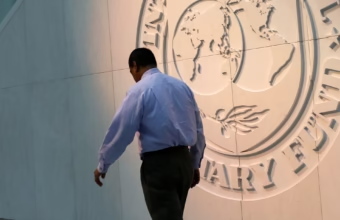
The International Monetary Fund has improved its outlook for African economic growth while warning that falling development assistance is reducing the region’s ability to withstand future crises.
Table Of Content
Speaking at an IMF and World Bank meeting in Bangkok on Thursday, Zeine Zeidane, head of the IMF’s Africa department, said African economies had managed to weather the energy crisis brought on by the Iran war.
The IMF expects Africa’s economy to grow by 4.5% this year and accelerate to 5% in 2027. The forecast for this year is slightly higher than the Fund’s earlier estimate.
Aid decline raises vulnerability
Zeidane said development assistance to Africa had fallen sharply last year and was expected to decline by a further 12% this year. He warned that the reduction was leaving countries with limited capacity to respond to another major disruption.
“That leaves the region with little room to absorb another shock,” Zeidane said, pointing to renewed interruptions to energy supplies, increased global risk aversion and a strong El Niño as developments that could intensify economic pressures.
He added that persistent conflict and insecurity were weighing on regional economies and threatening food security in some areas. Despite those risks, many African countries have introduced reforms aimed at strengthening their economic resilience.
“Overall risks remain firmly tilted to the downside and the challenges are significant, but so is the region’s ability to adapt and move forward,” Zeidane said.
Minerals offer opportunity and risk
Some African economies are benefiting from rising prices for critical minerals used in advanced technologies, including artificial intelligence. IMF officials urged governments to manage those revenues carefully and use them to improve competitiveness rather than relying solely on raw-material exports.
Guinea’s Minister of Economy, Finance and Budget, Mariama Cire Sylla, said the railway linking mines in Simandou to the coast formed part of a long-term economic transformation programme. Guinea has substantial mineral resources, but half of its population lives in poverty, and the government is relying on the Simandou iron ore project to help strengthen the economy.
“How can we leverage mining to really develop other sectors and diversify the economy?” Sylla asked. She said scarce financial resources made it necessary to establish investment centres and growth poles.
Across West Africa, governments have been changing mining laws, restricting exports of unprocessed commodities and seeking larger state ownership in the sector. Guinea and Ghana have recently restricted gold exports, while Mali has said it is building a gold refinery with Russia’s Yadran Group. Ivory Coast has announced plans to open a refinery the following year.
Burkina Faso, described as a major gold exporter, has opened its first gold refinery. Its military-led government is pursuing greater economic sovereignty after breaking with traditional Western partners.
Burkina Faso’s Finance Minister Aboubakar Nacanabo said African countries needed to capture more value from strategic resources such as gold, cobalt and copper.
“The first step is to create the value chain,” Nacanabo said, adding that the objective was “to create opportunity for our youth.”
AI could support long-term growth
The IMF also encouraged African countries to adopt artificial intelligence to improve productivity. Zeidane said the Fund estimated that the adoption, adaptation and scaling of AI could raise economic growth by more than 4% over 10 years.
He identified agriculture, education, health and government services as areas where the technology could make a difference, particularly where productivity and yields remain low. However, the longer-term effects of AI on African economies remain uncertain.



No Comment! Be the first one.