
Conflict and Aid Shortfalls Fuel Congo’s Deadliest Ebola Outbreak
The Democratic Republic of Congo is confronting its largest and deadliest Ebola outbreak, with conflict, displacement and limited resources obstructing efforts to trace infections and reach patients.
The Democratic Republic of Congo is facing what has been described as its largest and deadliest Ebola outbreak, with the rare Bundibugyo virus spreading amid armed conflict, mass displacement and severe gaps in healthcare capacity.
Table Of Content
The outbreak was first detected in Ituri province in May 2026 and has since reached eight of the country’s 26 provinces. The source report records more than 11,000 infections and 5,300 deaths, making it the second-worst Ebola outbreak globally after the West African epidemic of 2014 to 2016.
Experts cited in the report believe the virus may have circulated undetected in Ituri as early as February, although that has not been confirmed. Cases have also been reported across borders in Uganda, Kenya and Nigeria.
Insecurity obstructs the response
Violence has repeatedly disrupted screening, contact tracing, surveillance and access to treatment. Anna Halford, Médecins Sans Frontières’ coordinator for the response across the DRC, said physical access to some affected areas had been severely compromised.
“The physical access to some of the affected areas is severely compromised,” Halford said, describing the difficulty of delivering supplies and maintaining health operations in insecure locations.
An attack in Cantine on November 6 killed at least 33 people, according to authorities and civil society groups, and burned more than 50 houses. Around 180 patients fled a health post during the violence, including numerous suspected Ebola cases and at least one confirmed case. The flight of those patients left a high-risk group scattered and difficult to monitor.
The source report says local authorities blamed the attack on the Allied Democratic Forces rather than M23, but that attribution was not independently verified.
The eastern DRC conflict has continued for nearly three decades. The region is home to approximately 100 armed groups, while more than five million people are displaced across Ituri, North Kivu and South Kivu. The prolonged crisis has also weakened health infrastructure and made it harder for medical teams to reach communities.
Patients and health workers face severe conditions
Nearly two-thirds of reported Ebola-related deaths during the month before November 12 occurred in communities rather than treatment centres, according to MSF. That pattern has made the outbreak more difficult to track and contain.
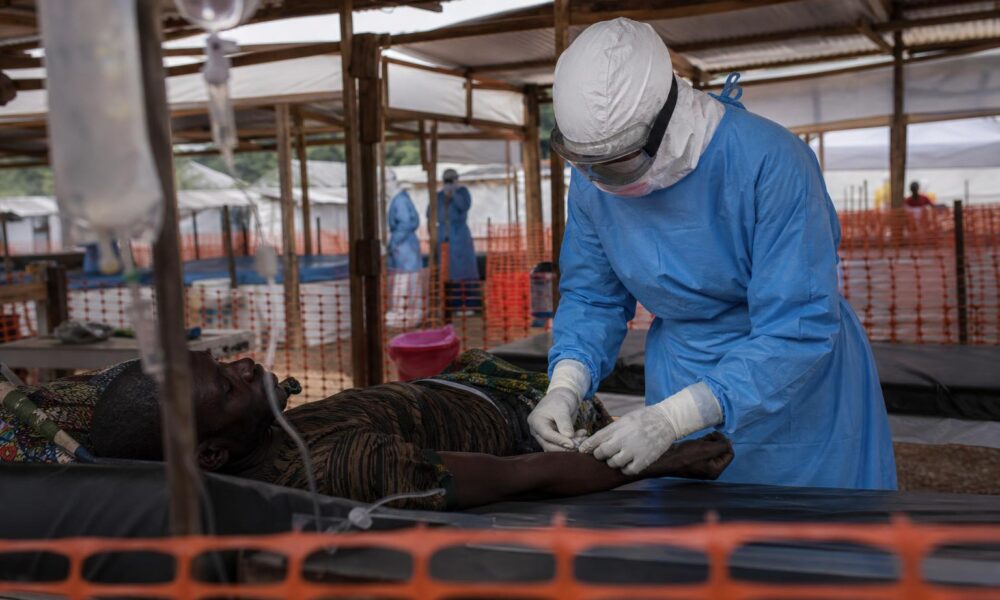
At the Elikya Ebola treatment centre in Bunia, patients and caregivers worked under demanding conditions. Emily Vandamme, an MSF doctor, described the strain of operating in protective equipment, where health workers could remain inside the isolation area for no more than 90 minutes at a time.
One patient, 17-month-old Bahati Prince, initially appeared to recover before later dying, apparently after a sudden drop in blood sugar. “Ebola is horrifically ruthless,” Vandamme said.
The Elikya centre closed on October 31 after MSF redeployed teams and resources to other affected areas. Ebola survivors have also been recruited to care for infected patients, including children who arrived without family members. Alex Bonane Murutsi, a Congolese physician at the Bunia treatment centre, said some children had lost nearly their entire families.
Murutsi said community trust was essential to the response. “You don’t earn people’s trust by simply telling them what to do; you have to talk to them,” he said. Resistance to safe burials, stigma against survivors and violence against health workers have all complicated prevention efforts.
Funding and surveillance gaps
The response has also been affected by declining international aid and shortages of staff, transport and protective equipment. Jeremy Konyndyk of Refugees International linked the dismantling of the United States Agency for International Development to delayed detection, while Alain Casseus of Partners in Health said other major donors had reduced support at the same time.
Javid Abdelmoneim, MSF’s international president, said many front-line responders remained without adequate resources despite pledged funding. He cited untrained and unpaid health workers, ambulances without fuel and surveillance teams absent from the field.
According to Abdelmoneim, only 9 percent of Ebola patients treated by MSF teams in Ituri had previously been identified as contacts by the surveillance system. “Despite the vast amounts of money provided for the response, many front-line responders are left trying to contain the outbreak with empty hands and empty pockets,” he said.
New pledges from G20 foreign ministers and major donors in September brought total global commitments since May to about $2.9bn. However, the source reports that the previous year’s United Nations humanitarian response plan for Congo was funded at barely a quarter of the amount required.
Bundibugyo virus remains particularly challenging because no approved vaccine or virus-specific treatment exists for it. Clinical trials have begun using Ervebo, a vaccine proven effective against the more common Zaire strain, while researchers continue work on a Bundibugyo-specific vaccine.



No Comment! Be the first one.