
Funeral held for DRC politician who died after attack amid Ebola tensions
Marie-Celestin Karondwa died after being attacked at his home in Butembo, as uncertainty remains over who carried out the assault and why.

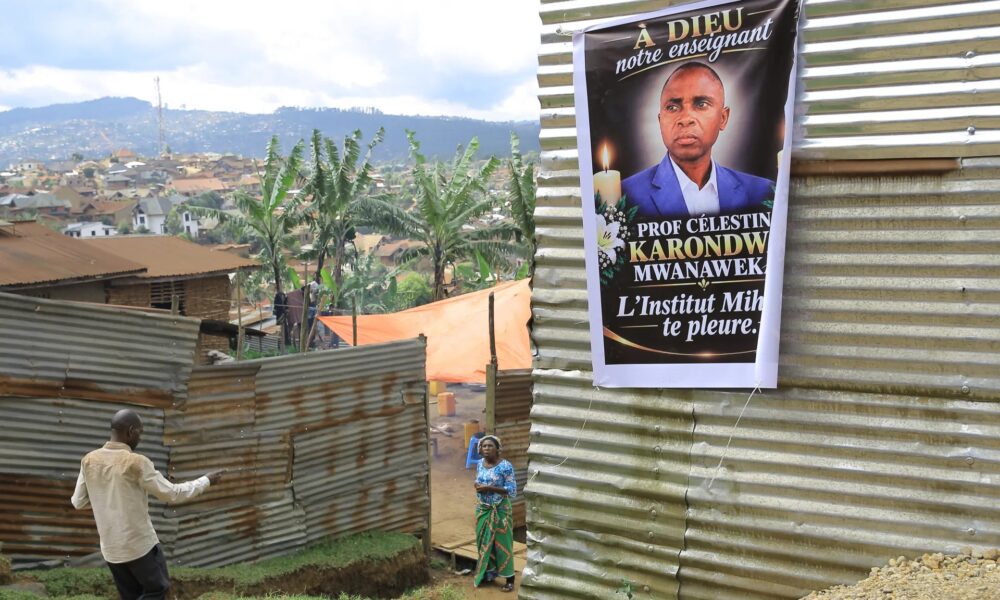
A funeral was held in Butembo on Wednesday for Marie-Celestin Karondwa, a local politician who died after being attacked at his home in the eastern Democratic Republic of the Congo.
Karondwa was assaulted on Sunday and later died from his injuries at a local hospital, according to the report. His political party, the Union for Democracy and Social Progress (UDSP), said he was an innocent victim because he defended the party’s position that Ebola exists and poses a threat to the population.
The circumstances of the attack remain unclear. It was not immediately known who carried it out, how many people were involved or what their motive was. The UDSP’s explanation of why Karondwa was targeted has not been independently verified.
Speaking to The Associated Press at the funeral, Karondwa’s granddaughter, Sagesse Kavira, said: “They beat him up and then set the house on fire.”
Attack follows wider threats to responders
Butembo, in North Kivu province, has been described as an Ebola hotspot. Karondwa’s death came after a series of attacks on health workers and other responders involved in the outbreak response.
The UDSP leads the Congolese government. Its statement described Karondwa as “an innocent victim for having defended the party’s position on the existence of the Ebola virus disease … and the threat it poses to the population.”
The current outbreak has been described as the Democratic Republic of the Congo’s 17th and deadliest Ebola outbreak, with more than 8,000 cases and nearly 4,000 deaths reported. The World Health Organization says the outbreak is caused by the Bundibugyo strain, for which it says there is no vaccine or specific treatment, although researchers are testing potential candidates.
Distrust complicates response
The WHO has reported Ebola in Bas-Uele, Haut-Uele, Ituri, North Kivu, South Kivu, Sud Ubangi and Tshopo. Ituri remains the most affected province, according to the organisation.
Officials have sought to contain the outbreak through a village-based approach. However, some residents have resisted the response because they do not believe Ebola exists, distrust the government or feel shame associated with infection.
Responders have said scepticism has made their work more difficult, particularly in remote communities and newly emerging hotspots where medical supplies and health workers are scarce.
Mistrust has been especially difficult to overcome in rebel-held parts of eastern Congo, where conflict and human rights abuses have left residents wary of outsiders and state authorities.
WHO Director General Tedros Adhanom Ghebreyesus has described the conditions affecting the response in eastern Congo as “a catastrophic collision of disease and conflict.”





No Comment! Be the first one.