
Dangote Refinery IPO Opens as Nigeria’s Fuel Market Faces Price and Supply Concerns
Dangote Petroleum Refinery opened its initial public offering on September 14, as Nigeria’s reduced reliance on petrol imports coincided with continuing concerns over fuel prices, crude supply and...


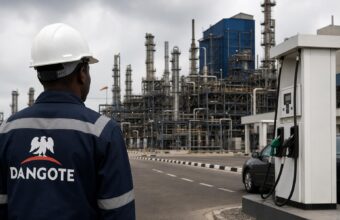
Dangote Petroleum Refinery opened its initial public offering on September 14, 2026, marking a major development for Nigeria’s energy industry as the country seeks to reduce its dependence on imported petroleum products.
Table Of Content
The facility, located in the Lekki Free Zone in Lagos, has increased its stated crude-processing capacity from 650,000 barrels per day to 700,000 barrels per day. Built at an estimated cost of about $20bn, it was commissioned in May 2023.
Production of diesel and jet fuel began in January 2024, while petrol supplies to Nigeria’s domestic market started in September of the same year. The source describes the refinery’s IPO as the largest in African history, although it does not provide details on the offering size, share price or valuation.
Imports have fallen, but prices remain high
Nigeria’s petrol imports have declined from about 400,000 barrels per day in 2024 to approximately 83,000 barrels per day in 2026, according to the source. The reduction reflects the expansion of domestic refining and has lowered the country’s reliance on overseas supplies.
However, the decline in imports has not brought the lower petrol prices many Nigerians expected. Petrol prices rose from about 185 naira ($0.14) per litre before the government’s subsidy reforms to more than 1,000 naira ($0.75) per litre after the subsidy was removed and pricing moved towards market levels.
Higher petrol and diesel costs affect transport expenses, the price of essential goods and the cost of running generators used by households and businesses. The government has also been expanding compressed natural gas as an alternative to petrol and diesel, but the source says the programme has yet to produce results on the required scale.
Concerns over competition and crude supply
The source reports continuing disputes since 2024 involving Dangote Refinery, the Nigerian Midstream and Downstream Petroleum Regulatory Authority and the Nigerian National Petroleum Company. The disagreements have included crude supply, fuel import licences and rules governing the domestic market.
It also reports that Dangote has at times been forced to purchase crude abroad in dollars because of shortages in domestic supply. Although the government introduced a crude-for-naira mechanism allowing local refineries to buy crude in naira rather than dollars, domestic refining remains exposed to international crude prices and exchange-rate movements.
The source’s analysis warns that a highly concentrated fuel market could weaken competitive pressure on prices and limit the benefits received by consumers. It calls for major industry players to disclose their daily pricing structures and for regulators to ensure that local distributors and importers receive non-discriminatory treatment.
At the IPO opening, Aliko Dangote, president of Dangote Group, described the offer as the “People’s IPO” and said, “We fully share all our prosperity with the people.” Days earlier, while the IPO documents were signed, he said the refinery was important to Africa’s industrialisation because “we can’t industrialise if we don’t have energy security.”
State refineries remain a challenge
Nigeria’s government-owned refineries in Port Harcourt, Warri and Kaduna have remained largely dormant or operated at negligible capacity for much of the past decade. Estimates cited by the source put government spending on their rehabilitation and turnaround maintenance over the past two decades at more than $18bn and as much as $25bn.
The source proposes accelerating the rehabilitation of those facilities, restoring them to full-capacity operation and providing support for small- and medium-sized refineries. It also suggests directing funds previously used for fuel subsidies towards electricity, subsidised public transport, healthcare and education.
Dangote’s expanded capacity has changed Nigeria’s fuel-supply picture, but the source concludes that reliable crude access, effective regulation and stronger competition will be important if domestic refining is to deliver broader benefits for Nigerian consumers.




No Comment! Be the first one.