
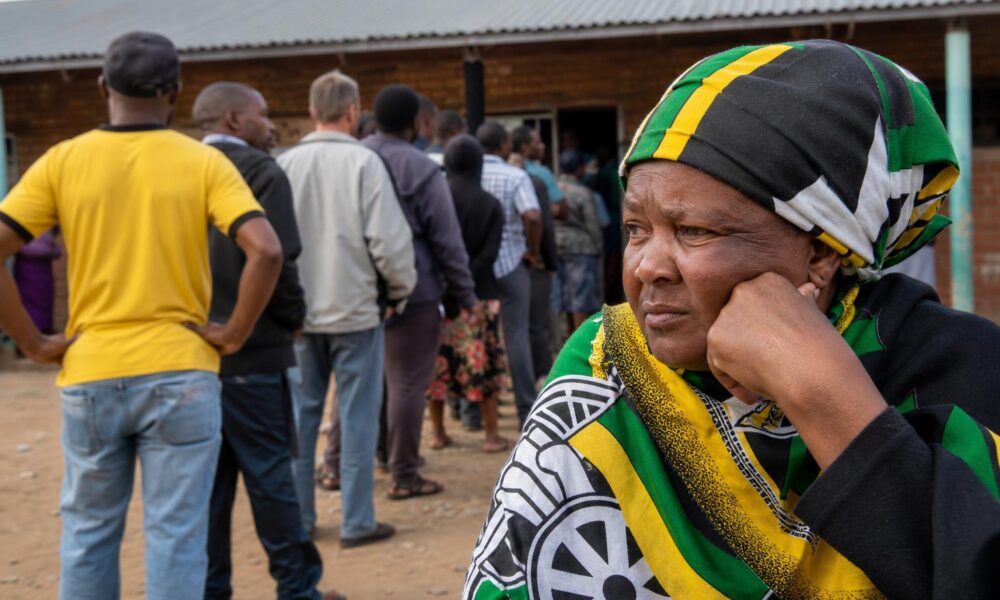
The African National Congress (ANC) has suffered a further decline in support in South Africa’s 2026 local government elections, receiving 32.5 percent of the popular vote, according to an analysis of the result.
Table Of Content
The ANC remained the country’s largest political party, but the result left it dependent on coalition partners to govern urban metros and cities. The analysis describes the outcome as evidence of deepening electoral, organisational, ideological and moral challenges within the governing movement.
Long-term decline in support
The ANC’s reported vote share has fallen steadily in recent elections. Its support stood at 57.5 percent in 2019, before declining to 47.5 percent in 2021, 40.2 percent in 2024 and 32.5 percent in 2026.
The analysis attributes the decline to developments across three nine-year leadership periods associated with Thabo Mbeki, Jacob Zuma and Cyril Ramaphosa. It also points to disaffection among significant parts of the Black middle class and sections of Black African rural and working-class communities, expressed through defections and abstention.
According to the analysis, the ANC has become increasingly reliant on support outside major urban centres. It characterises the party as essentially rural, while noting that its ability to govern is no longer secure in many cities without agreements with other parties.
Leadership periods under scrutiny
The analysis credits Mbeki’s period in leadership with leaving successors an economy that recorded GDP growth of 5.4 percent, unemployment of 25 percent and substantial savings for infrastructure expansion. It also notes that the ANC won 65.7 percent of the vote in the 2006 local elections, including what it describes as its strongest share of minority votes.
However, the analysis argues that the advantages associated with Mbeki’s period were later squandered during Zuma’s nine years in office. It links that period to state capture and cites the Madlanga, Nugent and Zondo commissions, which examined problems involving the criminal justice system, revenue services and public enterprises.
The economic cost of state capture has been estimated at up to 500 billion rand, or about $30bn, according to the analysis.
Ramaphosa’s leadership is also criticised in the assessment, which describes his period in office as marked by hesitation, indecision and uncertainty. It says public expectations initially rose around what it calls “Ramaphoria” after the state-capture scandal, but that the government did not respond with sufficient urgency to local governance problems and public concern over basic services.
The analysis also cites youth unemployment of 63 percent during Ramaphosa’s period. It further argues that decisions involving Jacob Zuma contributed to Zuma’s release on medical grounds. These claims are presented as the author’s analysis.
Coalitions and political competition
The ANC’s declining support has increased the importance of coalition politics. The analysis states that the Democratic Alliance was the ANC’s preferred coalition partner in 2024, while also identifying the uMkhonto weSizwe Party, the Economic Freedom Fighters and the South African Communist Party as forces challenging the ANC’s support.
The MKP received nearly 15 percent of the national vote in 2024 and almost 10 percent in 2026, according to the analysis.
The assessment concludes that the ANC faces what it calls an existential “poly-crisis”, involving electoral, organisational, ideological and moral dilemmas. It raises questions about whether the party can achieve renewal, rebuild public trust and maintain stable leadership ahead of future electoral tests.






No Comment! Be the first one.