
ART X Lagos Links African Heritage to Migration, Memory and Belonging
ART X Lagos used exhibitions, installations, film and education to examine African heritage, identity, migration, memory and belonging during Nigeria’s annual art week.

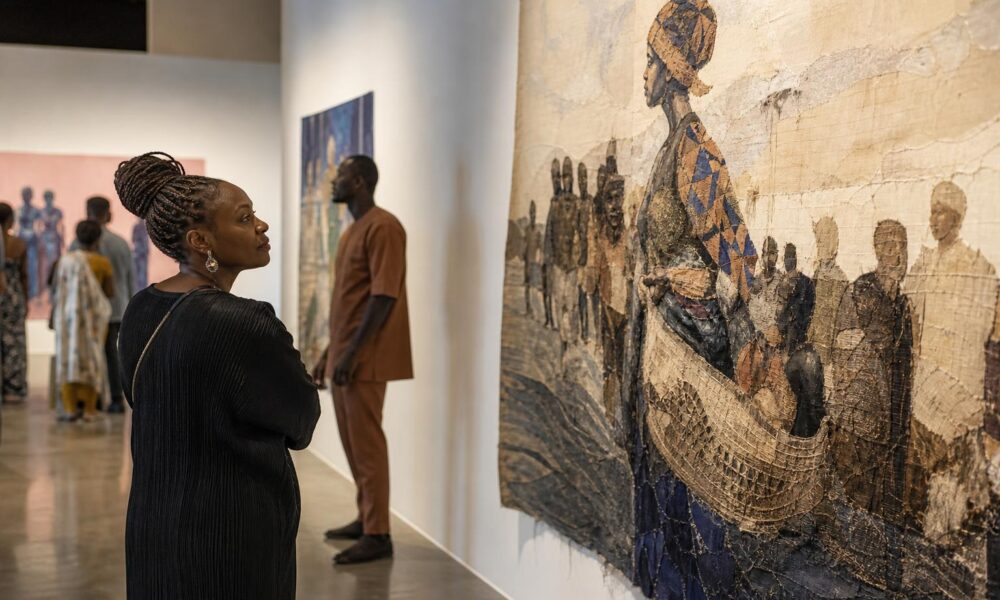
LAGOS, Nigeria — ART X Lagos brought together artists, galleries, museums, schoolchildren and visitors for a programme examining African heritage, identity, migration, memory and belonging.
Table Of Content
The 11th edition of the fair, held from November 5–8 at the Federal Palace Hotel on Victoria Island, formed part of Nigeria’s annual art week. Activities also took place at galleries and museums across Lagos and included exhibitions, installations, music, discussions and film screenings.
Organised under the theme “A New Chapter, A New Decade,” the fair drew on the influence of an earlier generation of Nigerian artists, architects, educators and thinkers associated with the development of modernism in the country. The event featured 15 partitioned exhibition spaces and attracted thousands of visitors.
History as a source for new work
Tokini Peterside said the exhibitions were connected by an approach that treats history as an active resource rather than something confined to the past.
“For me, the thread connecting these presentations is the idea that our histories are not simply things to preserve or look back upon. They are living sources of knowledge that can inform what we create next,” Peterside said.
Among the featured works was Ndidi Dike’s Residues of Past Encounters II, an installation containing a suspended wooden canoe, sand from Badagry, Adire-style fabric and the sound of waves. Badagry, a historic town in Nigeria, was once a transit point for enslaved West Africans.
Dike’s work connected the history of the transatlantic slave trade and colonialism with questions of memory and contemporary migration. She said the sound of the water encouraged audiences to consider the emotional experience of people leaving their homes.
“I find that there is a correlation between slavery and what is happening now,” Dike said, pointing to the continuing movement of Africans abroad and the loss of people from the continent’s younger and working populations.
Remembering artists and personal experiences
The exhibition Beyond the Vessel presented the work and legacy of Nigerian potter and ceramicist Ladi Kwali, who came from a long line of Gbari women potters in Kwali, near Abuja. Her work has been exhibited and collected internationally, and her portrait has appeared on Nigerian currency.
Jareh Das said preserving Kwali’s legacy could help future generations recognise her achievements and encourage young artists. She described pottery as an example of how cultural resources can offer ways to respond to present challenges.
“Culture is not always outside, but looking at what exists within and how you can draw from that, how you can rise above immediate challenges … through something as familiar as pottery,” Das said.
Other presentations focused on personal memory and recovery. Adeniyi Adewole exhibited Breath Beneath the Waters, a fibreglass sculpture linked to his experience of depression and recovery. Mercy Imiegha’s group exhibition, Every House Remembers, examined how bodies, objects and domestic spaces can retain memory, history and spiritual identity.
Film, education and public engagement
The programme also included Joel Benson’s feature-length documentary Mothers of Chibok. The film follows three parents and a woman who was abducted and later freed during the 2014 kidnapping of 276 schoolgirls from their dormitory in Chibok.
Benson said the story needed to remain visible because forgetting was easier than confronting its consequences. He said he hoped the film could contribute to action beyond empathy, including efforts to shape policy and improve security.
The fair’s educational programme welcomed more than 750 schoolchildren. Peterside said the experience could give some children an early introduction to contemporary art and help them view creativity as something in which they could participate.
The G.A.S. Foundation also organised a citywide art tour across Lagos, extending the programme beyond the main venue. Visitors encountered work addressing cultural erosion, migration, insecurity, collective memory and contemporary African artistic expression.


No Comment! Be the first one.