
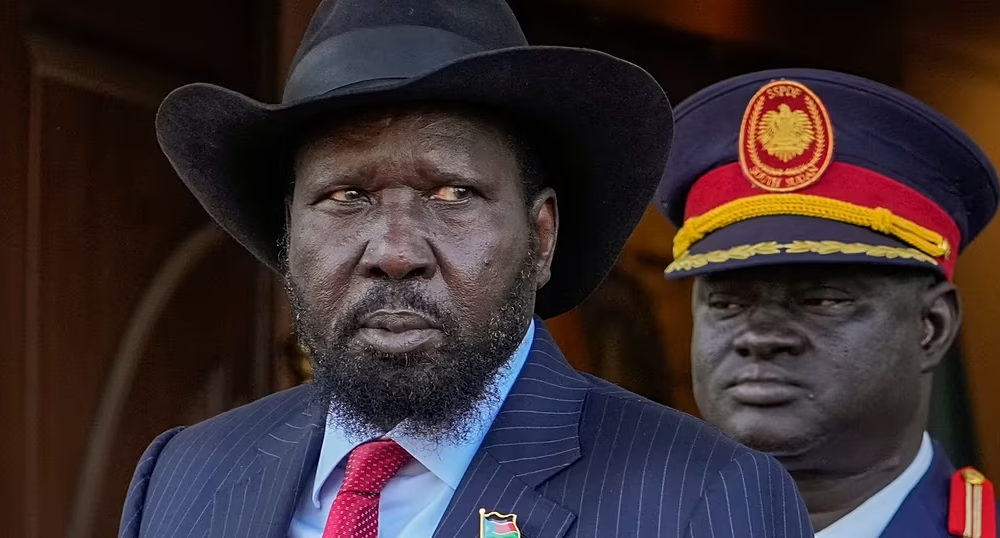
South Sudan’s political transition has entered a period of renewed uncertainty after President Salva Kiir was reported to have dissolved the transitional government amid controversy over changes to the country’s election laws.
Table Of Content
A later announcement from the president’s office said the government would be dissolved at midnight local time, or 2200 GMT, and that Kiir would appoint a new transitional administration to oversee the vote. The differing accounts leave the precise timing of the move unclear.
Election law changes
The reported government change followed Kiir’s signing of amendments to the National Elections Act. The revisions removed requirements for a permanent constitution and a national census before the election can proceed.
The amendments also allow Kiir to remain in office during the election period while removing vice-presidents appointed under the 2018 peace agreement, according to the reported account. The election is scheduled for December 22 and has already been postponed twice.
Michael Wani, a lawyer and former member of the constitution drafting committee, told AFP’s Nairobi bureau that the changes could leave Kiir with overwhelming control of the state. He said: "Kiir will be the only person in power, without vice-presidents, without the executive, without the parliament."
Independent analyst Machot Amuom described the legal changes as marked by "ambiguity" and said the amended law gave the president broad authority. He warned that Kiir could decide not to hold elections for another year or two.
Those assessments reflect analysts’ interpretation of the amendments, and the source material does not independently establish that the president has unrestricted control or that the election will be delayed.
Security concerns in Juba
The political developments have coincided with heightened security activity in the capital, Juba. An AFP journalist reported seeing many soldiers along roads, while the Internal Security Bureau directed all forces to wear uniforms and remain on high alert for three days from September 22.
An unidentified vendor told AFP that the military presence was unusual. "I have seen many soldiers present along the roads. This is not the normal thing in Juba, and I don’t know what is happening. So I decided to close my shop," the vendor said.
A civil servant also told AFP that a ministry had been closed without warning and that military personnel were stationed outside. "I was told to go back. I don’t know what is happening," the civil servant said.
Unresolved transition
South Sudan became independent in 2011 and later endured a five-year civil war. The government has failed to implement almost all of the preconditions set out in the 2018 peace agreement, including voter registration, the unification of rival armies and the completion of a long-awaited constitution.
Opposition leader Riek Machar was described as being jailed on treason charges, while tensions between rival political groups remain high.
International observers have warned that the election could push the country back into full-scale conflict. However, the available information does not establish whether the December 22 vote will take place as scheduled.




No Comment! Be the first one.