
Noma Leaves More Children in Northern Nigeria Needing Lifesaving Surgery
More than 500 children from northern Nigeria were treated for noma at a specialist hospital in Sokoto between 2023 and 2025, as medical workers warn that delayed care can lead to severe facial damage.
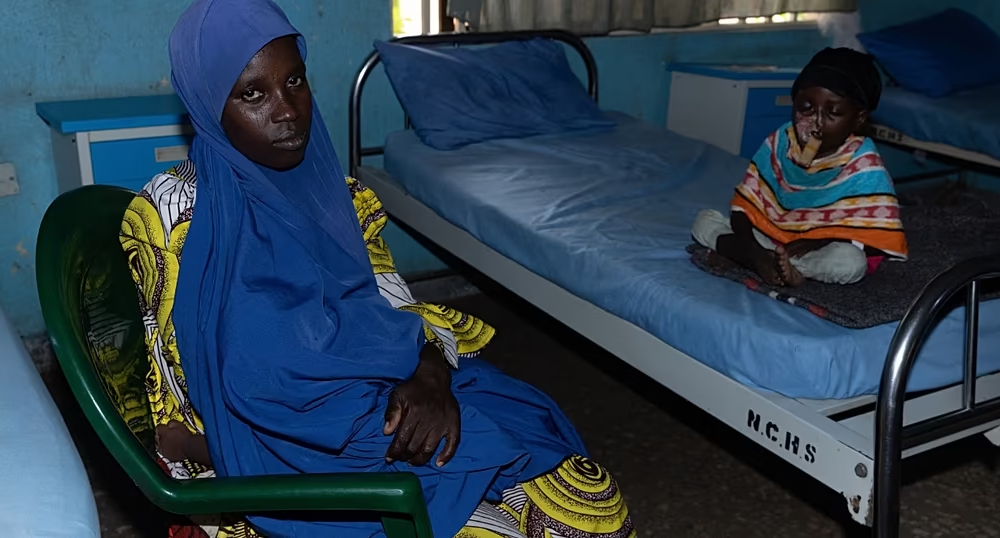
Children in northern Nigeria are suffering severe facial injuries from noma, a rapidly progressing disease that mainly affects malnourished children in poor communities.
Table Of Content
Medical workers and officials say they are seeing more patients with the disease, while Doctors Without Borders, also known as MSF, is providing free multi-stage operations at the Noma Children Hospital in Sokoto state.
More than 500 children from across northern Nigeria were treated at the specialist hospital between 2023 and 2025, according to data seen by The Associated Press.
A disease that advances quickly
Noma begins with inflammation of the gums and can destroy facial soft tissue and bone. It mostly affects children between the ages of 2 and 6, particularly those living in poor conditions and experiencing severe malnutrition.
The World Health Organization classifies noma as a neglected tropical disease. WHO has said evidence shows that early treatment can greatly reduce its impact. Initial care includes antibiotics, wound treatment and improved nutrition, while advanced cases may require reconstructive surgery.
Dr. Abubakar Abdullahi Bello, chief medical director of the Noma Children Hospital, said the disease can cause extensive damage in a short time.
“The disease damages the mouth tissues within a short period. It eats up the tissue within two weeks of onset if the patient does not receive treatment,” Bello said.
He described the situation as “quite worrisome.”
Research has identified 117 microorganisms that can cause noma, according to Yuka Makino, a WHO technical officer for oral health at the agency’s Africa office. Makino described the condition as an opportunistic, polymicrobial infection.
Children wait for operations
MSF runs three treatment sessions each year for children whose health allows them to undergo surgery. Some patients remain on waiting lists, including the 4-year-old son of Maryam Sabiu, who contracted noma in 2024 but is considered too young for the procedure.
Sabiu said the reactions of other people to her child’s condition had been deeply painful.
“I feel like the way people would stop and look at my child is one of the worst experiences in my entire life,” she said.
MSF Nigeria medical coordinator Bukola Oluyide said earlier intervention could limit tissue loss and reduce the need for major reconstructive procedures later.
“We are seeing more acute noma cases, and we are veering toward awareness for the community so they can bring their children earlier to prevent tissue loss and require reconstructive surgery later in years,” Oluyide said.
The organization is carrying out the operations free of charge. For families unable to afford treatment, the support can offer a path to recovery.
Muhammad Dalhatu, whose son Ibrahim developed noma at age 3, said he had feared that treatment would be unaffordable. Ibrahim had his first facial reconstructive surgery in 2021 at the Sokoto hospital. Now 8, he has undergone six operations and can eat and speak normally after surgery to address a nasal fistula.
“I was very excited because I thought there was no solution to the disease. Before, I was worried about the cost of the treatment, but when I was told it was free of charge, I was so happy,” Dalhatu said.
Limited data and specialist care
The scale of noma remains difficult to measure. WHO has not updated its available data since 1998, when it estimated 140,000 cases worldwide each year and a fatality rate of 90 percent.
A study published in July in The Lancet Global Health reported more than 50,000 cases across 12 northern Nigerian states between 1999 and 2024, using data from the Sokoto hospital.
Makino said Nigeria reports more cases than other countries partly because it has specialist hospitals, a large population and a government-led response that likely results in more cases being identified. Nigeria has two noma hospitals, including one in Abuja built in 2023.
Noma is associated with extreme poverty and severe malnutrition. The disease is also linked to a wider belt across Africa stretching from Senegal and Mauritania in the west to Ethiopia in the east. The United Nations Human Rights Council has said the conditions that lead to noma constitute a human rights violation for affected children.
WHO has said it plans to engage heads of state and partners during the United Nations General Assembly to raise awareness and promote shared responses to noma and other health challenges. Nigeria’s federal Ministry of Health and Sokoto state ministry did not respond to requests for comment about government plans to combat the disease.



No Comment! Be the first one.