
Caritas Freetown Gives Cash Assistance to 80 Households in Flood-Prone Communities
Caritas Freetown has provided NLe3,480 each to 80 households in three disaster-prone communities in Western Area Urban under a Trocaire-funded resilience project.

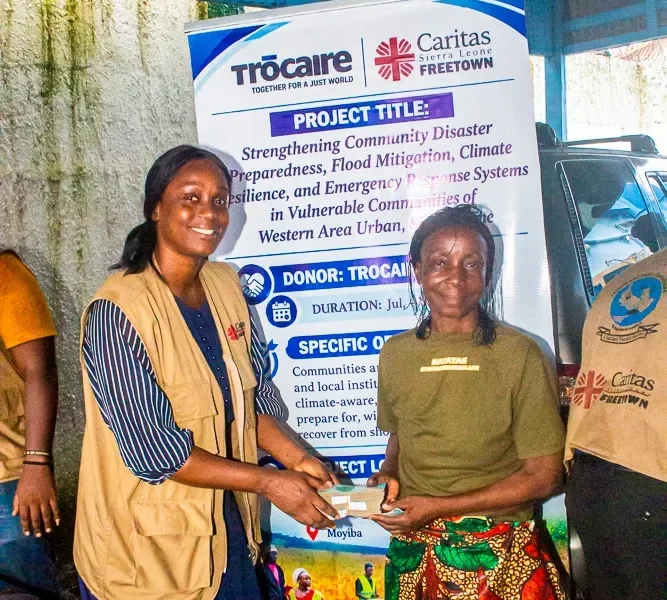
Caritas Freetown, with funding from Trocaire, has provided Multi-Purpose Cash Assistance to 80 households in three disaster-prone communities in Western Area Urban.
Table Of Content
Each household received NLe3,480 at Rokel Commercial Bank’s Wellington PMB Branch on Wednesday, September 23, 2026. The beneficiaries came from Moyiba, Moa Wharf and Bottom Oku in Wellington.
The distribution is part of a project focused on strengthening community disaster preparedness, flood mitigation, climate resilience and emergency response systems in vulnerable communities across Western Area Urban.
Support linked to community preparedness
Eliza G. O. C. Sillah, Programs Manager at Caritas Freetown, said the project followed an assessment that identified gaps in disaster management structures in the targeted communities, including the absence of structured Community Disaster Management Committees.
According to Sillah, the initiative supports the strengthening of those committees and provides tools for mitigation activities, including community cleaning and identifying houses located in disaster-prone areas.
She said financial literacy training was conducted before the cash distribution. Caritas Freetown plans to carry out post-distribution monitoring two weeks after the transfer to assess how the funds were used, the impact of the assistance and beneficiary satisfaction.
Sillah described the cash support as a key part of the project, intended to help households strengthen their homes and support their families. The assistance is also expected to help beneficiaries manage challenges during the rainy season.
Agency backs anticipatory approach
Gerald King, Deputy Director of Disaster Risk Reduction and Preparedness at the National Disaster Management Agency, said the intervention complements the Government’s disaster management efforts.
King said residents in disaster-prone communities are particularly exposed to flood-related incidents during the rainy season. He also linked many disaster-related incidents in Sierra Leone to human activities, including continued occupation of areas vulnerable to disasters and other actions that increase exposure to risk.
“What is good about this intervention is that it’s not a response to disaster but preparedness,” King said, describing the project as anticipatory action designed to equip communities before a disaster occurs.
Beneficiaries outline plans for the funds
Alusine Bangura, a beneficiary from Moyiba, said he planned to use part of the money to strengthen his house and the remainder to establish a small kiosk selling phone recharge cards.
Dora Mansaray of Moa Wharf said flooding had previously forced her family to leave their home temporarily and resulted in the loss of household properties. She said she planned to purchase sand and cement to repair the house.
The project combines household-level financial assistance with support for local disaster-management structures in the three communities.




No Comment! Be the first one.