
Kenyan Quaker Churches Blend Modern Worship With Historic Traditions
Quaker congregations in western Kenya are adopting faster music and contemporary instruments to attract young people, while theological training and archive projects seek to protect the movement's...

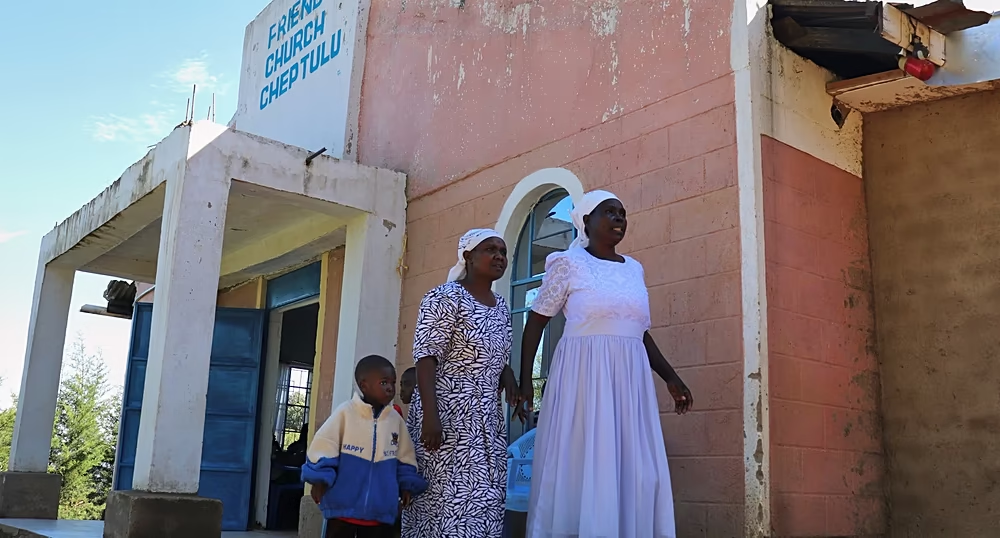
Quaker churches in western Kenya are reshaping their worship services with keyboards, drums, faster music and dance as they seek to keep younger generations connected to the faith.
Table Of Content
At the Friends Church in Cheptulu, a choir recently performed a local hymn with musical instruments as congregants danced and clapped. Young people led praise and worship during the service at the approximately 100-year-old church, while older women singing another hymn were accompanied by a young man playing a keyboard.
The changes reflect an effort to make worship more relevant to local communities without abandoning the identity of the Religious Society of Friends.
A faster, more energetic service
Cheptulu senior pastor Kennedy Shiverenje said the church changed its music to reach young people and strengthen participation among older worshippers.
“We needed to capture the youth and re-energize the elderly so that our service is vibrant,” he said.
Rose Oside recalled that earlier Quaker services were marked by very slow singing and little physical participation. “The songs were the slowest I had ever heard in my life,” she said, describing a period when older women would sing without clapping or using African drums.
Catherine Ikalakala said some young people had avoided Quaker services because other churches offered faster music. After the Cheptulu congregation acquired a keyboard, she said, more young people came to church.
“The young people used to see us singing slow motion while other churches had faster music,” Ikalakala said.
Shiverenje said worship music had to be appropriate to the local context. He also questioned whether silent worship would have appealed to early Kenyan converts, saying, “If you just brought an unprogrammed service where people sit silently, I’m not sure people would concentrate.”
Balancing change with Quaker roots
The approach in Kenya differs from the silent worship practiced by many Quakers in the United States. In that tradition, worshippers wait for individual messages from God, and many meeting houses have no clergy, pulpit or altar.
Quakerism began in 17th-century England with George Fox, who objected to the Anglican emphasis on ceremony. The movement’s teachings include the idea of an Inner Light and a doctrine founded on peace.
American missionaries from the Friends United Meeting in Indiana arrived in Kaimosi in 1902 and introduced a form of Quakerism centred on evangelism and slow hymns. Their work also included investment in schools and hospitals, helping the movement attract many local converts.
Some older Kenyan Quakers have been unsettled by later changes. Thomas Amalemba, who was 90 at the time described in the report, said increased emphasis on church giving had contributed to concerns that people were “buying blessings.” He also recalled older worshippers feeling uncomfortable with changes in the music.
Shiverenje said local church members now raise funds for programmes after the initial donor support ended and missionaries left.
Training and preserving the record
Alongside changes in worship, Quaker institutions in Kenya are working to strengthen pastoral training and preserve the movement’s history.
The Friends Theological College in Kaimosi has more than 400 students studying on campus and online. The college trains pastoral ministers, with Robert Wafula saying the programme is intended to ensure that congregations receive the correct message.
Wafula said the training had also supported work in other countries. He cited Rwanda, where he said the government closed 70 Quaker churches during a crackdown involving untrained pastors. He also said Quaker teaching on peace had been useful during ethnic tensions and postelection violence in Kenya, as well as in regional conflicts.
“Quakerism has spread peace across East Africa, for example in Rwanda and even in the Congo, where Quakers are participating in peace-building through the major groups,” Wafula said.
The college also houses a Quaker Archive programme containing historical material, including an old Bible written in the local Maragoli language.
Researchers have collected accounts from early Quakers and documents such as notes from early yearly meetings. Linet Mmbone said the work was intended to give younger people a reference point and protect the dignity of the Quaker tradition.
“Because we don’t want to lose our dignity as Quakers, we want to go back to the roots and conduct our services the way the early Quakers used to do it,” Mmbone said.
The Religious Society of Friends is estimated to have about 400,000 members worldwide, with roughly half living in Africa and most of those in Kenya, according to the report.






No Comment! Be the first one.