
Madagascar activists mark anniversary of protests that ousted Rajoelina
Madagascar's Gen Z activists are marking one year since protests led to President Andry Rajoelina's departure, while raising concerns about limited reforms, arrests and divisions within the movement.

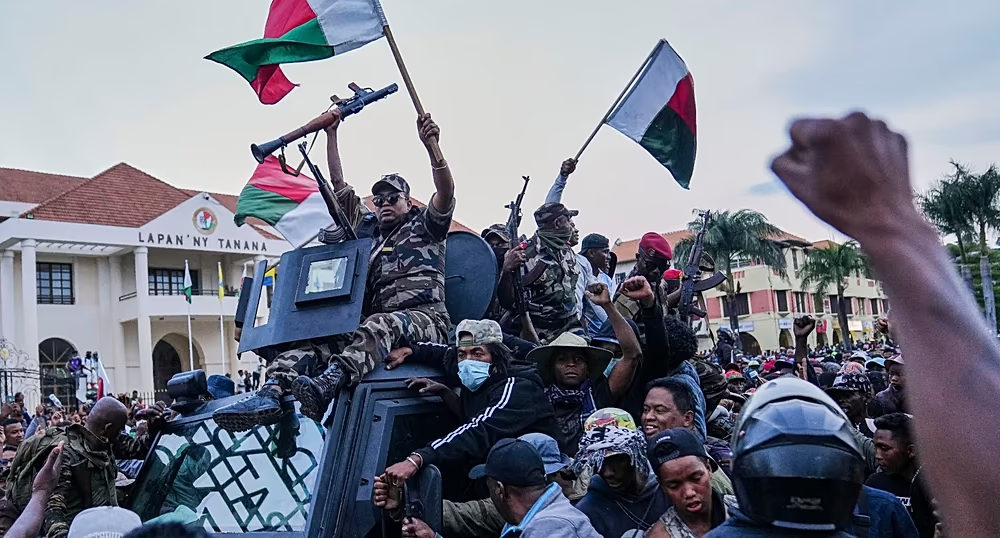
Madagascar’s Gen Z activists are marking the first anniversary of protests that forced President Andry Rajoelina from power, with members of the movement accusing the authorities that followed of using familiar repressive methods.
Table Of Content
The demonstrations began on September 25, initially focusing on chronic shortages of water and electricity. Soldiers from the Capsat military unit later joined the protesters in October, after which Rajoelina fled the country and the military seized power.
Colonel Michael Randrianirina, the Capsat commander, was sworn in as interim leader on October 17. He has promised elections by the end of next year.
Activists question pace of change
Herizo Andriamanantena, a figurehead of the movement and an agricultural engineer, said the change in government had brought only “little changes here and there”. He was among six activists detained after a march in April that protested the slow pace of promised reforms.
Andriamanantena said the detainees were accused of endangering state security and of having contact with people planning another coup. He spent 13 days in police custody on the state-security charge, which allows detention for up to 15 days.
Describing his detention, Andriamanantena said he was held in a small cell with around 20 prisoners. “You fought for your country but you’re treated like a criminal,” he said.
Lawyer Maromanana Aliarivelo said the charge had long been used by those in power in Madagascar to silence opponents, calling it “the tool par excellence used for ages by those in power in Madagascar”.
Nomena Ratsihorimanana, an activist and former employee of the National Human Rights Observatory, said his arrest involved violence. He described “blows raining down everywhere” and alleged that officers put guns in detainees’ mouths and threatened to kill them. Ratsihorimanana was released after five days in detention.
The allegations of mistreatment have not been independently verified. Both Andriamanantena and Ratsihorimanana lost their jobs after the events.
A movement with competing views
The unrest claimed at least 22 lives, including during a government crackdown. Felana Andriatahina, an activist and eco-construction entrepreneur, said the movement’s supporters felt betrayed by the authorities now in power.
“It’s thanks to us taking to the streets… that they’re in power today,” Andriatahina said. “It’s a betrayal.” She described the movement as “like a box of coloured pencils”, reflecting its varied composition.
The movement was largely made up of urban, educated young people, although many participants fell outside the 1997–2012 birth-year range commonly associated with Generation Z. UNICEF estimates that around 70 percent of Madagascar’s population is under 30.
Political scientist Ketakandriana Rafitoson said the movement contained multiple strands, adding: “I don’t even know how many sub-movements there are, who the real Gen Z are, the fake ones”. One faction supports Randrianirina, while another is wary of official commemorations.
The Gen Z Madagascar Facebook page, which coordinated demonstrations in September and October last year, had around 200,000 followers at the height of the revolt. It was hacked and deleted shortly before the military switched sides, although responsibility for the incident has not been established.
Anniversary events planned
Anniversary activities planned in Antananarivo include the unveiling of a stele, a march and an address by Randrianirina at May 13 Square, a longstanding symbol of political protest in Madagascar.
Elliot Randriamandrato, the administrator of the original Facebook page, expressed skepticism about official commemorations. “If it’s something that’s being used again, it’s pointless,” he said.



No Comment! Be the first one.