
Immigration Department Holds Leadership Training Ahead of Service Transition
The Sierra Leone Immigration Department has completed a three-day leadership, command and control programme in Makeni as it prepares to transition into the Sierra Leone Immigration Service.

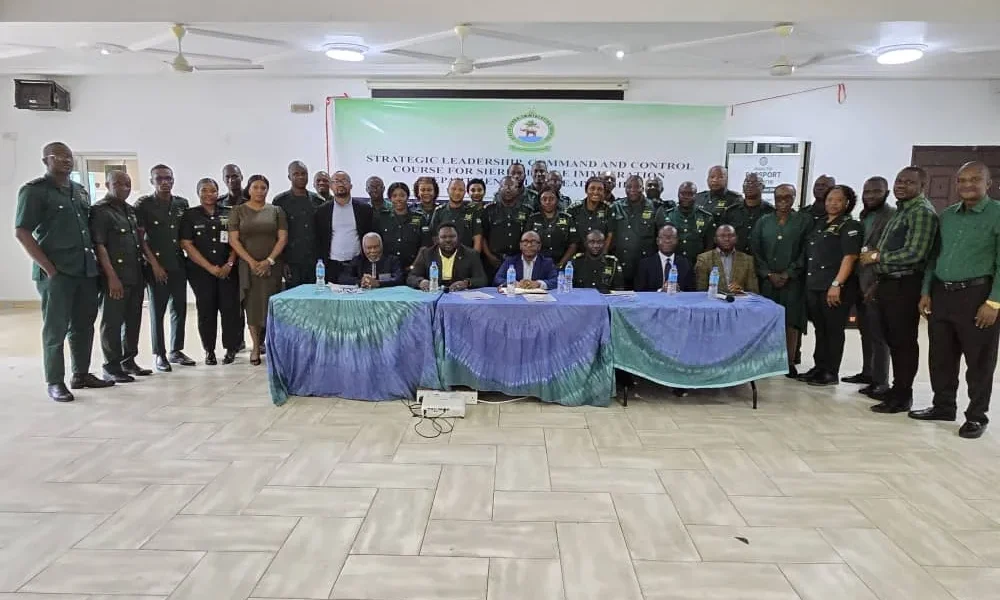
The Sierra Leone Immigration Department has completed a three-day Strategic Leadership, Command and Control Training programme in Makeni as the institution prepares to transition into the Sierra Leone Immigration Service.
Table Of Content
The programme ran from 24 to 26 September 2026 under the theme “Commanding the Transition.” It brought together senior immigration officers, Regional Commanders, District Heads and Heads of Command Posts.
The Department said the training was designed to strengthen leadership capacity, command structures, institutional discipline, accountability and strategic decision-making. It formed part of a wider institutional transformation drive aimed at developing a professional, competent and accountable leadership cadre.
Focus on leadership and command
Participants engaged in case studies, group discussions, leadership exercises and interactive sessions. They were also divided into three groups to examine practical command challenges and propose solutions.
Laud Kwasi Ofori Affrifah, Esq., a lead consultant and former Deputy Comptroller General of Operations of the Ghana Immigration Service, facilitated Module Four, which focused on Command and Control.
Dr. Moses Tiffa Baio, Esq., Chief Immigration Officer, addressed participants on the importance of credible, competent and responsible leadership as the Department prepares for the transition. He stressed the need for a clear chain of command, defined lines of authority and effective structures to support discipline, order and accountability.
“Leadership is not only about the title you carry but the responsibility you bear. What matters most is how you honour that responsibility,” Baio told the participants.
He also identified competence and integrity as essential foundations of effective leadership. According to Baio, the transition requires leaders who can manage immigration operations effectively while maintaining professional and institutional standards.
Institutional transformation
Swaray Junisa, Director of Finance and Administration, delivered opening remarks on behalf of the Chief Immigration Officer and the Management of the Sierra Leone Immigration Department.
Osman Kamara, Regional Commander for the Northern Region, welcomed participants to Makeni and assured them of a conducive and secure environment throughout the training.
Tidiane Traore, a lead consultant, discussed the consulting team’s earlier engagement with the Department in Kenema. He said effective leadership and strong institutional structures would be necessary to achieve the Department’s strategic objectives.
Amadu Bah addressed the Department’s institutional transformation and said the process was continuous. He also reminded officers that the Department’s responsibilities extend beyond passport services to include critical immigration and national security functions.
Bah said the transformation process began with the Department’s engagement in Kenema and could only be sustained through effective leadership. The Department’s leadership teams have previously championed institutional reforms, according to his remarks.
Preparing for the transition
The Sierra Leone Immigration Department is preparing to become the Sierra Leone Immigration Service, although no specific date for the transition was provided.
During the programme, senior officers were encouraged to apply the knowledge gained to improve leadership and service delivery across the Department. They were also challenged to transfer the training knowledge to officers at their respective command posts.
The training concluded in Makeni on 26 September. The Department described the programme as part of its broader effort to support institutional transformation and prepare its leadership for the transition to the Sierra Leone Immigration Service.






No Comment! Be the first one.