
Sierra Leone Journalist Joins China Seminar on Political Leadership and Development
Amin Kef Sesay of Sierra Leone’s The Calabash Newspaper was among 31 international participants attending a seminar in Yan’an focused on political leadership, governance innovation and development...

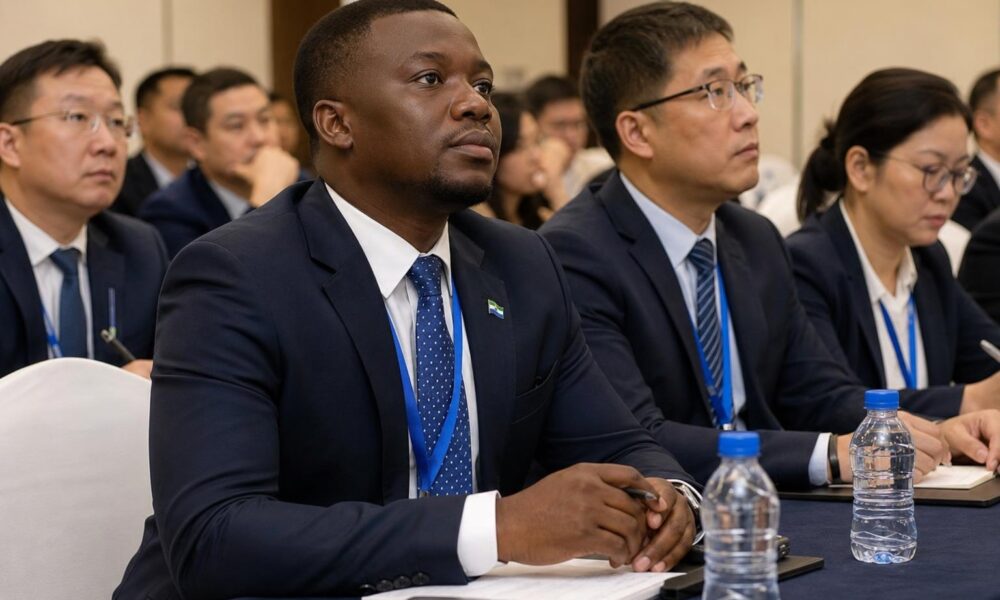
YAN’AN, China — A seminar examining political leadership, governance innovation, poverty reduction and people-centred development brought together 31 participants from 24 countries, including Sierra Leone, at the China Executive Leadership Academy Yan’an on 9 November 2026.
Table Of Content
The programme was organised as part of efforts to strengthen international cooperation and encourage the exchange of development experiences. It also sought to deepen participants’ understanding of the Communist Party of China’s political philosophy and its application to economic and social development.
Leadership and development discussions
The engagement took place in Classroom 8 of the academy’s Teaching Building in Yan’an, Shaanxi Province. Wang Jigang, vice president of the China Executive Leadership Academy Yan’an, chaired the opening ceremony, while Executive Vice President Li Shufeng and Ali Salum Hapi, head of the seminar participants, delivered formal addresses.
Wang Tao delivered a presentation titled “Stay True to Original Aspiration and Founding Mission of the CPC — On General Secretary Xi Jinping’s People-Centered Development Philosophy.” The lecture covered China’s approach to governance and a range of development issues, including poverty reduction, access to education and healthcare, employment, rural development and environmental sustainability.
Participants were introduced to China’s targeted poverty-alleviation strategy, including the identification of disadvantaged households, the allocation of resources according to specific needs, development programmes and monitoring of results. The presentation also discussed agricultural production, relocation assistance, social security, education and ecological compensation.
Other subjects addressed during the programme included educational equity, improvements in healthcare, digital transformation, public services, housing, infrastructure and environmentally sustainable economic growth.
Chinese Government statistics presented during Wang Tao’s lecture indicated that the number of rural residents below China’s official poverty threshold fell from approximately 98.99 million in 2012 to zero by the end of 2020. The figures were presented as part of the lecture’s account of China’s poverty-reduction experience.
Visit to Liangjiahe Village
The participants also visited Liangjiahe Village in Wen’anyi Town, Yanchuan County. The visit focused on the historical experiences of Chinese President Xi Jinping during the seven years he spent living and working in the community as a young man.
According to the programme’s account, the visit offered insight into grassroots leadership, rural development and historical experiences associated by Chinese authorities with Xi Jinping’s people-centred development philosophy.
Amin Kef Sesay, an investigative journalist and managing editor of Sierra Leone’s The Calabash Newspaper, described the seminar as informative, well-structured and relevant to its objectives.
Sesay recommended that future sessions include more practical examples from developing countries, particularly African countries. He also called for more interactive comparisons with China’s rural development experiences.
Further exchanges planned
The programme is due to continue with visits to other historical and development institutions across China. The organisers presented the wider engagement as an opportunity for international dialogue, knowledge-sharing and comparative learning.
The seminar’s broader discussions also referred to China’s Global Governance Initiative, which the report describes as advocating sovereign equality, multilateralism, international rule of law, people-centred development and practical cooperation.
Yan’an, a historic city in northern Shaanxi Province on the Loess Plateau along the Yan River, is described as a centre for political education, leadership training and the study of the Communist Party of China’s development experiences.



No Comment! Be the first one.