
Syrian children return to classrooms amid damaged schools and insecurity
Syrian children are returning to school, but damaged buildings, electricity shortages, long journeys and insecurity continue to disrupt their education.

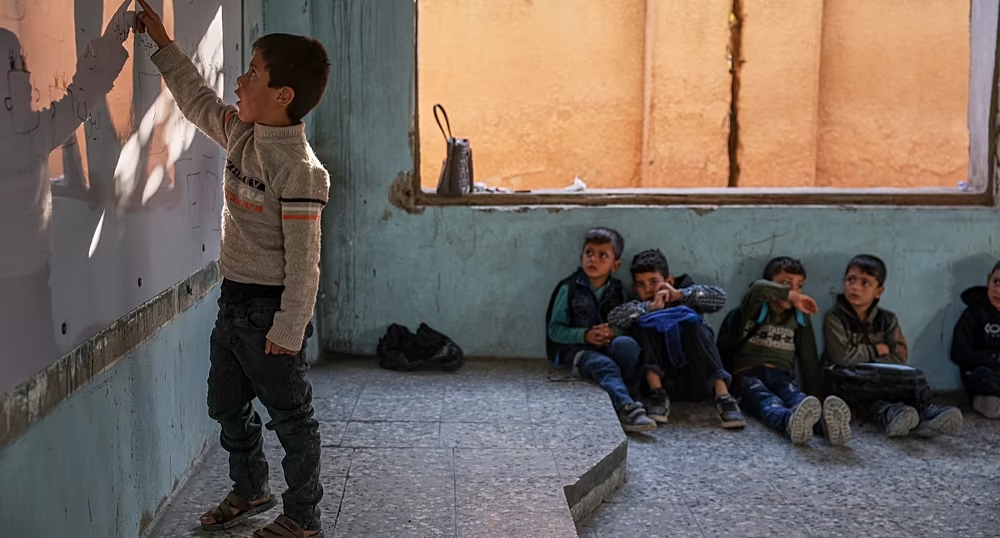
School bells are ringing again across Syria, but the return to education remains difficult for many children living amid the damage left by years of conflict.
Schools have been damaged or destroyed in large numbers, with more than 7,000 affected across the country. In some areas, children must travel long distances to reach classrooms that are still operating, while families also cope with unreliable or unavailable electricity and security concerns.
A long journey to school
Tasnim, an eight-year-old girl in Damascus, attends a school far from her home because nearby schools have been devastated and are no longer in service. She walks several kilometres home after classes.
“When we returned to Damascus, I signed up for a school here. Because the schools near our house are all devastated and out of service, I moved to a school far away. Going back and forth is hard to do every day. I wish the nearby schools weren’t damaged,” Tasnim said.
Her family returned to Syria because they had nowhere else to go. Their house in Damascus is still standing amid the rubble, while her father, Mahmoud Rushdi, works as a cobbler between damaged walls and broken doors.
Studying without electricity
Tasnim also has to organise her studies around the lack of electricity. She helps her father after school and studies during daylight because the battery used by the family loses power at night and there is no light.
“When I come back from school, I help my dad with his work, and sometimes I go with him to send his work to his employer. Then I come back to study during the day, as the battery runs out of power at night and there’s no light. After that, I go to bed,” she said.
Rushdi said basic services in the area remained severely limited because there was no electricity grid. Although residents needed solar power, he said most people could not afford it.
“The services here are crippled, especially as no electricity grid is available. We need solar power, but most people can’t afford it,” Rushdi said.
Safety concerns for families
The condition of the surrounding area has also created fears about children travelling to school. Rushdi said residents were concerned that their children could be kidnapped when passing through deserted and abandoned areas.
“There are a lot of risks also, as the area is deserted and abandoned, and when our children go to school, we worry about them being kidnapped. Living in such a place requires a high level of caution,” he said.
The UN refugee agency said more than three million displaced Syrians had returned home by December 2025, a year after the fall of the Assad regime. The return of children to classrooms is therefore taking place alongside the wider challenge of rebuilding communities and restoring essential services.
While schools are operating again in parts of Syria, the damage to education facilities, shortages of electricity and continuing insecurity remain major obstacles for children and their families.






No Comment! Be the first one.