
Amnesty Proposes Notification System for Public Processions in Sierra Leone
Amnesty International Sierra Leone has proposed replacing police approval requirements for public processions with a notification-based framework, following consultations on Part III of the Public...

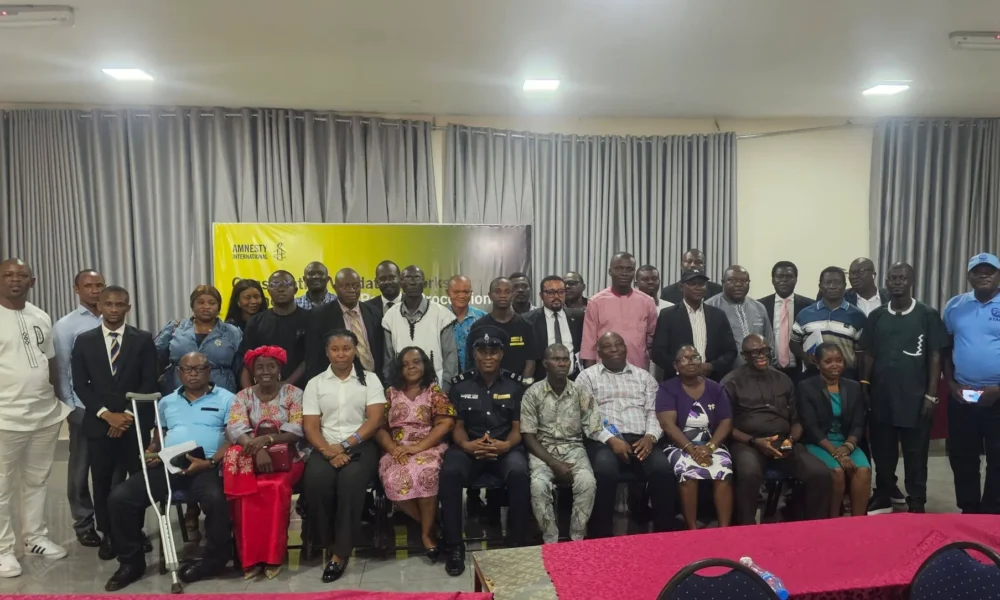
Amnesty International Sierra Leone has presented proposed reforms to the legal framework governing public processions and demonstrations, including a shift from police approval to a notification-based system.
The findings were shared at a validation workshop held on September 29, 2026, at the New Brookfields Hotel in Freetown. The review focused on Part III of the Public Order Act of 1965, which regulates public processions and demonstrations.
The organisation said its legal consultants conducted consultations in Freetown, Makeni, Kenema, Kambia and Bo to gather views on how the law is enforced and how it could be reformed.
Concerns over enforcement
Amnesty International Sierra Leone’s findings identified concerns about the discretionary authority available to police to approve or prohibit public processions. Stakeholders also raised questions about inconsistent enforcement and the absence of clear definitions for terms such as procession, protest and demonstration.
Provincial stakeholders reported difficulties accessing police leadership in Freetown. They also pointed to differences between decisions taken at central level and the actions of lower-ranking officers in the field.
The consultation recorded differing views among stakeholders. Civil society participants in Freetown and the provinces supported replacing the approval-based system with a notification framework. State institutions generally defended the existing arrangement while acknowledging the need for greater clarity and accountability.
Amnesty International Sierra Leone Executive Director Solomon M. Sogbandi said peaceful assembly is an important part of democratic participation, allowing people to express their views, take part in public affairs and demand accountability. He also said restrictions should be governed by clear, objective, necessary and proportionate criteria.
Jeremy Simbo, Acting Executive Director of the Centre for Accountability and Rule of Law, said the state has a responsibility to prevent violence and disorder while ensuring public spaces are used safely and responsibly.
Proposed legal changes
The recommendations call for a fixed notice period for public processions. Under the proposed approach, a procession that has been notified would be allowed to proceed unless authorities raise a lawful and reasoned objection.
The proposals also include objective criteria for restrictions that can be reviewed by the courts, expedited judicial review, decentralised notification procedures and independent oversight of police conduct.
Amnesty International Sierra Leone’s report further proposes removing imprisonment as a sanction for failing to notify authorities. It also recommends seeking an interpretation from the Supreme Court on the meaning of “notification” as used in Part III of the Act.
The consultation considered comparative practices and international standards, including notification-based systems, risk assessments, dialogue between organisers and police, and independent oversight.
The recommendations will undergo additional stakeholder review and validation before Amnesty International Sierra Leone finalises its report. No legislative or policy change has yet been confirmed as adopted.





No Comment! Be the first one.