
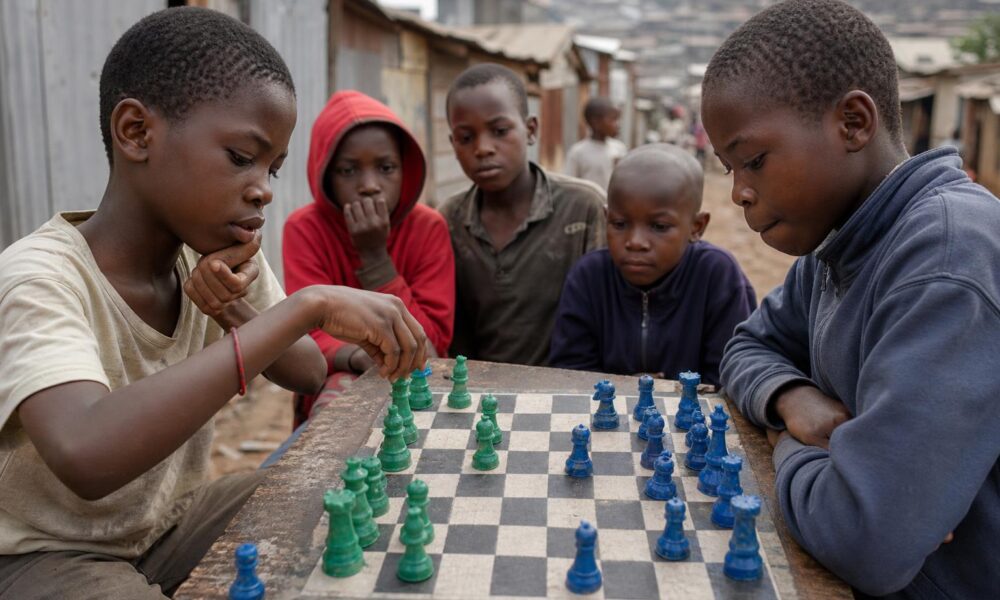
A community recycling initiative in Nairobi’s Kibera informal settlement is combining plastic-waste recovery with access to chess for children who might otherwise be unable to afford equipment.
Table Of Content
Kijiji Solutions has recycled about 200 kilograms of plastic waste to produce nearly 2,000 tournament-quality chess sets. Working with The Gift of Chess, the organisation is distributing the sets to children in an area where access to chess equipment and organised training is limited.
From discarded plastic to chess pieces
Kijiji Solutions collects plastic and other waste in Kibera, sorts the material and sends selected items for processing. The material is returned as pellets, which are then used in an extruder fitted with custom-made moulds shaped like chess pieces.
Richard Haukom, the organisation’s founder, said the pellets are produced after washing, shredding and other processing. He said the chess-piece moulds were made in Nairobi.
Haukom also acknowledged that the environmental contribution remains limited because chess pieces are small. “The total amount of plastic removed, it’s more symbolic than it is impactful in terms of the plastic waste problem,” he said.
He added that production could rise substantially if Kijiji Solutions were able to meet demand for the sets.
Chess at Centre of Hope School
Children at Centre of Hope School regularly play and practise with the recycled sets. The school regards chess as an important part of its curriculum.
Chess teacher Ian Ombati said the game offers children a way to step away from daily difficulties and compete according to their ability rather than their background. “Once they go to that board, it does not matter where you come from,” he said. “It’s just your skills and your competence.”
Eleven-year-old Esther Mutua said she initially struggled with chess but attended training regularly and later improved at the game and in her academics. Nine-year-old Markham Odhiambo said chess helps him focus in class and answer mathematics questions.
Academic benefits remain debated
Students and teachers at the school say chess has helped with concentration, problem-solving and classroom performance. Head teacher Wilson Akhonya also said students who play chess have shown progress in critical thinking, problem-solving, leadership and academic performance.
Isabel Omondi, the school’s founder, said chess makes students more attentive, active, focused and concentrated.
However, the report provides no evidence supporting these claims. Researchers have debated whether chess itself causes improved academic performance, while studies referenced in the report are said to show only a modest positive correlation. The studies were not identified.
Despite the uncertainty surrounding broader academic effects, the initiative is providing children in Kibera with regular access to chess equipment and organised practice while giving discarded plastic a new use.







No Comment! Be the first one.