
Kabila Launches New Alliance With M23- and AFC-Linked Figures in Eastern DRC
Former Democratic Republic of the Congo President Joseph Kabila has launched the Front pour la Refondation de la Nation, a political-military coalition involving figures linked to M23 and the Congo...

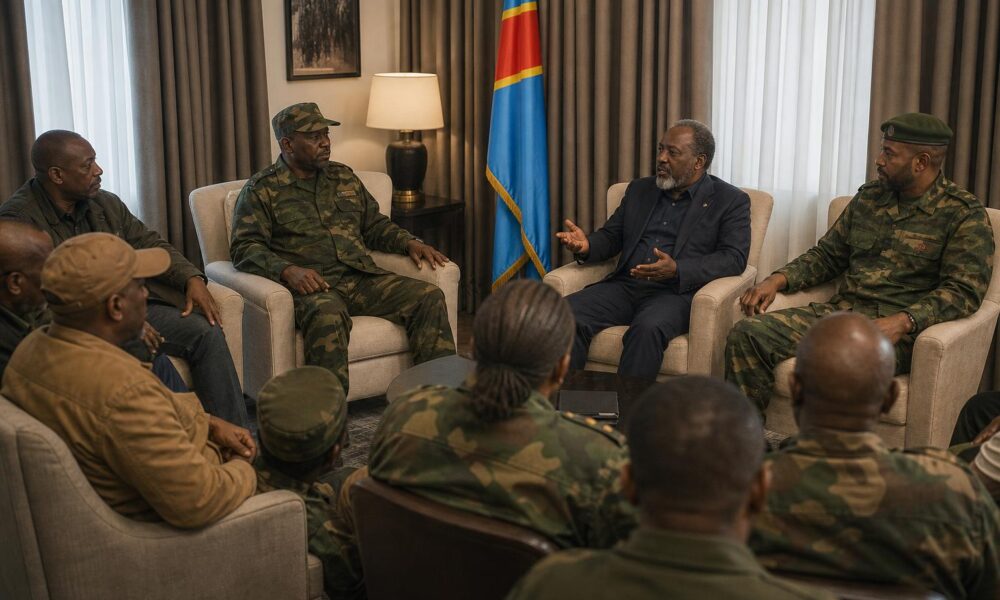
Former Democratic Republic of the Congo President Joseph Kabila has announced a new political-military coalition involving figures linked to the March 23 Movement and the Congo River Alliance, deepening uncertainty around the country’s conflict and peace efforts.
Table Of Content
Kabila introduced the Front pour la Refondation de la Nation, or FRN, from his residence in Goma on Monday. He said he would lead the alliance, which was launched to replace the existing M23-AFC alliance.
The new structure brings together political and military figures associated with the rebel alliance. Corneille Nangaa and Bertrand Bisimwa were named as deputies, while Freddy Kaniki was appointed secretary-general. Sultani Makenga was identified as the FRN’s army chief.
Movement says force could be used
Claude Ibalanky, a spokesperson for the coalition, said the movement would seek to end what it described as tyranny by any means necessary.
That would include force, Ibalanky said, adding to concerns that the announcement could lead to further military escalation in eastern DRC.
Kabila’s decision also reinforces accusations previously made by the government in Kinshasa that he had links to armed rebel groups. The former president’s political relationship with President Felix Tshisekedi had already deteriorated after Kabila’s allies were initially placed in government following a reported power-sharing arrangement. Tshisekedi began removing them in 2020.
Kabila later went into self-imposed exile in South Africa in 2023. A military court in Kinshasa subsequently sentenced him to death on charges including treason, war crimes and alleged collaboration with Rwanda and M23-AFC. The United States also imposed sanctions on him in April, alleging that he funded rebel groups.
Peace talks face new uncertainty
The FRN announcement comes as diplomatic efforts seek to address the fighting in eastern DRC. The Democratic Republic of the Congo and Rwanda signed a United States-led peace agreement in June 2025. Separately, the DRC and M23-AFC signed the Doha Framework in a Qatar-mediated process last November.
Bram Verelst of the Institute for Security Studies said the new alignment was unlikely to end the DRC-Rwanda peace agreement, but could pose a greater threat to the Doha process.
“We are likely to see a hardening of Kinshasa’s position toward the rebel movement and Kabila, including efforts to isolate Kabila and FRN regionally,” Verelst said.
He added that the future course of the conflict would depend partly on whether Kabila could take control of the rebellion and expand alliances beyond North and South Kivu.
Al Jazeera reporter Alain Uaykani said people in the country were concerned that the development could trigger renewed escalation and encourage some soldiers to defect to Kabila.
Long-running eastern conflict
M23 emerged in 2012 from remnants of Congolese Tutsi armed groups that fought during the Second Congo War. The movement says it is defending the rights of minority Congolese Tutsis and seeking to remove the government in Kinshasa.
After taking Goma and other eastern towns in 2012, M23 was pushed back by a special United Nations force operating alongside the FARDC, the Congolese army. The group resurfaced in 2022 amid worsening relations between Tshisekedi and Kabila.
Nangaa later left government and formed the Congo River Alliance, which became M23’s political partner. AFC-M23 launched major offensives in early 2024 and captured Goma again in January 2025. The rebels are reported to control areas of North and South Kivu, including Goma and Bukavu, as well as border crossings with Rwanda and Uganda.
The United States and the United Nations accuse Rwanda of supporting M23, a claim Kigali denies. The conflict has displaced 7.8 million people and left 28 million facing food shortages, according to United Nations figures.




No Comment! Be the first one.