
Tunisia’s Economic Gains Struggle to Ease Household Pressures Under Saied
Tunisia’s economy expanded in the second quarter of 2026 and overall unemployment fell, but food inflation, youth unemployment, debt and weak investment continue to weigh on living standards and...

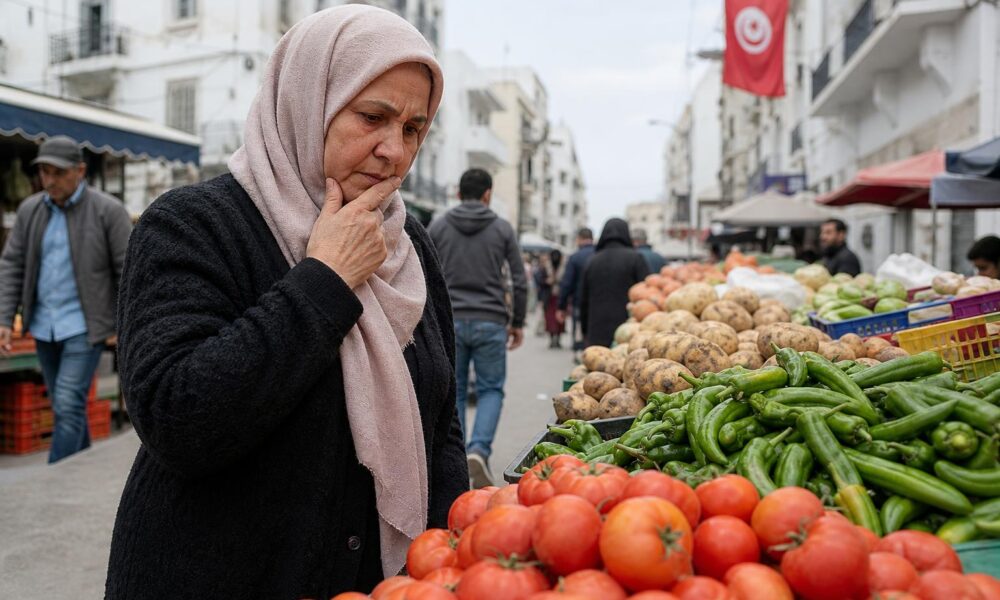
Tunisia’s economic record is showing some improvement nearly seven years into President Kais Saied’s tenure, but households continue to face steep living costs while the government manages high debt, limited investment and rising energy pressures.
Table Of Content
Annual inflation reached 5.6 percent in September 2026, up from 5.4 percent in August and 4.8 percent in January, according to the National Institute of Statistics. Food and beverage prices rose 8.4 percent over the year, with poultry increasing 16.5 percent, fruit 16.3 percent and lamb 14.6 percent. Core inflation, excluding food and energy, stood at 4.9 percent.
The impact of higher prices is evident in everyday expenses. Taxi driver Houssam Oueslati told Al Jazeera that engine oil which cost about 35 Tunisian dinars, or $13, in 2018 now costs close to 100 dinars, or $34. That represents an increase of approximately 186 percent.
Growth below government projection
Tunisia’s economy grew 2.3 percent year on year in the second quarter of 2026, while quarter-on-quarter growth was 1.4 percent. The annual figure was below the approximately 3.3 percent growth projected in the 2026 Finance Law.
Economist Ridha Chkoundali said the difference between projected and actual growth mattered because expansion would improve household conditions only if it generated investment, jobs and income. He also linked the country’s difficulties to weak investment, declining production and reliance on domestic borrowing.
Chkoundali estimated average annual inflation at 6.8 percent between 2015 and 2021 and 8.1 percent between 2021 and 2026. He said tighter access to credit, changing financing conditions and revised cheque regulations had left consumers with fewer options for managing expenses.
The Central Bank cut its key interest rate twice in 2025, bringing it to 7 percent. However, the report said government borrowing could make it more difficult for private businesses to obtain financing, depending on borrowing terms and how the funds are used. Domestic borrowing was cited at about 7 billion dinars, or $2.3 billion, in 2024 and 2025, rising to 11 billion dinars, or $3.7 billion, at the beginning of 2026.
Unemployment remains a major concern
Overall unemployment fell to 14.9 percent in the second quarter of 2026, compared with 15.3 percent in the same period of 2025 and 17 percent in 2020, according to the National Institute of Statistics.
Young people, however, continue to face much higher joblessness. Unemployment among those aged 15 to 24 reached 35.4 percent, while the rate among university graduates was 26.6 percent.
Supporters of Saied emphasise the economic problems he inherited, as well as the effects of the COVID-19 pandemic, global food and energy price volatility and geopolitical instability. Houssam Ben Ahmed, a political activist who supports the president, said Tunisia had already been in serious decline across several sectors when Saied came to power. He described the measures taken on July 25, 2021, as “an absolute necessity to save the state.”
Critics, including the Democratic Current party, have accused the government of refusing to confront economic realities. The party said that blaming failures on conspiracies would deepen the country’s problems.
Debt and energy costs constrain policy
Finance Ministry data shows public debt increased from 67.8 percent of gross domestic product in 2019 to 84.9 percent in 2024, before declining to 82.1 percent in 2025. The 2026 Finance Law projects debt at approximately 83.4 percent of GDP.
Higher-than-assumed international oil prices have added pressure to fuel subsidies and public finances. The Finance Law was based on a Brent crude price of $63.30 per barrel, while the average price cited in the report was approximately $92.60 by the end of June.
Fuel subsidy spending reached 2.427 billion dinars, or $826 million, during the first half of 2026, using 48.6 percent of the allocation set in the annual budget. Public investment expenditure stood at 1.665 billion dinars, approximately $566.6 million, over the same period.
Saied’s government has made combating monopolies and speculation a central part of its economic agenda. Critics cited in the report warned that authorities had not always clearly distinguished speculative stockpiling from storage needed to maintain supplies. They said restrictions affecting warehousing, inventory management and distribution could contribute to shortages if alternatives were not available, although the report did not establish that such disruption had caused specific shortages.
Tunisia’s economic performance under Saied therefore remains mixed: headline growth and overall employment indicators have improved from pandemic-era levels, but food inflation, youth unemployment, debt and constrained investment continue to limit the extent to which those gains are felt by households.




No Comment! Be the first one.