
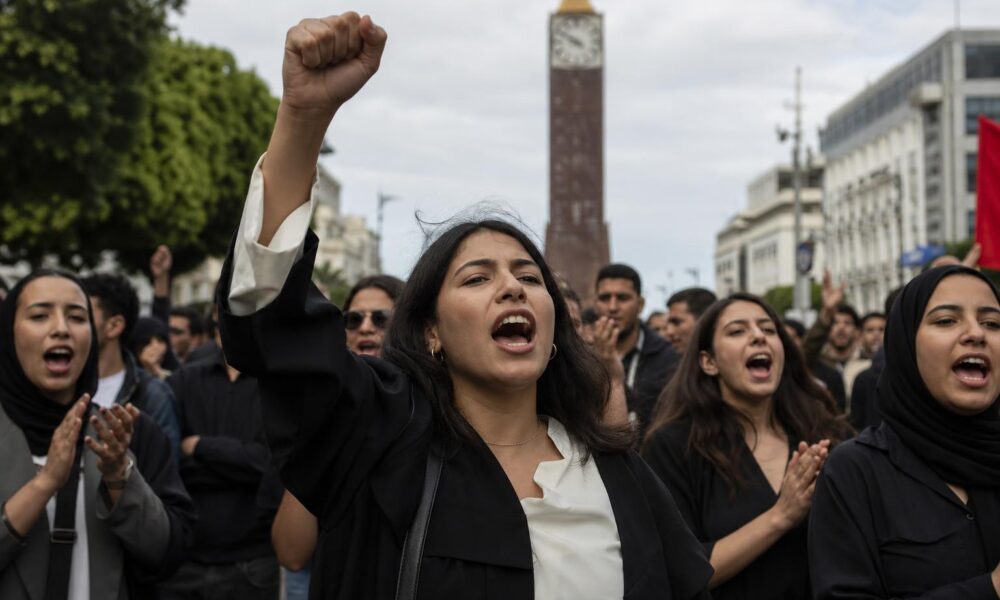
Tunisia’s economic crisis is intensifying as unemployed university graduates and other demonstrators take to the streets over scarce jobs, rising financial pressure, unreliable public services and deteriorating living conditions.
Table Of Content
On September 27, graduates began an approximately 300-kilometre march from Menzel Bouzaiane toward Tunis. Known as the Dignity March, the action initially involved 23 people, while its coordinating committee later estimated that more than 120 had joined. Participants paused at points because of exhaustion and injuries.
Police blocked the group from continuing in Borj Cedria, south of Tunis, on October 6. March participants said they were told they could travel individually but not as a group. They had hoped to reach Carthage, where the presidential palace is located, to press for measures addressing long-term graduate unemployment.
Pressure over recruitment law
The graduates are demanding implementation of legislation intended to create a route into public-sector employment. The 2022 Law No. 38 sought to establish such a pathway, but implementation stalled amid financial constraints.
Law No. 18, dated December 22, 2025, provides for exceptional recruitment of long-term unemployed university graduates into the public sector and civil service. The law includes a digital registration platform, prioritisation criteria and phased recruitment over a period of no more than three years from its publication.
The report does not establish whether recruitment under the law has begun or how many graduates have been hired. Cherif Khraifi, spokesperson for the Tunisian Union of Higher Education Graduates, said measures addressing graduate unemployment had often served to release public frustration rather than resolve the underlying problem.
Khraifi said Tunisia also needed investment and businesses capable of expanding and hiring, arguing that public-sector recruitment alone could not address unemployment on this scale.
Graduate unemployment remains high
Figures from Tunisia’s National Institute of Statistics show an overall unemployment rate of 14.9 percent in the second quarter of 2026. Among university graduates, the rate was 26.6 percent, rising to 35.6 percent among women graduates and standing at 14.2 percent among men graduates. Unemployment among people aged 15 to 24 reached 35.4 percent.
Cherine Ghanmi, who graduated in 2012 and remains unemployed, said she grew up in al-Mazzunah in the central Sidi Bou Zid governorate and still relies financially on her parents. She said graduates had believed university would provide a route out of poverty, but continued unemployment had instead placed a greater burden on their families.
Ghanmi described the Dignity March as an expression of the hardship and disappointment experienced by graduates who had spent years looking for work. She also questioned the authorities’ community-based companies programme, saying none of the companies had succeeded in delivering the promised jobs and development.
Wider protests over services and freedoms
On October 17, thousands gathered in Tunis to protest against President Kais Saied’s government, deteriorating living conditions and restrictions on freedoms. The demonstration was led by the Tunisian General Labour Union, opposition groups and civil society organisations.
Reuters reported that recurring electricity and water cuts were among the grievances raised at the protest. Extreme summer heat had coincided with electricity interruptions and water shortages in several parts of the country, affecting households and small businesses.
Anis Ben Said, a tax adviser and university professor, said Tunisia’s central problem was not a shortage of skills but the economy’s inability to turn those skills into production, investment and employment. He linked weak investment, poor infrastructure and unreliable public services to constraints on business activity and job creation.
Tunisia’s economy grew by 2.7 percent in 2025 and 2.4 percent in the first half of 2026. The World Bank projects full-year growth of 2.3 percent for 2026.
Saied has presented his political project as a response to corruption and the failures of the established political class. Critics say the concentration of political power has weakened democratic checks and balances while doing little to resolve the country’s economic problems.
For many young Tunisians, the continuing lack of opportunity has also strengthened interest in leaving the country. Khalil, a 20-year-old barber in L’Aouina, said he planned to leave as soon as possible, reflecting the frustration felt by a generation facing economic and social uncertainty.





No Comment! Be the first one.