
Gambia’s First Visually Impaired Magistrate Presses for Inclusive Institutions
Muhammed Krubally, the Gambia’s first visually impaired magistrate, has presided over more than 1,000 cases while advocating for stronger inclusion across public institutions.

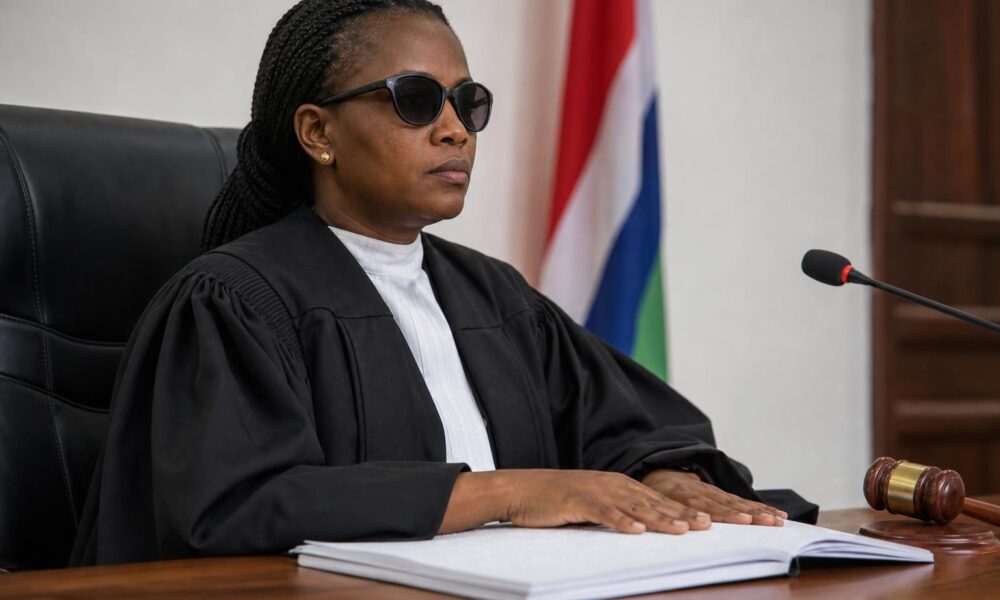
BANJUL, The Gambia — Muhammed Krubally’s work at the Banjul Magistrates’ Court has become an example of how technology and support can help make public institutions more accessible to people with disabilities.
Table Of Content
Krubally became the Gambia’s first visually impaired magistrate in 2016. He says he has since presided over more than 1,000 civil and criminal cases.
To prepare for hearings and work with legal documents, Krubally uses JAWS, or Job Access With Speech, a screen reader that allows him to navigate his computer and read documents and judgements. He also uses AI-enabled smart glasses, auditory observation and assistance from his clerk.
“This makes my job very easy,” Krubally said of JAWS.
His appointment was identified by the Gambia Organisation of the Visually Impaired as the first time a person with a visual impairment had held a magistrate’s position in the country.
A career shaped by advocacy
Krubally grew up in a village in the Central River Region as the second of nine children. He wanted to become a lawyer to defend his own rights and advocate for others.
He is now president of the Gambia Federation of the Disabled, through which he promotes recognition of the rights and abilities of people with disabilities. He also mentors young people, including visually impaired people such as Modou Lamin Dampha.
“I became a magistrate to change the system, to make it inclusive,” Krubally said.
Dampha said Krubally encouraged him to continue pursuing his goals. “He advises and encourages me to keep going, that things are possible,” he said.
Krubally has also described facing discouragement from fellow students and some teachers during his education. “Their discouragement kept me going. I knew what I wanted, and see where I am now,” he said.
Legal protections and practical barriers
The Gambia passed its Persons with Disabilities Act in 2021. The law includes provisions on independence, non-discrimination, participation, equality of opportunity, accessibility, employment, public buildings and services, information and access to justice.
However, the National Human Rights Commission has identified continuing discrimination and difficulties for people with disabilities in accessing services, education and employment.
Lamin Colley, head of GOVI’s Resource Centre for the Blind, said limited learning materials and the size of school clusters were putting pressure on support for students with visual impairments. The centre provides specialist education for children before they move to mainstream schools, where special-needs teachers are expected to support them.
“The reality on the ground is that not much has changed after the disability act has been passed,” Colley said.
The centre currently has 49 pupils aged between four and 14, according to Colley.
Access remains uneven
Ndey Yassin Secka-Sallah, a visually impaired parliamentarian and disability rights advocate, said she had depended on parliamentary colleagues to know what was being discussed.
“I would have loved to be independent, without depending on people for help,” she said. “Inclusion is all we wish for.”
Musa Barrow, a visually impaired teacher of media law and ethics, uses digital tools to read, write and prepare lecture notes. “Technology has broken that barrier for me,” he said.
“I can do more than what sighted people can do,” Barrow added.
Later analysis of the Gambia’s 2013 Population and Housing Census recorded disability prevalence at 1.2 percent, representing 21,873 people. The figure may understate the scale of disability because the census used a narrower set of questions and did not use the Washington Group questions commonly applied to measure functional difficulties.
Preliminary results from a new population and housing census released in September 2024 did not include detailed updated national disability data.
The Ministry of Gender, Children and Social Welfare did not respond to questions about implementation of the disability law, accessibility, education or employment opportunities. The judiciary also did not respond by publication time to questions about accommodations for Krubally or accessibility measures for judicial officers and court users.
Krubally continues to frame his career as part of a wider effort to challenge assumptions about disability. “I want to see a world for all; inclusion matters,” he said. “Disability does not mean inability.”





No Comment! Be the first one.