
Malawi cattle keepers travel farther as feed supplies tighten
Cattle farmers and fodder gatherers in Malawi’s Mulanje district are traveling longer distances to find grass, as farmers report scarce feed, reduced milk production and thinner cattle.

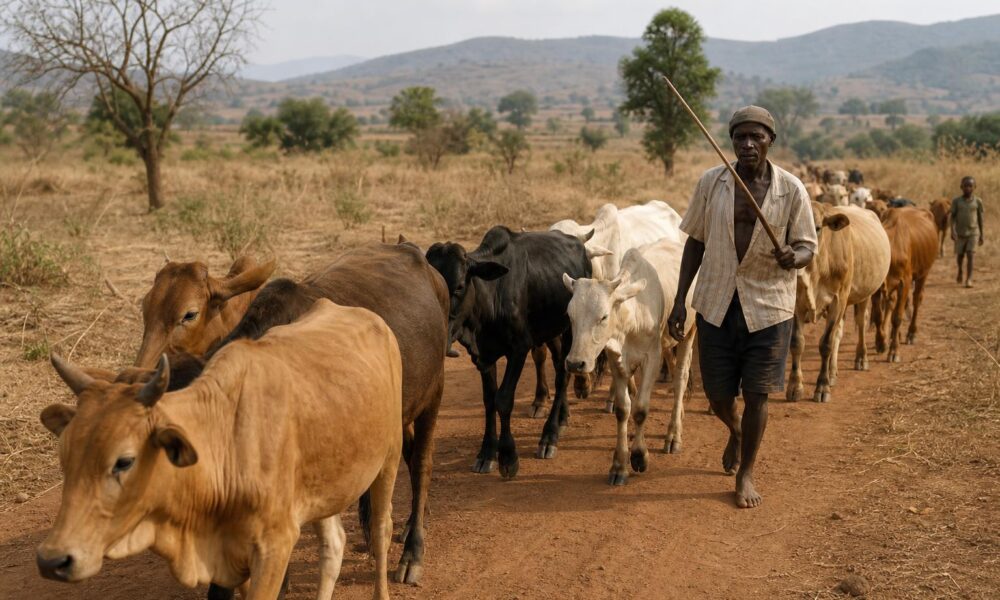
MULANJE, Malawi — Cattle farmers and fodder gatherers in Mulanje district are traveling farther and starting their journeys earlier to find grass, as feed becomes more difficult and expensive to obtain.
Table Of Content
Lawrence Abison, a 25-year-old fodder gatherer from Nsanjama, traveled 27km with three friends to the Likhubula River, where they spent two hours cutting grass. The amount they collected was enough to feed 10 cattle for one day.
“It’s very hard to find the grass these days, that’s why we have travelled this long distance,” Abison said. “Even here, the grass is not enough for a week and we need to proceed farther.”
Fodder gatherers said they had begun making trips to rivers months earlier than in previous years. The Likhubula River flows from Mount Mulanje and provides water for surrounding communities, while its reeds and grass have traditionally supported local livelihoods and livestock.
Rising costs for cattle farmers
Macdonald Khandalawo, a 54-year-old cattle keeper from Nsanjama, said the shortage of grass had increased the cost of maintaining his 10 cattle. He said he now spends much of his milk income on fodder gatherers and maize bran.
“After the rains have stopped, we look for the grass around here but due to the change in climate there has been scarcity of grass. That is why we send these boys to those rivers,” Khandalawo said.
He said the journeys to find feed could take a full day and that reduced feed had affected the cows’ milk production. Farmers also reported that maize bran and other supplementary feed had become scarce and more expensive, with lower maize harvests making the bran harder to afford.
Khandalawo said his usual monthly income from milk sales was more than one million Malawi kwacha, equivalent to $577, but that higher fodder costs were putting pressure on those earnings. He is a member of the New Thuchira Milk Bulking Group, which has up to 400 farmers and collects and sells members’ milk to commercial processors.
Concerns over riverbank cultivation
Farmers in the area also linked declining vegetation along the Likhubula River to cultivation on its banks. Khandalawo said vegetable growers were cultivating in places where reeds and grass had previously been available for livestock.
“Because of that, the water is drying up faster and grass is scarce,” he said.
He called for restrictions on cultivation near riverbanks to be restored or enforced as before. The report does not include an official response to the farmers’ concerns.
Residents said the river had become shallower in some locations and that trees and grass along its banks had disappeared. Batson Kweluza, a 57-year-old resident of Supuni Village, said the area had once had enough tree cover to create shade during the day.
“Now even rains don’t come as they used to because of those trees that have been cut and people can cross that river without even taking off their shoes,” Kweluza said.
Farmers seek alternatives
Some members of the New Thuchira Milk Bulking Group are preserving maize stalks and collecting pea and rice remains to use as supplementary feed when grass is unavailable.
In Nkando, 25-year-old farmer Alefa Saulo said her three cows were becoming thinner while she waited for rains to help grass grow. She said the animals were hungry but that she could not provide enough food.
“As a farmer, I always get concerned because when the animals are eating and looking healthy, I am also happy. But now I am sad. The animals are hungry but I can’t give them food,” Saulo said.
Malawi’s Department of Climate Change and Meteorological Services warned of below-normal rainfall and prolonged dry spells in parts of the country, with southern areas facing an increased threat of drought. The 2023/24 rainfall season was also marked by dry spells and high temperatures in parts of Malawi, while El Nino affected rainfall patterns across southern Africa.
The available information does not establish that El Nino alone caused the reported feed shortages, river changes or loss of vegetation.




No Comment! Be the first one.