
Central African Republic Tightens Ebola Screening Along DRC Border
The Central African Republic has strengthened Ebola screening and prevention messaging along its river border with the Democratic Republic of Congo, while communities dependent on cross-border trade...

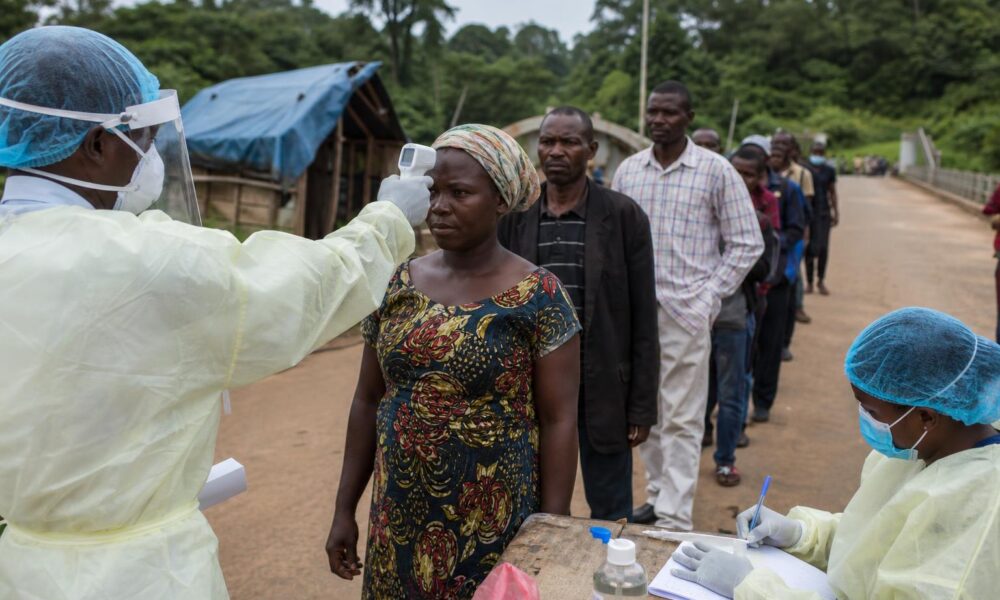
The Central African Republic has intensified Ebola screening and public-awareness measures along its river border with the Democratic Republic of Congo, where reported cases have surpassed 10,000.
At the M’Poko Bac frontier post in south-western Bangui, passengers arriving by canoe are being processed individually. Maldiana Bagalama, who is responsible for health screening at the pier, said travellers are directed to a hand-washing station, briefed on the situation, checked for fever and registered.
“Passengers arriving by canoe dock at the entry point. Then they disembark one at a time,” Bagalama said.
She added that staff guide passengers to wash their hands before they receive information and proceed to a tent for temperature checks and registration.
Multiple agencies involved
Dr Valentin Nebanga, head of the Health Promotion Department at the Ministry of Health, said entry points are staffed by health workers as well as personnel from the Water and Forests Department, Customs, Civil Protection and Internal Security Forces.
Community health workers systematically screen passengers arriving in and leaving the country, Nebanga said. Authorities have also launched awareness campaigns involving neighbourhood chiefs, community leaders and religious figures, who are being engaged to share prevention guidance with residents.
The Oubangui River connects the CAR and the DRC, and people and goods move frequently between the two countries. Nebanga said the same communities live on both sides of the border, contributing to substantial cross-border movement.
The frontier is described as porous and largely unmonitored, extending for more than 1,500 kilometres. The DRC is the reported epicentre of the outbreak, while several cases have also been reported in Kenya and one case has been detected in Nigeria.
River communities fear disruption
Fishing, canoe transport and fish selling continue along the Oubangui River, providing livelihoods for communities on both sides of the border. The ongoing economic activity has left some workers worried about the risk of infection.
Neige, a fishmonger and mother of three, said people working near the river could be particularly vulnerable if Ebola reaches the area. She called on the Ministry of Health to adopt stronger precautions.
Foxy Yeti Nzapa, a canoe operator and father of two, said passengers are transported between the two countries without protection. He said reports of Ebola-related deaths across the river had raised fears that he could also become infected.
Nebanga said there were no reported Ebola cases in the Central African Republic at the time described. He also acknowledged that the country faced challenges in maintaining its preparedness capacity, saying staff retention and engagement remained difficult.
“We’ve not had any cases yet, but our biggest challenge remains retaining staff and keeping them engaged,” he said, adding that “we are never fully prepared.”
Despite the strengthened controls, travel and trade continue along the river as authorities work to combine screening with prevention messaging in border communities.



No Comment! Be the first one.