
Ethiopia Receives 12 Russian Su-35 Jets, Plans Four S-400 Batteries
Ethiopia has received 12 Russian Su-35 fighter jets and will acquire four S-400 air-defence batteries, Prime Minister Abiy Ahmed announced during talks in Moscow.

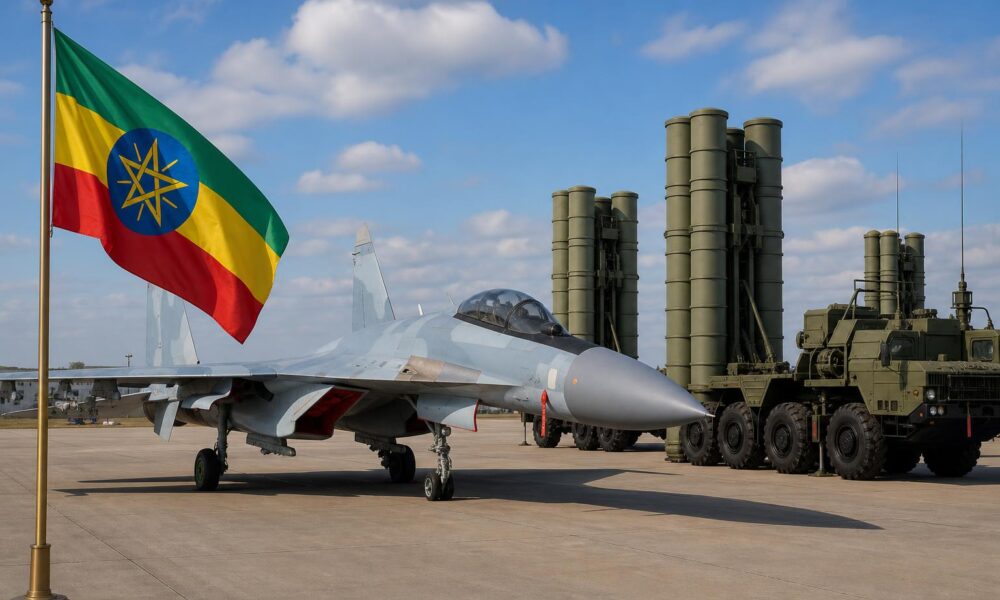
Ethiopia has taken delivery of 12 Russian Su-35 fighter jets and will acquire four S-400 air-defence batteries, Prime Minister Abiy Ahmed announced in Moscow.
Table Of Content
The announcement came during the two-day Russia-Africa Summit, where Abiy held talks with Russian President Vladimir Putin. The agreement adds to Ethiopia’s existing fleet of Russian-made fighter aircraft and is expected to expand the country’s air-force capabilities.
Abiy said the equipment would help Ethiopia “preemptively deter aggression”. The timing of the announcement comes as Ethiopia faces renewed fighting in Tigray, a separate rebellion in Amhara and concerns over a possible conflict with Eritrea.
Military cooperation and regional influence
Experts cited in the report said the agreement could strengthen Russia’s foothold and diplomatic influence in the Horn of Africa while supporting Ethiopia’s military during a period of internal conflict and regional tension.
Benedict Manzin, lead analyst on the Middle East and Africa at Sibylline, said the S-400 systems would be most useful against conventional air threats. In a potential conflict with Eritrea, he said, they could be used against the country’s limited air force and drones.
Manzin also cautioned that conventional air-defence systems have limitations. “As we have seen in Ukraine, conventional air defence systems can be overwhelmed by small, cheap drones,” he said.
Russia and Ethiopia have military ties dating back to the Cold War, when the Soviet Union supported Ethiopia’s former communist government. The two countries have also signed military agreements focused on technology, knowledge and training for Ethiopia’s armed forces, according to the Ethiopian News Agency.
Manzin said arms sales provide Russia with revenue while helping maintain long-term relationships with governments that need training, maintenance and replacement equipment. He described arms sales as one of Russia’s primary exports to Africa.
However, he said Ethiopia was not committing itself exclusively to Moscow. The country also maintains significant ties with China and continues to receive Western investment. “Everyone engages a bit, and Ethiopia tries to maximise its gains,” Manzin said.
Talks extend beyond defence
Abiy said his discussions with Putin covered nuclear energy, health, trade, and bilateral and multilateral cooperation. Putin identified energy, agriculture, industry and education as possible areas for expanded cooperation.
Putin said, “I value the friendly relations between Russia and Ethiopia,” adding that “Russia and Ethiopia stand together in international affairs.” He also said bilateral trade reached $1.3bn between January and September, more than twice the total recorded for all of 2025.
Data from the Stockholm International Peace Research Institute showed that Russia accounted for 15 percent of Africa’s imports of major weapons between 2021 and 2025. The United States supplied 19 percent and China 17 percent.
Arms delivery amid Tigray fighting
The aircraft delivery coincided with renewed clashes between Ethiopia’s federal army and Tigrayan forces. Fighting intensified in late September, effectively unravelling the November 2022 Pretoria peace agreement.
Government troops and allied forces entered Mekelle earlier in October after Tigray People’s Liberation Front fighters withdrew. Addis Ababa subsequently installed a six-month caretaker administration in Tigray, while rebel commanders said they would continue fighting.
Manzin said the timing of the delivery should not necessarily be taken as evidence that recent battlefield developments directly prompted purchases negotiated earlier. He noted, however, that aircraft remain useful to forces conducting military operations.



No Comment! Be the first one.