
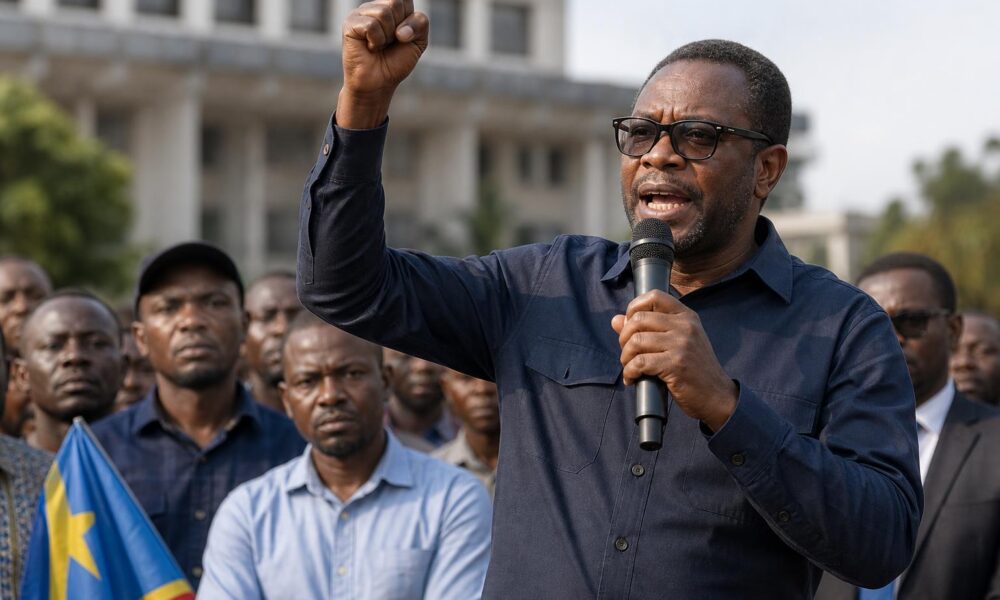
Opposition parties in the Democratic Republic of Congo have vowed to resist constitutional changes after President Félix Tshisekedi enacted a law easing the rules for referendums on constitutional matters.
Table Of Content
The measure was announced in an order read on national television overnight from Tuesday to Wednesday. While the law does not establish that Tshisekedi will seek another term, opposition figures say it could create a route for changes to the constitution, including the rules governing presidential terms.
Opposition raises third-term concerns
Jean-Baptiste Kasekwa, an opposition politician and member of the C64 coalition, told AFP that the legislation could be used to unlock constitutional provisions and “grant an unlimited number of terms”. He also accused Tshisekedi of wanting to remain in office until a sufficiently strong opponent removes him.
“He openly declares that he wants to stay in power until someone strong enough can drive him out,” Kasekwa said.
Tshisekedi, who has been president since 2019, previously said he had not planned to seek a third term. At a news conference in early May, however, he said: “If people want me to have a third term, I will accept.”
Under the current constitution, his second five-year term is due to end in 2028, when the next scheduled elections are expected to take place.
Coalition rejects constitutional change
The C64 coalition, formed by opposition parties opposed to constitutional amendments and a possible third term, condemned the seizure of power by force, constitutional changes, a third term and any postponement of the 2028 elections.
Tresor Kibangula, a researcher at the Congolese institute Ebuteli, said the new law was unlikely to reduce political tensions. He said it would give government critics evidence that the authorities intended to retain power and provide additional room for manoeuvre ahead of any potential referendum.
“This is no longer just an intention, the current government really wants to cling to power,” Kibangula said, reflecting the argument opposition and civil society groups may now make.
He also said that, given the current security situation, it was difficult to envisage elections being held in 2028. Tshisekedi’s proposal for a national dialogue has already been rejected by the main opposition parties.
Political tensions amid eastern conflict
The constitutional dispute follows opposition demonstrations in Kinshasa and other cities in June and September against what protesters called a “constitutional coup”. The opposition has been weakened and divided since Tshisekedi’s reported landslide victory in the 2023 election.
The political tensions are unfolding alongside a long-running conflict in eastern DRC. The region has endured about 30 years of violence, while the M23 rebellion has made territorial gains, including the capture of the provincial capitals of North Kivu and South Kivu, according to the supplied reporting.
Joseph Kabila, who ruled the country from 2001 to 2019, has been linked in the reporting to the renamed Front for the Refoundation of the Nation. The source says he was sentenced to death in absentia for treason on allegations that he colluded with M23, and is under United States sanctions over financial and political support for the group. Opposition parties have sought to distance themselves from Kabila.
Kabila has vowed to end what he calls tyranny by all means, including force. Diplomatic sources and observers have expressed concern that political opposition could increasingly be portrayed as support for the rebellion.



No Comment! Be the first one.