
Secret UN Security Council Ballots Shape Race for Next Secretary-General
The UN Security Council is using confidential straw polls to narrow the field for the next secretary-general, with the five permanent members retaining decisive influence through their veto power.

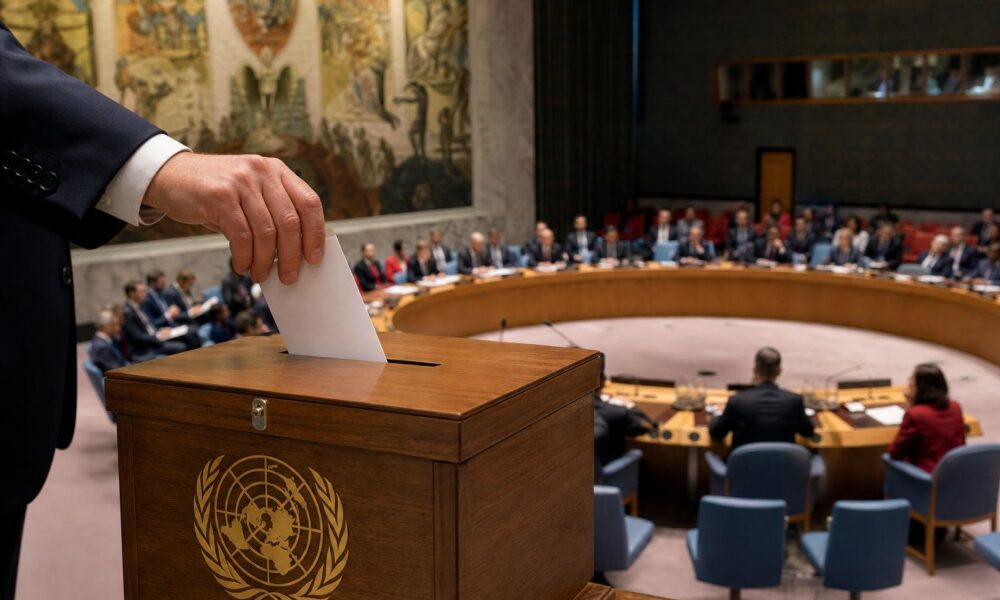
The United Nations Security Council is conducting confidential straw polls to identify a candidate for the next secretary-general, in a process shaped by the veto power of its five permanent members.
Table Of Content
Eight candidates remain in the contest after earlier withdrawals. The council must recommend a nominee before incumbent Secretary-General Antonio Guterres steps down on December 31. Under Article 97 of the UN Charter, the General Assembly is expected to endorse the person recommended by the council.
Grynspan leads eighth poll
The informal ballots ask the council’s 15 members whether they encourage, discourage or have no opinion about each candidate. Eight rounds had been held, but no candidate had received zero discourage votes, meaning a consensus choice had not emerged.
Rebeca Grynspan led the eighth poll with 12 encourage votes and three discourage votes, according to figures reported by the 1 for 8 Billion campaign. Grynspan heads the United Nations Conference on Trade and Development and played a key role in brokering the 2022 Black Sea Grain Initiative between Russia and Ukraine.
Rafael Grossi, the Argentinian head of the International Atomic Energy Agency, received nine encourage votes, four discourage votes and two no-opinion votes. A candidate identified in the reporting by the surname Birkett received eight encourage votes, five discourage votes and two no-opinion votes.
The wider field includes Lana Nusseibeh, the United Arab Emirates minister of state for foreign affairs. The supplied reporting does not establish the full names of all eight candidates.
Veto power remains decisive
A candidate needs at least nine Security Council votes and must avoid a veto from China, France, Russia, the United Kingdom or the United States. It was unclear how the permanent members voted in the eighth poll or whether any of them had used a veto.
Later voting rounds use coloured paper ballots to distinguish the permanent members from the elected members. A formal council vote follows a straw poll showing at least nine encourage votes and no vetoes.
The current nonpermanent members are Bahrain, Colombia, the Democratic Republic of the Congo, Denmark, Greece, Latvia, Liberia, Pakistan, Panama and Somalia.
The General Assembly has never rejected a candidate recommended by the Security Council, although it extended a secretary-general’s term without a council recommendation in 1950. That history gives the council an influential role in the final selection.
Questions over secrecy and a possible deadlock
Jane Kinninmont of the UN Association-UK described the traditional selection process as “closed and secretive”. She said civil society campaigns and member-state engagement had made the contest more open, while the Security Council continued to protect its confidentiality.
Gabriel Elizondo said the five permanent members retained “the overwhelming amount of power” in choosing the next secretary-general. Kinninmont also argued that allowing one country to block a candidate with broad support had fuelled “growing resentment”.
The UN Charter does not specify what happens if the council fails to select a successor before the incumbent’s term ends. Possible responses include recommending a shorter term, reaching a compromise candidate or placing a senior UN official in temporary charge of operations. The council reached a compromise on Kofi Annan after a deadlock in 1996.
Elizondo said Guterres had indicated that he hoped and expected to return to Portugal after January 1 if no successor had been chosen, while acknowledging that the consequences of such a situation were unknown.
Kinninmont has proposed a more transparent and democratic approach in which the council would agree on two or three candidates and allow the General Assembly to vote among them. No formal selection had been announced in the reporting supplied.



No Comment! Be the first one.