
Bio Sets Out Government Priorities at Opening of New Parliamentary Session
President Julius Maada Bio used the opening of Parliament’s Fourth Session to present reported progress under his government and outline priorities covering food production, jobs, energy,...

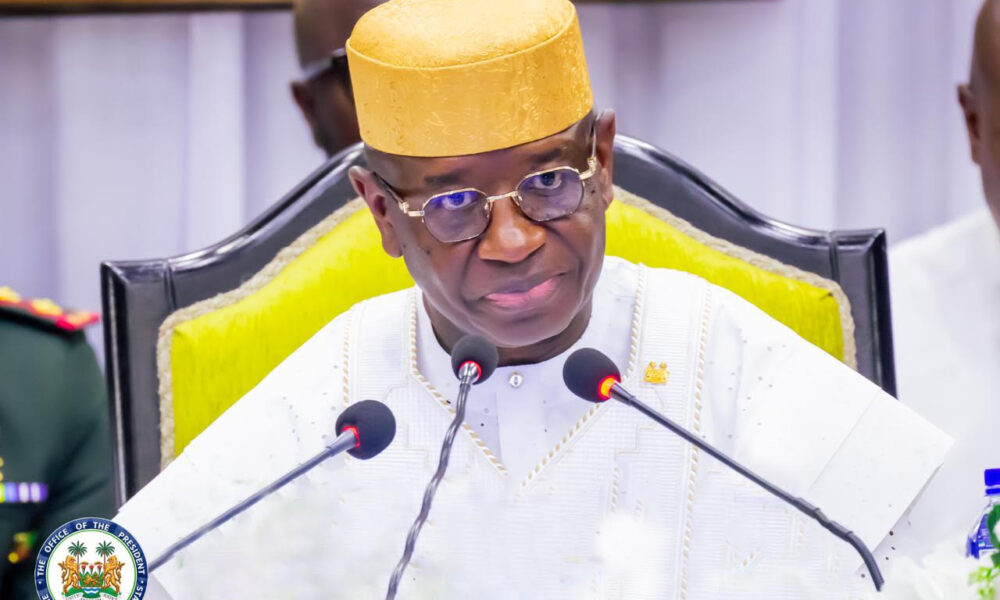
President Julius Maada Bio has outlined his government’s development record and priorities for the new parliamentary session, with a focus on food production, employment, infrastructure, energy access and institutional performance.
Table Of Content
Bio delivered the address on Friday, 7 August 2026, at the Chamber of the Parliament Building in Tower Hill, Freetown, during the state opening of the Fourth Session of the Sixth Parliament of the Second Republic of Sierra Leone.
The President said the session begins during the “Year of Action and Accelerated Delivery” and is guided by the five Big Five Game Changers in the Medium-Term National Development Plan 2024–2030: Feed Salone; Human Capital Development; Youth Employment and Entrepreneurship; Technology and Infrastructure Development; and Transforming the Public-Service Architecture.
Economic and agricultural performance
According to figures presented by Bio, real gross domestic product grew by 4.6 percent in 2024 and 4.8 percent in 2025. He said inflation fell to 4.4 percent by December before rising to 10.8 percent in April 2026, which he linked to higher global oil prices.
The President said Sierra Leone’s IMF Extended Credit Facility programme remained on track, with about USD 79.8 million and USD 31.7 million released after reviews in December 2025 and June 2026. He also reported that domestic revenue increased to NLe 18 billion in 2025, while the trade deficit declined to USD 1.07 billion from USD 1.60 billion in 2024.
Bio reported rice production of 1,441,015 metric tonnes in 2025 and said rice self-sufficiency had risen to 73 percent. The government plans to expand irrigation, mechanisation, processing and rural connectivity under Feed Salone, alongside greater support for aquaculture and women involved in fisheries processing and marketing.
Citing the World Food Programme, he said severe food insecurity declined from 28 percent of households in 2023 to 13 percent in 2025. He also reported that school feeding was reaching 1,016,191 pupils in 4,034 schools across all 15 districts, including 270,000 children fed daily with locally supplied rice.
Jobs, services and infrastructure
The government has set a target of creating 500,000 new jobs over five years. Bio said it would publish a verified cumulative employment figure, together with information on how employment is defined, the sectors involved and the duration of the jobs.
He also pledged continued investment in education, healthcare, water, sanitation and social protection. The address cited a reduction in maternal mortality from 1,200 deaths per 100,000 live births in 2013 to 354 in 2023.
Under the Mission 300 Energy Compact, the government aims to increase electricity access from 36 percent in 2024 to nearly 80 percent by 2030. Bio also reported that 474.46 kilometres of roads had been paved and 23 bridges built or rebuilt between 2018 and 2026.
Other commitments include expanded public transport, improved road safety, modernised land administration, affordable housing and continued investment in digital connectivity, cybersecurity, data protection, digital skills and innovation.
Governance and parliamentary agenda
Bio said ministries, departments and agencies would be assessed against national priorities and measurable targets, with performance reports published and delays or failures addressed. The government plans to bring measures covering economic growth, local enterprise, public-resource management, justice, national security, environmental protection, land, extractive industries, social protection and public administration.
The President announced that a technical committee led by the Vice President would examine a proposal to increase Paramount Chief representation in Parliament from one to two representatives per district. He also said the government would continue electoral reforms arising from the Agreement for National Unity and recommendations of the Tripartite Committee.
Bio welcomed members of the main opposition All People’s Congress back to Parliament. He also stated that criminal proceedings against former President Ernest Bai Koroma had been discontinued by the Attorney-General and Minister of Justice under authority conferred by Section 45 of the Criminal Procedure Act 2024.
The government will conduct the 2026 Population and Housing Census, with the main census scheduled for December. Bio said the administration would focus ahead of the next state opening on food production, electricity, clean water, roads, bridges, healthcare, education, youth and women’s employment, public-service delivery and reduced administrative delays.
“The progress we have made is real, but it is not enough,” the President said, while calling for cooperation among state institutions, political actors and citizens.



No Comment! Be the first one.