
Sierra Leone Mining Model Projects US$3.63 Billion for State and Communities
A fiscal model presented by Mines Minister Julius Daniel Mattai estimates that a fictitious large-scale bauxite mine could generate US$3.627 billion for Sierra Leone’s Government and host communities...

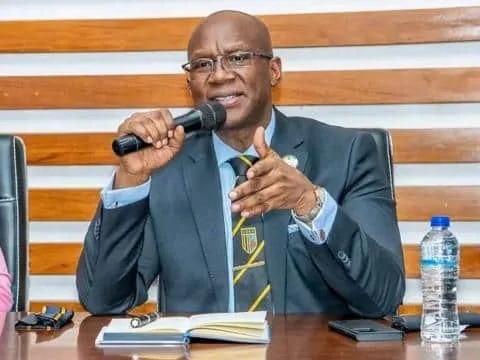
A fiscal model presented by Mines Minister Julius Daniel Mattai estimates that a fictitious large-scale bauxite operation in Port Loko District could provide approximately US$3.627 billion to Sierra Leone’s Government and host communities over a 25-year licence period.
Table Of Content
The illustration, delivered in Freetown in September 2026 in collaboration with the National Minerals Agency, was part of a presentation titled “From Ore to Treasury: Sierra Leone’s Mining Fiscal Regime Explained in Plain Language.”
Mining Company A Limited, the company used in the presentation, is not an existing mining operator. The model projected total gross revenue of US$14.46 billion during the assumed licence period.
How the model was calculated
The assumptions included bauxite production of 5 million tonnes in the first year, 6 million tonnes in the second year and 10 million tonnes annually from the third year onward. The assumed free-on-board price was US$60 per tonne.
Operating costs were set at 50 percent of revenue, while capital expenditure over the first three years was estimated at US$250 million. The model also assumed a US$200 million debt facility carrying annual interest of 5.5 percent and contractor payments equivalent to 15 percent of revenue.
Mattai explained the fiscal regime as 11 charges drawn from four principal statutes and applied in an order established by law. Seven of the charges are payable regardless of whether a mining company makes a profit, while four are linked to profitability.
Royalty on bulk minerals such as bauxite, rutile and iron ore is charged at 3 percent of market value. In the model, royalty payments reached US$433.8 million over 25 years, with US$86.76 million allocated to mining districts, representing 20 percent of total royalties.
Mining income tax was modelled at 30 percent of chargeable income under the Extractive Industries Revenue Act 2018, as amended by the Finance Act 2026. The model projected US$1.92 billion in mining income tax over the project period, including US$82.8 million in a mature year.
The presentation also projected US$640.16 million in mineral resource rent tax over the life of the project, including US$27.6 million in a mature year. Mattai said the tax should be calculated on accumulated net receipts rather than by applying its rate directly to chargeable income.
State and community participation
Under the model’s account of the Mines and Minerals Development Act 2022, the State is entitled to a 10 percent free-carried and non-dilutable interest in large-scale mining operations. It may acquire a further 35 percent interest on agreed terms, subject to the required approvals.
Mining companies are also required to contribute at least 1 percent of annual gross revenue directly to communities through publicly accessible community development agreements. The model estimated Community Development Fund contributions of US$144.6 million over 25 years.
In a mature year, the presentation estimated Government and host-community receipts of US$154.6 million from gross sales of US$600 million. That represented 25.8 percent of mature-year sales. Across the full period, the combined receipts were projected at US$3.627 billion, or 25.1 percent of total gross revenue.
Surface rent was treated separately, with 70 percent distributed to landowners and 10 percent each allocated to the Paramount Chief, the Constituency Development Fund and the District Council.
The model excluded dividend withholding tax because it assumed no dividend policy. The presentation noted that actual Government revenue could be higher if dividends were declared.
Calls for stronger fiscal oversight
Mattai recommended that resource rent tax consistently be modelled on its statutory base, while unresolved fiscal questions should be clarified. He also called for the digitisation of community development agreements and stronger measurement of mineral production and exports.
He urged that every mining project be assessed against the statutory fiscal baseline before agreements are signed. The Minister said the presentation was not intended to advocate higher mining tax rates or pass judgment on any company.
“We cannot put the ore back,” Mattai said, stressing the need for informed decisions on mineral pricing and transparent public scrutiny of exported resources.



No Comment! Be the first one.