
Health Minister Inspects Medical Training Projects in Freetown
Sierra Leone’s Health Minister Dr. Austin Demby has inspected construction at two Freetown sites planned to support medical education, research and postgraduate specialist training.
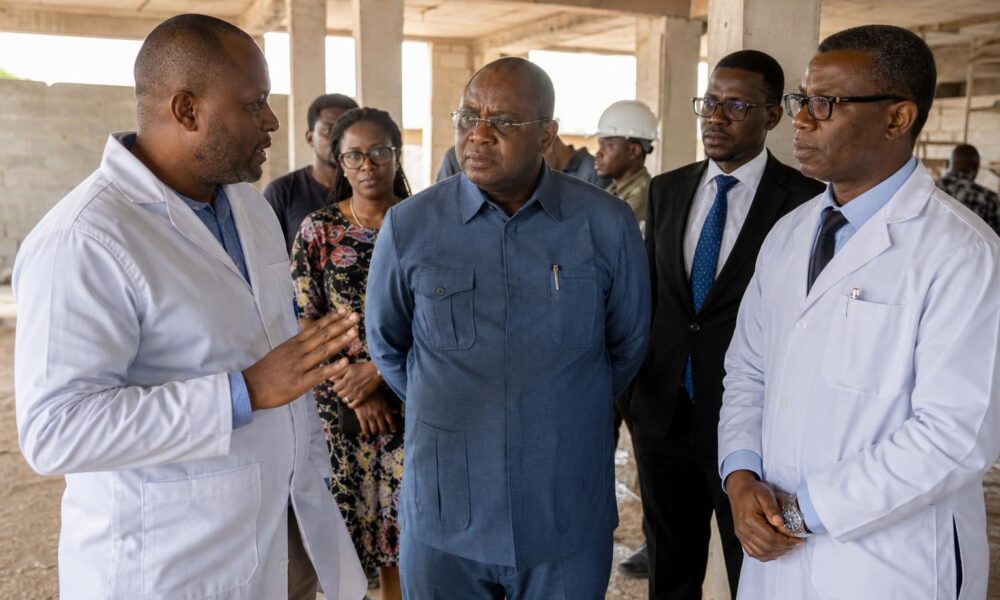
Sierra Leone’s Minister of Health, Dr. Austin Demby, and his senior leadership team have inspected ongoing construction at two facilities intended to strengthen medical education and specialist training in Freetown.
Table Of Content
The inspection took place on 17 August 2026 at the College of Medicine and Allied Health Sciences, east of Freetown, and at Laka in the far west of the capital.
Facility planned for 1,500 students
At the College of Medicine and Allied Health Sciences, the Ministry of Health is completing a building for the Faculty of Basic Medical Services.
The facility is valued at around USD 3.5 million and is planned to accommodate 1,500 students. It is also intended to serve as a centre for medical education, training, research and innovation.
Dr. Demby said the building’s teaching capabilities, including an auditorium, should give students broader access to learning resources and opportunities to connect with peers and tutors overseas.
“It is hoped that this new facility, with its teaching capabilities including an auditorium, students will be exposed to unlimited access to learning resources and opportunities that links them with peers and tutors overseas,” he said.
Laka project to support postgraduate training
The project at Laka comprises two major structures intended to house three postgraduate colleges: the College of Physicians and Surgeons, a postgraduate college for pharmacists, and a postgraduate nursing and midwiffery college.
The twin buildings are planned to host up to 500 student doctors who will be trained locally to become specialists.
“At Laka, we will receive these young doctors and help them achieve their dreams of becoming experts in their chosen areas of specialization,” Dr. Demby said.
The Ministry has linked the facilities to the Government of Sierra Leone’s wider investment in medical education and healthcare training. The projects are intended to create additional opportunities for learning, research, innovation and postgraduate specialist development.
Government investment in health education
Dr. Demby described the facilities as more than physical structures, saying they represented the government’s commitment to preparing future healthcare professionals.
“They represent a beacon of hope and a testament of the Government of Sierra Leone’s unwavering dedication to nurturing the next generation of healthcare professionals,” he said.
The source also points to the performance of Sierra Leonean doctors in the West Africa College of Surgeons examinations as evidence of the country’s ability to produce medical specialists.
The construction works remain ongoing, and no completion or opening dates were provided.


No Comment! Be the first one.