
Rising Costs Threaten Africa’s $30 Smartphone Goal
Africa’s mobile-internet challenge is increasingly shifting from network availability to affordability, as rising component, logistics, tax and energy costs make the target of a $30 entry-level...

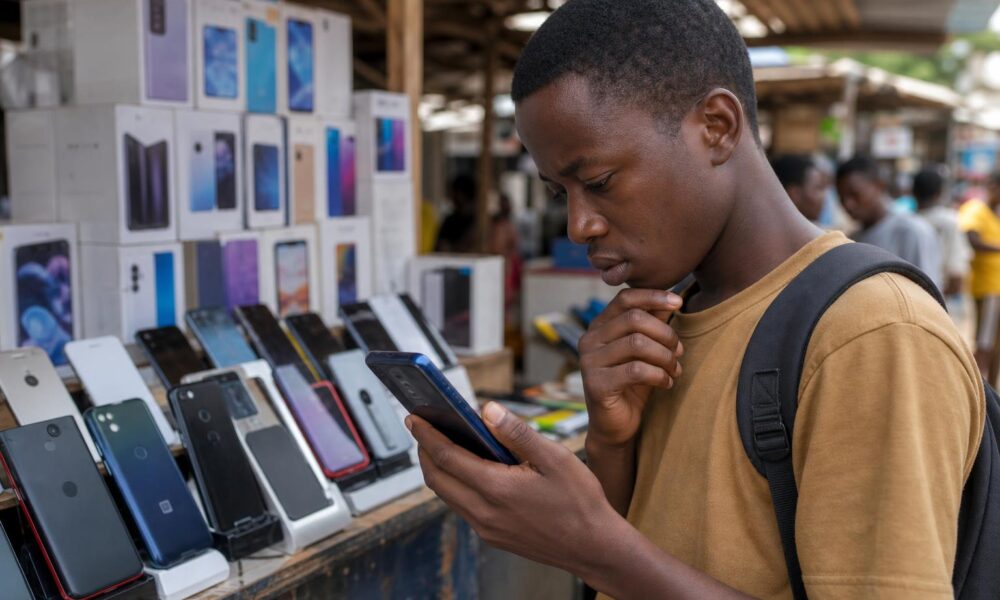
Africa’s expanding mobile networks are reaching more people, but the cost of internet-enabled smartphones is preventing millions from taking advantage of that coverage.
Table Of Content
The GSMA says 906 million people in Africa—nearly 60% of the continent’s population—live within reach of 3G, 4G or 5G networks but remain offline. Globally, more than 90% of the 3.4 billion people without internet access are already covered by mobile broadband.
Caroline Mbugua of the GSMA said the gap was increasingly about whether people could afford to use the infrastructure already in place.
“Africa has built the networks,” Mbugua said. “But not enough people can afford to use them.”
Device prices move higher
In Sub-Saharan Africa, 25% of the population uses mobile internet, while 66% lives within mobile-broadband coverage without using it, according to figures attributed to Mbugua.
The GSMA estimates that an entry-level internet-enabled handset represented 76% of average monthly income for the poorest fifth of people in Sub-Saharan Africa by the end of 2025. Across low- and middle-income countries, the comparable figure was 44%.
At the same time, the cost of producing and selling low-priced smartphones is rising. Memory prices more than doubled between the third quarter of 2025 and the first quarter of 2026, before increasing by a further 80% to 90% in the second quarter, according to the supplied industry reporting.
Omdia reported that Africa’s average smartphone selling price rose by $41 year-on-year to $202. Shipments of smartphones priced below $100 declined by 34%.
Manufacturing expenses are only one part of the final price. Import duties, taxes, logistics, foreign-exchange movements, distribution costs and retailer margins can all increase what consumers pay.
The $30 target becomes harder
The GSMA has previously modelled that a $30 smartphone could be affordable for almost 1.6 billion people living within mobile-broadband coverage. At $20, the potential number rises to about 2.2 billion.
However, Mbugua said even reaching a $40 price point remains difficult, with chipsets representing the largest challenge.
“The biggest challenge we have, to be honest, in reaching the $40 price point is the price of chipsets,” she said. “The prices have skyrocketed.”
The $30 objective refers to the retail price of a capable device, rather than only the cost of manufacturing it. In markets such as Nigeria, South Africa, Kenya and Ghana, a $30 handset is equivalent to approximately ₦40,000, R490, KSh3,900 and GH₵350 respectively at the exchange rates cited in the reporting.
Policy choices affect affordability
The GSMA has identified spectrum pricing, taxation and energy expenses as areas where governments can influence the cost of connectivity. Mbugua said spectrum charges in China and Japan had been reduced to about 1% of operator revenues, while they could reach 26%, 50% or more in some other markets. She noted that comparisons vary by market, licence band and operator.
“Governments in the region continue to treat spectrum as a revenue resource, a revenue earner,” Mbugua said. “At the end of the day, these costs are passed on to the consumer.”
Energy can account for up to 30% of a mobile operator’s operating expenditure in some markets, adding pressure to network-operation costs.
South Africa removed a 9% excise duty in April 2025 on smartphones priced below 2,500 rand, or about $156. The GSMA said entry-level smartphone sales increased by 80% during the following 11 months, although Mbugua acknowledged that the increase cannot be attributed entirely to the tax change.
The GSMA recommends longer spectrum-licence terms, local-currency pricing where appropriate, staggered payments and coverage obligations to reduce large upfront fees. Other proposed measures include targeted tax reductions, device financing, more efficient distribution and a stronger second-hand market.
Affordability is not the only barrier
A cheaper smartphone would not remove all obstacles to mobile-internet use. Limited digital skills, unreliable electricity, fraud, safety concerns, language barriers, poor network quality and a shortage of relevant local content would continue to affect adoption.
The GSMA expects Africa to attract $76 billion in mobile-network investment between 2025 and 2030. It has also modelled that closing the global mobile-usage gap could generate $3.5 trillion in additional gross domestic product between 2023 and 2030, with more than 90% of the potential benefit going to low- and middle-income countries.
Those figures are estimates rather than guarantees, but they underline the economic importance of making both devices and connectivity more affordable.






No Comment! Be the first one.