
Unpredictable Weather Deepens Financial and Mental-Health Strain for Kenyan Farmers
Kenyan farmers in Nyeri and Kiawara say unreliable rainfall, prolonged dry periods and livestock disease have caused serious losses, while a clinical psychologist warns of growing mental-health...

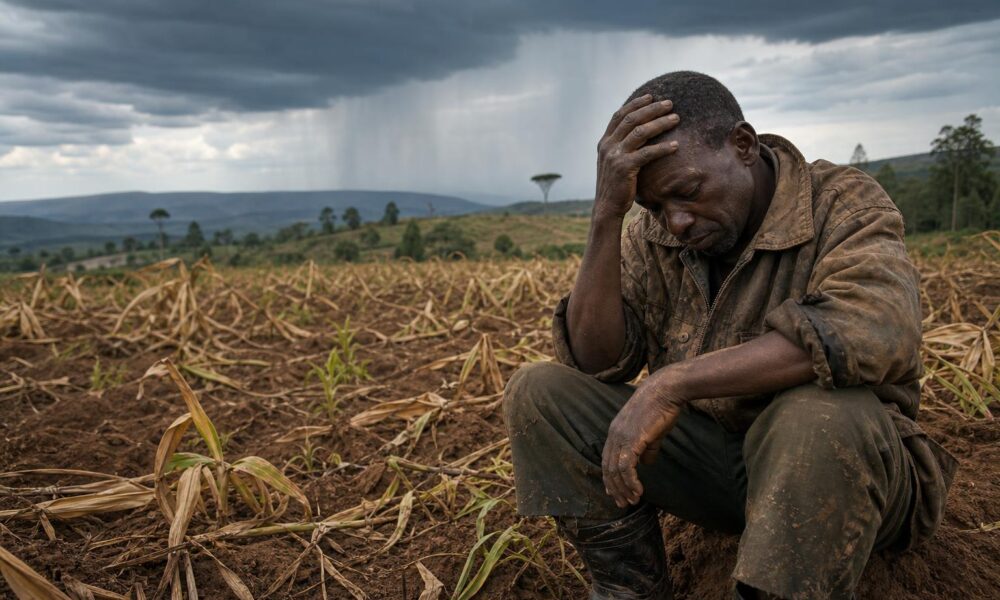
Unreliable weather is placing Kenyan farmers under growing financial and emotional pressure, with coffee and livestock producers reporting losses linked to prolonged dry periods, irregular rainfall and disease.
Table Of Content
Farmers in Nyeri and Kiawara say changing conditions have made it harder to protect crops, maintain livestock and plan household expenses. A clinical psychologist at Outspan Hospital in Nyeri says repeated agricultural losses and uncertainty are contributing to mental-health concerns among farmers.
Coffee farmers face higher costs
Josephine Kihu, who has worked on her coffee farm in Nyeri for three decades, said prolonged sunshine forced her to change to a more resilient coffee variety. She also had to hire someone to water the trees when rainfall was insufficient.
"Before we never used to water our seedlings because the rain was good and it was enough but as from today," Kihu said.
Describing the light rainfall affecting the farm, she added: "Let’s see now you can see it’s raining. Is it really raining? This is drizzling. It cannot help the tree. So it forces us to employ someone to water the coffee tree."
Kihu said farmers can invest heavily in their crops without knowing whether they will receive a harvest. She linked the uncertainty to financial and emotional distress, saying: "Can you imagine how much money, you have invested here? I have invested a lot and finally I don’t harvest anything, I might die. As a farmer, you could go insane."
She also said unpredictable weather may be affecting farmers’ mental wellbeing, even when some may not recognise the source of their distress.
Livestock losses follow dry spell
In Kiawara, livestock farmer Charles Ndung’u said rainfall in March did not produce enough pasture to sustain his animals through a prolonged dry period. A livestock disease outbreak in June worsened the shortage, and significant losses followed.
Ndung’u, who has kept livestock for more than two decades, said he lost 40 goats over three months. Some animals became too weak to stand. Goat farming had traditionally provided a dependable source of income in the semi-arid area where he farms.
He said uncertainty over rainfall and feed had also affected his ability to meet family expenses. "The seeds are in the ground and we are not sure if they will sprout. We are waiting to see if the rains continue. If they don’t grow, that’s more stress. We don’t have money," Ndung’u said.
He added that the goats helped pay his children’s school fees. "We depend on the goats for our children’s school fees. You would sell one or two and send children to school. Without the goats and money, we have many problems."
Psychologist links losses to chronic stress
Kahindo Gacago, a clinical psychologist at Outspan Hospital, said the repeated nature of agricultural losses can create long-term stress, particularly when farmers are unable to control the weather.
"The cumulative losses and also the chronic stress that comes with always having to plan to know what to do at this time or when," Gacago said.
He said about a third of his patients are farmers facing mental-health issues linked to repeated agricultural losses. Gacago also said climate-related challenges can contribute to loss of identity, changes in lifestyle and relocation. Some farmers may turn to alcohol or other substances as coping mechanisms, he said.
"Especially when you feel like you’ve lost control, because something like the weather it’s not something in your control," Gacago said.
Gacago urged policymakers to include mental wellbeing in farmer-support programmes, promote climate-smart agriculture and improve access to irrigation.




No Comment! Be the first one.